Most running gift guides are written for people who already run. They assume the recipient knows their preferred drop height, has strong opinions about stack cushion, and is training toward a race. That describes someone in month six, not month one.
The person this guide is written for is in the first eight weeks — probably doing run-walk intervals, probably sore in places they didn’t expect, and still deciding whether this is a thing they actually do now. The dropout rate peaks in weeks two through four. The gifts that matter in this window are not the impressive ones. They are the ones that make the next run feel less like a bad idea.
Shoes are excluded deliberately. So is sports nutrition. Both require personalized fitting or stomach-tolerance testing that no gift-giver can do on someone else’s behalf. What remains is a short list of gifts that remove friction, prevent the small injuries that derail habits, and support recovery — without requiring the giver to know anything beyond the recipient’s waist size.
How we select these gifts
- Specialty retailers and running community consensus first: We cross-reference what specialty running retailers actually stock against what beginners recommend in communities like r/running and dedicated Couch to 5K forums. Products that surface in both signals get the heaviest weight — retailers whose business depends on repeat customers don’t stock items that cause injuries, and community threads surface what actually gets used past week two.
- Community consensus: We weighted heavily toward r/running beginner threads and the r/C25K community, where first-time runners report what helped and what they returned. The Feetures and Garmin Forerunner 55 appear repeatedly in “what helped me finish C25K” threads — the kind of unsolicited endorsement that matters more than marketing copy.
- Beginner-stage fit: Every pick is evaluated against the specific physiology and psychology of weeks one through eight: run-walk intervals, sub-15-mile weeks, high susceptibility to shin splints and IT band problems, and a habit that hasn’t solidified yet. If a product requires the runner to have formed preferences they can’t possibly have formed yet, it’s excluded.
- Size-safe to gift: Every pick here can be gifted without a fitting appointment. The FlipBelt requires a waist measurement; everything else is universal. Shoes and custom orthotics are not on this list for this reason.
- Budget range: Picks span $11 to $167 so the guide works whether you’re spending $11 or going all-in on a coaching watch.
- Skip-this guidance: Where a popular gifted item is genuinely wrong for this stage — running shoes being the most obvious — we explain the specific risk and offer a better alternative.
What the Beginner Stage Actually Looks Like (And Why It Changes Everything)
The Couch to 5K arc is built around one insight: the human body adapts to running stress more slowly than the cardiovascular system does. A beginner will feel aerobically capable of running further within two weeks. Their tendons, fascia, and bone density need eight to twelve weeks to catch up. This gap — feeling fit enough to push harder, while connective tissue isn’t ready — is where most beginner injuries happen.
Run-walk intervals aren’t just a training method; they’re injury prevention. The average C25K participant covers fewer than 15 miles per week in the first month. Shin splints, plantar fasciitis, and IT band syndrome are not the result of high mileage — they’re the result of mileage increases that outpace tissue adaptation. For a gift-giver, this means the highest-value items are not the ones that help someone run faster or farther. They’re the ones that keep someone from stopping.
The psychological dimension matters equally. Exercise habit research consistently shows the highest dropout rate in weeks two through four — past the initial enthusiasm but before the habit groove is set. Friction is the enemy: a blister that makes the next run uncomfortable, a phone that has to be hand-carried because there’s nowhere to put it, soreness that isn’t addressed and turns into an excuse. The gifts that work in this window are the ones that remove those specific friction points before they become reasons to skip a run.
The Friction-Reduction Picks: Comfort and Protection
Blisters and chafing are responsible for more skipped runs in the first month than any training error. They’re also entirely preventable — which makes the gifts that prevent them among the highest-leverage items in this guide. Neither requires knowing the recipient’s shoe size, training schedule, or fitness level.
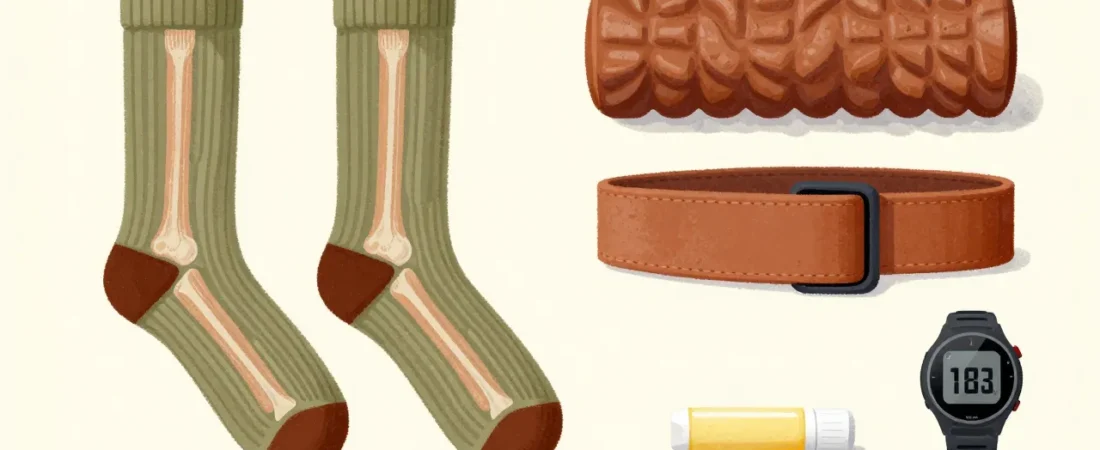
The Feetures Elite Socks are the single highest-leverage gift in the guide for a beginner who doesn’t yet own running-specific socks. The anatomical left-right fit isn’t a marketing detail — it eliminates the fabric bunching at the toe box that creates blisters during the heel-strike pattern beginners haven’t yet eliminated from their gait. A recurring pick in r/C25K “what actually helped” threads, they show up alongside running shoes as the most frequently cited gear upgrade that changed the experience.
Body Glide Anti-Chafe Balm is the under-$12 gift that solves a problem the recipient hasn’t discovered yet — which makes it the kind of thoughtful gift that signals you actually know what runners deal with. Chafing from waistbands, sports bras, and inner thighs typically first appears around week three, when runs get long enough to matter. Having the solution before the problem arrives is the gift.
The Balega Hidden Comfort Socks are the single-pair entry point for gift-givers who want a quality sock without committing to the Feetures 3-pack price. The mohair-blend cushioning provides noticeably more impact protection than standard athletic socks on hard pavement — relevant for urban beginners running on concrete. If your recipient runs in a warm climate, the Drynamix moisture-wicking matters: cotton socks become blistering agents once they’re wet.

Feetures Elite Socks (3-Pack)
Highest-leverage gift for a beginner: anatomical left-right fit eliminates bunching and blisters, lifetime guarantee signals quality, and the 3-pack covers a full week of runs. A recurring pick in r/C25K beginner threads, this addresses the leading cause of skipped runs in weeks 1–4 without requiring any fit knowledge from the gift-giver.
- Left/right anatomical fit eliminates fabric bunching at the toe box — the primary cause of blisters in beginner runners
- Lifetime guarantee from Feetures — a meaningful signal of quality that generic athletic socks can’t match
- Light cushion weight works with virtually any running shoe and in warm climates
- Higher price per pair than generic athletic socks — the value becomes obvious after the first blister-free long run, but harder to justify before that moment
- The no-show cut can slip below the heel collar on lower-cut shoes for runners with narrow heels

Body Glide Anti-Chafe Balm
Under $12, universally sized, and solves a painful problem the beginner hasn’t encountered yet. Body Glide’s plant-based stick formula has been the standard in endurance sports since 1996 — stocked in virtually every specialty running store as a checkout-counter staple. Best low-cost gift in the guide; works as a standalone stocking stuffer or paired with the socks.
- Plant-based, skin-safe formula — no petroleum jelly staining on technical fabrics
- Stick deodorant format means zero mess and quick application before a run
- Under $12 price makes it an easy low-risk gift that solves a real and painful problem
- The 1.5 oz size runs out faster than expected for runners who apply liberally across multiple friction zones
- Requires reapplication on runs over 90 minutes in humid conditions

Balega Hidden Comfort Socks
The single-pair alternative to the Feetures 3-pack — mohair-blend cushioning, a deep heel pocket that prevents mid-run slipping, and aggressive moisture-wicking via Drynamix fiber. The right choice for gift-givers who want a quality sock without the higher 3-pack commitment, or who want to pair it with another item in the guide.
- Extra-plush mohair-blend cushioning reduces impact fatigue on hard pavement — noticeable on urban concrete runs
- Drynamix fiber wicks moisture aggressively — critical in warm climates where a 30-minute run can soak standard socks
- Single-pair entry price makes it a natural add-on gift alongside Body Glide
- Single-pair format costs more per pair than buying the Feetures 3-pack — better value for a try-before-committing scenario
- Plush cushioning adds slight bulk; runners who prefer a close-to-ground feel may find them over-cushioned
Carry and Recover: Mid-Range Picks That Build a Routine
Two problems reliably emerge when beginners start running solo for the first time: what to do with their phone, and what to do with their body afterward. The phone problem gets solved quickly or it becomes an excuse not to run. The recovery problem gets ignored until it becomes a shin splint or a knee that ends the habit.
The FlipBelt Classic Running Belt addresses the first problem cleanly. Beginners run with their phone for safety, for music, and because they haven’t yet built the confidence to leave it behind. Holding it is uncomfortable past the first five minutes. The FlipBelt’s tubular no-bounce design solves this without the zipper-abrasion and bounce issues that plague cheaper armband alternatives. It requires knowing the recipient’s waist measurement — the one piece of sizing information the giver needs.
The TriggerPoint GRID Foam Roller is the expert pick that looks unremarkable. The overuse injuries that end beginner running programs — shin splints, IT band syndrome, plantar fasciitis — don’t announce themselves loudly. They build quietly over weeks three through six and become unignorable at the worst time. A foam roller introduced before those injuries arrive turns into a daily practice that prevents the derailment. The GRID’s free instructional video library is not a marketing afterthought; for someone who has never rolled before, it’s what turns the purchase into actual use.

FlipBelt Classic Running Belt
Solves the phone problem that keeps beginners from running solo comfortably. The tubular body-contour design eliminates bounce entirely — the single most common complaint about running belts. Sized by waist measurement (XS through XL), so the gift-giver just needs to know one number.
- Tubular body-contour design eliminates bounce — solves the most common complaint about running belts
- Flip-over closure secures items without zippers that can abrade skin or come undone mid-run
- Waist-based sizing (XS–XL) is easy for a gift-giver to determine without awkward questions
- No zipper on the Classic model — items held by flip-over closure, which most runners find secure but takes one run to trust
- Tubular design means stepping into it like pants — slightly awkward first-time experience that surprises some users

TriggerPoint GRID Foam Roller
The expert’s gift that looks simple. Multi-density surface mimics real massage strokes in a way flat-surface rollers don’t, and the free instructional video library makes it approachable for someone who has never foam-rolled. Directly addresses the IT band issues and shin splints that derail beginners in weeks 3–6 — stocked as a front-of-store staple at specialty running retailers for a reason.
- Multi-density exterior surface mimics real massage strokes — more effective than flat-surface foam rollers at releasing IT band and calf tension
- Hollow-core rigid construction won’t deform with repeated use — holds shape through years of daily rolling
- Free online instructional video library teaches specific patterns for IT band, calves, quads, and hip flexors
- Firmer than beginner foam rollers — runners with very tight muscles may find initial sessions intensely uncomfortable
- 13-inch length can feel short for rolling the full IT band without repositioning
The Investment Pick: A Watch That Coaches
A GPS watch is the right investment-tier gift for a beginner who has already run at least once and is committed to a training program. The wrong version of this gift is a basic step counter or a cheap GPS tracker that tells you where you went but offers no guidance on whether that was the right effort. The right version actively teaches pacing — which is the technical skill beginners lack most.
The Garmin Forerunner 55 earns its place here as the forum consensus pick for beginner GPS, appearing consistently in r/running “what watch should I start with” threads at the $150–$200 price point. PacePro technology provides gentle real-time pace alerts that teach the most common beginner mistake — going out too fast in the first mile and burning out before the interval ends. Suggested daily workouts that adapt to training history address “I don’t know how much to run” paralysis directly.
The two-week battery life is not a minor spec. Beginners are still building the habit infrastructure around their runs — charging a watch every two days is one more thing to remember and one more point of failure. A watch that’s always on the wrist and always charged removes an entire category of friction from the routine.

Garmin Forerunner 55
The single investment-tier pick. PacePro pacing and adaptive suggested workouts make this a coaching tool, not just a tracker — the exact guidance a beginner needs in place of a running coach. The 2-week battery removes the charging friction that kills daily device use during habit formation. A recurring recommendation in r/running beginner watch threads at this price point.
- PacePro technology provides real-time pace alerts — teaches beginners to run at sustainable effort and avoid the “go out too fast” mistake
- Suggested daily workouts adapt based on training history and recovery — removes the “how much should I run today” decision entirely
- 2-week battery life means it never needs charging between runs — eliminates a daily friction point during early habit formation
- Display is small and transflective — harder to read in direct sunlight compared to pricier Garmin models
- No built-in music or contactless payments — runners who want to leave their phone behind entirely will need a separate music solution
What to skip
Running shoes are the most-gifted item on every competitor list and the worst choice for a beginner recipient. Fit requires a gait analysis, brand loyalty forms quickly, and a mismatched pair is a direct path to the shin splints and knee pain that end most beginner programs in the first month. The correct substitute is a gift card to a local specialty running store — Fleet Feet, Road Runner Sports, or an independent local equivalent — where they can get properly fitted by a staff member whose livelihood depends on the customer returning. The same logic, for different reasons, applies to sports gels and chews: beginners haven’t learned what their stomach tolerates mid-run, and gifting the wrong fuel means a genuinely unpleasant 5K experience. Budget GPS trackers in the $30–$60 range are a third category to avoid — they record distance without any training intelligence, which means the beginner gets data without guidance and no mechanism to learn from it.
The best gifts for a beginner runner share one quality: they remove a reason to skip tomorrow’s run. That is a different design brief than “best running gear” and it produces a different list — one that skews toward the unglamorous and the under-$40 rather than the impressive and the technical.
If you are choosing between two items, ask which one addresses a problem your recipient is more likely to have hit already. Four weeks in and running outdoors? The socks and Body Glide have probably already revealed themselves as gaps. Eight weeks in and logging structured workouts? The Garmin starts to make sense. When in doubt, pair the socks with Body Glide for under $55 — it’s the combination that handles the two most common first-month problems in a single purchase.
The beginner window is eight weeks long. The gifts that matter most in it are not the ones that celebrate the hobby — they’re the ones that keep the person in it long enough for the hobby to take hold on its own.