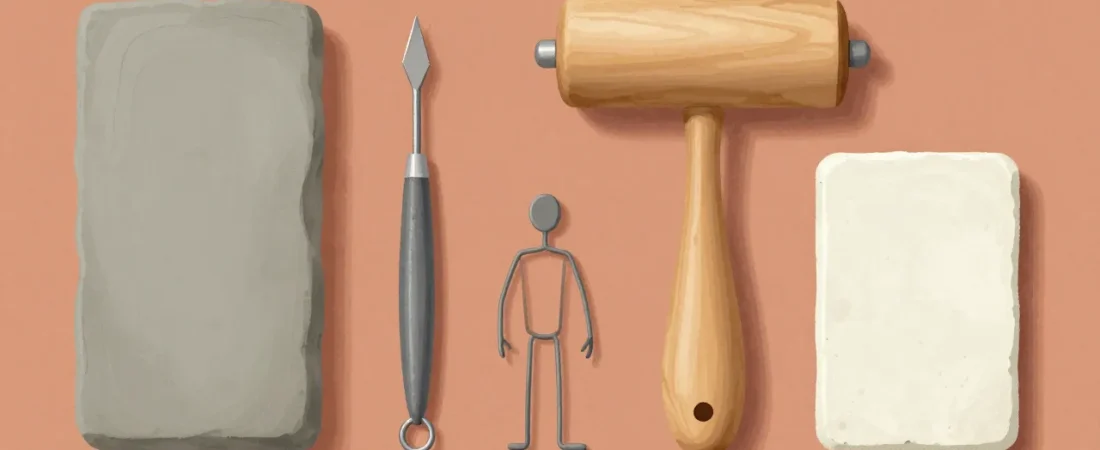
Walk into any craft store and the same gift announces itself from the shelf: a plastic-windowed box with a block of air-dry clay, five tools, and a label that says Beginner Sculpting Kit. It looks right. It is almost always wrong.
Air-dry clay — the default medium in virtually every all-in-one kit on the market — is the most punishing clay type for complex sculptural forms. It shrinks as it dries, which means cracks appear on anything thicker than a slab. It doesn’t bond cleanly back to itself once surface-dry. And it has zero workability window for rework. For an adult beginner who wants to make a figure, a portrait, or anything with detail, an air-dry kit is a fast path to a frustrating first experience and an unfair conclusion that they’re bad at this.
The right clay gift for an adult beginner depends on one question the gift-giver almost never asks: what does this person actually want to make? That answer maps directly to a clay type, and each clay type points to a different set of gifts. This guide walks you through that framework, then gives you our picks at every price point — including the two low-cost accessories that polymer clay experts say beginners always skip and always regret skipping.
How we select these gifts
- Specialty retailers first: We start with what specialty retailers actually stock — Jerry’s Artarama, Blick Art Materials. Stores whose business depends on return customers don’t stock junk.
- Community consensus: We cross-reference retailer inventory against what hobbyists recommend in their own communities — r/Sculpture, The Blue Bottle Tree (the most-cited polymer clay practitioner resource), and prop-maker communities where epoxy clays are workshopped daily.
- Age and stage fit: Adult beginners can hand-build using pinch, coil, and slab techniques but haven’t yet developed proportional eye or surface control. The critical early-stage risk is choosing the wrong clay type — not lacking enough tools. We cap tool recommendations at what covers the first six months without redundancy.
- Budget range: Picks span $7–$33 individually, with recommended gift bundles totaling $22–$51.
- Skip-this guidance: Where a popular pick isn’t right for this stage — particularly all-in-one beginner kits that bundle mediocre clay with plastic tools — we say so and explain exactly why.
How We Actually Pick Clay Gifts (and Why We Don’t Default to the Air-Dry Kit)
We filter every product through three questions before it makes this list.
First: does it match the right clay type for sculptural work? We differentiate between air-dry clay (decorative slabs, dishes, low-detail forms), polymer clay (figures, miniatures, detail work, jewelry), and epoxy clay (structural builds, armature-heavy projects, outdoor or functional pieces). A gift that ignores this distinction sets the beginner up for the wrong first experience.
Second: does it work across the first six months without being outgrown? Adult beginners don’t need 40 tools. They need five good ones. We exclude products that add complexity before the fundamentals are established.
Third: is it recommended by working practitioners — not just top-reviewed on Amazon? We cross-reference each pick against practitioner sources including The Blue Bottle Tree (the most-cited polymer clay authority online) and r/Sculpture community recommendations. Popularity and quality frequently diverge in clay tools.
One more principle: we do not recommend all-in-one beginner kits that bundle clay with tools as a single package — unless the clay and tools are genuinely professional-grade. Most are not. Our picks are separable, upgradeable, and each earns its place independently.
Best for No-Oven Beginners: Air-Dry and Epoxy Clay Gifts
Two distinct no-oven options exist for adult beginners, and they are not interchangeable. Air-dry clay works well for decorative objects, shallow-relief pieces, and simple sculptural forms where wall thickness stays relatively consistent. The failure mode is thickness variation: a form with a thin neck and a thick head will crack at the transition as moisture escapes unevenly. If the person you’re buying for wants to make pinch pots, wall tiles, or decorative figurines with simple geometry, a quality air-dry clay is the right call.
Epoxy clay is the option most gift-givers have never heard of — and it’s the one that prop makers, miniature sculptors, and figure-art communities reach for when they need no-oven reliability without the cracking problem. Aves Apoxie Sculpt cures through a chemical reaction so it experiences zero shrinkage and zero moisture-driven cracking. It bonds directly to armature wire, foam, and most other substrates. The trade-off: once you mix the two parts, the working window is roughly two hours, and any unused mixed compound cannot be saved.
For a no-oven beginner whose goals lean decorative, buy DAS. For a no-oven beginner who wants to build figures, animals, or anything over armature wire, buy Apoxie Sculpt. The price difference between them is $12. The difference in fit-for-purpose is significant.

DAS Air-Hardening Modeling Clay 2.2lb
DAS is the air-dry clay that actually earns the recommendation — Italian-made since 1963, with a stone-grey color that mimics traditional sculpture clay and a texture that holds surface detail better than the white or terracotta alternatives in most beginner kits. A 2.2lb block covers four to six beginner sessions, enough to get through the learning curve on basic forms. The 41,000+ reviews reflect genuine volume of use, and it consistently appears as the go-to recommendation in r/Sculpture threads when people ask which air-dry clay is worth using.
- No oven required — air-dries at room temperature
- Made in Italy since 1963; stone color mimics traditional sculpture clay
- 2.2lb covers 4–6 beginner sessions
- Doesn’t bond to dried sections without slip — partial repairs are difficult
- Once fully dry, rework requires carving, not reshaping

Aves Apoxie Sculpt 1lb Two-Part Epoxy Clay
Apoxie Sculpt is American-made and has been the prop-maker and figure-sculptor community’s default no-oven clay for decades — it surfaces repeatedly in r/Sculpture recommendations precisely because it solves the two problems that frustrate beginners most: cracking and structural failure. Zero shrinkage means the form you sculpt is the form you get. The self-adhesive chemistry means it grips directly to armature wire, cardboard, foam, and most craft substrates without primer or adhesive.
- Zero shrinkage and zero cracking — cures through chemistry, not drying
- Self-adhesive to armature wire, foam, and most substrates
- American-made; 3,200+ reviews across professional and hobbyist users
- Once the two parts are mixed, unused compound cannot be stored — mix only what you’ll use in two hours
- Semi-gloss finish requires sanding before painting for clean paint adhesion
Best for Figurative and Detail Work: Polymer Clay Gifts
Polymer clay is the medium that serious beginner figurative sculptors should be working in. It doesn’t air-dry, which means the workability window is open as long as you need it. You bake it in a home oven at 265–275°F to cure. The critical gift-giver question: does the recipient have access to a home oven? If yes, polymer clay opens possibilities that no air-dry or epoxy clay can match.
The Super Sculpey Ultimate DIY Sculpting Kit is the entry point for beginners who want to work the way commercial figure sculptors do. It ships with armature wire — the structural skeleton that prevents polymer clay figures from slumping — and includes four clay firmnesses so beginners can feel the difference between a harder clay (better for detail) and a softer one (better for initial blocking).
For a beginner who already has basic tools, Sculpey Premo in white is the clay the practitioner community actually buys. The Blue Bottle Tree — the closest thing polymer clay has to an authoritative reference resource — names Premo as the all-purpose workhorse for sculpting and fine jewelry work.

Super Sculpey Ultimate DIY Sculpting Kit
This is the kit that earns the kit format — because the clay and tools are genuinely professional-grade and the armature wire inclusion is not cosmetic. Armature wire is what prevents a polymer clay figure from slumping before cure; beginners who try to skip it discover why it exists after their first collapsed figure. The four-firmness clay selection teaches a real skill: figuring out when to use hard clay for a crisp ear or soft clay for a smooth cheek. This is the right first gift for a beginner who has oven access and wants to make figures, characters, or portraits.
- Ships with armature wire — eliminates the most common beginner structural failure
- Four clay firmnesses introduce an essential skill early
- Sculpey video tutorial link targets figurative work specifically
- Requires a home oven for curing — a hard stop for some recipients
- Thin sections can be fragile post-bake without internal wire support

Sculpey Premo Polymer Clay 1lb White
Premo is the clay The Blue Bottle Tree recommends as the all-purpose workhorse for sculpting and fine jewelry. It holds crisp tool marks, remains flexible after baking (which means thin sections survive handling), and the 1lb block in white is the correct choice for a beginner: every tool mark and surface texture reads clearly in white, accelerating the feedback loop when learning surface control. Stocked at Blick Art Materials locally so the recipient can resupply without waiting for shipping.
- Holds crisp detail; flexible after baking — thin sections survive handling
- White surface makes tool marks clearly visible for learning
- Stocked at local art retailers — easy to resupply
- Requires oven baking — not an option without oven access
- Single color only — not a colorwork medium out of the box
The Tools and Essentials Experts Say Beginners Always Skip
Three accessories appear on this list because the practitioner community names them repeatedly. Each costs under $20. Together they prevent the three most common beginner failures: working without the right tools, burning the first project in the oven, and cracking a finished piece during transfer from worksurface to oven rack.

Sculpey Essential 11-Piece Clay Tool Set
This set covers all five essential tool categories a beginner needs — roller, blade, needle, loop tool, and detailing stylus — in a single purchase that works across every clay type on this list: air-dry, polymer, and epoxy. It surfaces most consistently in beginner recommendations across r/Sculpture and polymer clay tutorial communities. Pair this with any clay pick on this list except the Super Sculpey Ultimate Kit, which already ships with six tools.
- Covers all five essential beginner tool categories in one purchase
- Works across all clay types — air-dry, polymer, and epoxy
- Includes roller and slicer blade, the two most commonly missing tools in off-brand sets
- Plastic blade handle — not professional-grade metal; blade edge dulls faster than metal alternatives

Taylor Classic Large-Dial Oven Thermometer
Every polymer clay practitioner source identifies oven temperature error as the single most common cause of a beginner’s first burned project. Polymer clay burns at 300°F and most home oven thermostats read 25–50°F low, which means a beginner setting the oven to 275°F may actually be running at 300–325°F. The result is a brown, brittle piece that the beginner blames on their own technique. They are not wrong. Their oven is. At 18,500+ reviews, this is the standard recommendation — the 3.25-inch dial reads through the oven door without opening it.
- 3.25″ dial reads through closed oven door — no heat loss while checking
- Under $8 — the highest-leverage item on this list per dollar
- 18,500+ reviews across home bakers and polymer clay users
- Analog only — no digital alarm for temperature drift
- Some units run 10–15°F warm out of the box

Sculpey Work ‘n Bake Silicone Clay Mat
The transfer step — picking up an uncured polymer clay sculpture and moving it from worksurface to oven rack — is where beginners distort their work. Soft, unfired clay does not survive being lifted and repositioned. The Work ‘n Bake mat is oven-safe silicone: you sculpt directly on the mat, then slide the entire mat onto the oven rack without touching the piece at all. The grid lines provide a proportion reference while sculpting.
- Oven-safe silicone — sculpt and bake on the same surface, eliminating transfer distortion
- Non-stick surface; grid lines provide proportion reference during sculpting
- Works as a clean, dedicated clay workspace that contains debris
- 11.5″ x 15.5″ — limits workspace for larger forms
- Shows permanent staining from pigmented clays after repeated use
What to skip
All-in-one beginner sculpting kits that bundle air-dry clay with plastic tools — the ones in a cardboard box labeled Sculpting Starter Kit or Creative Clay Set, usually priced $18–$28 with a high review count. The air-dry clay in these kits cracks on any form with meaningful thickness variation; the plastic tools are too flimsy for controlled surface work. The beginner finishes two sessions with cracked pieces and bent tools and concludes they are bad at sculpting. They are not bad at sculpting. The kit is bad at its job. Any individual pick on this list — even just DAS clay and the Sculpey tool set — will produce a materially better first experience at a comparable or lower total price.
The best clay sculpting gift for an adult beginner is not the most comprehensive one — it’s the one that matches the medium to the person and removes friction from the first session.
For a no-oven beginner with decorative goals: DAS Air-Hardening Clay plus the Sculpey tool set. Total: approximately $34. For a no-oven beginner who wants structural or figurative work: Aves Apoxie Sculpt plus the Sculpey tool set. Total: approximately $46. For a beginner who wants to develop real figurative sculpting skills and has oven access: the Super Sculpey Ultimate Kit plus the Taylor thermometer and the Work ‘n Bake mat. Total: approximately $51 — and that set will carry them through the first year without a single unnecessary purchase.
If you’re still deciding between the air-dry and polymer paths, ask one question: does the person have a home oven and the patience to learn one extra step? If yes, polymer is the better long-term investment. If the answer is uncertain, DAS is the safer gift.