You’ve got a camera—maybe it’s your phone, maybe it’s a hand-me-down DSLR—but your photos never quite look like the ones you see online. The good news? Great photography isn’t about expensive gear. It’s about understanding a few core principles and practicing them until they become second nature.

This guide covers the fundamentals every beginner photographer needs, from composition basics to lighting tricks that make any subject look better. Whether you’re shooting family moments, travel memories, or just want better Instagram photos, you’ll find practical techniques you can use immediately.

Understanding Your Camera (Any Camera)

Smartphone photographers: Your phone is more capable than you think. Learn to use portrait mode, HDR, and manual controls if available. The best camera is the one you have with you.

Point-and-shoot users: Explore your scene modes and learn when to override auto settings. Most have hidden depth that owners never discover.

DSLR/mirrorless beginners: Start in aperture priority mode (A or Av). This lets you control depth of field while the camera handles exposure—the perfect training wheels.

The Rule of Thirds: Your First Composition Tool

Imagine your frame divided into a 3×3 grid. Place your subject along these lines or at their intersections instead of dead center. This simple shift creates more dynamic, interesting images instantly.

Most cameras and phones can overlay this grid on your screen—turn it on and use it until placing subjects off-center becomes instinct.

Light Is Everything

Photography literally means “writing with light.” Understanding light transforms ordinary shots into compelling images.

  • Golden hour — The hour after sunrise and before sunset offers warm, soft, flattering light. This is when professionals shoot portraits and landscapes.
  • Overcast days — Clouds act as a giant softbox, eliminating harsh shadows. Perfect for portraits and flower photography.
  • Window light — For indoor shots, position subjects near windows. The soft, directional light creates beautiful natural portraits.
  • Avoid harsh midday sun — Direct overhead sunlight creates unflattering shadows under eyes and noses. If you must shoot, find open shade.

Get Closer (Then Get Even Closer)

Beginner photos often suffer from one problem: the subject is too small in the frame. Fill your viewfinder with what matters. If you’re photographing a person, their face should dominate the image, not the parking lot behind them.

Physical proximity also creates intimacy and connection. Instead of zooming from across the room, walk up to your subject.

Backgrounds Matter More Than You Think

A cluttered background competes with your subject. Before pressing the shutter, scan the edges of your frame. Look for distracting elements—poles growing out of heads, bright spots pulling attention, messy rooms.

Simple fixes: change your angle slightly, move your subject, or use a wider aperture to blur the background.

Essential Gear for Beginners

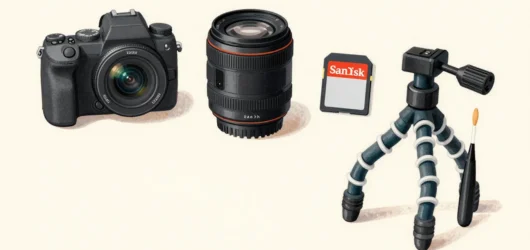
You don’t need much to start, but a few items make a real difference:

  • Tripod ($25-50) — Essential for low-light photography, self-portraits, and sharp landscape shots. Even a basic tripod beats hand-holding in dim conditions.
  • Lens cleaning kit ($10-15) — Fingerprints and dust degrade image quality. Keep your glass clean.
  • Extra memory cards ($15-30) — Never miss a shot because you ran out of storage. Carry spares.
  • Camera bag ($30-60) — Protect your investment and keep gear organized and accessible.

Practice Projects to Build Skills

Reading about photography only gets you so far. These projects force you to apply what you’ve learned:

  1. Photo-a-day challenge — Commit to one intentional photo daily for a month. Constraints breed creativity.
  2. Single lens week — Use only one focal length for seven days. You’ll learn to see compositions that match your lens.
  3. Light study — Photograph the same object at different times of day. Notice how light transforms the subject.
  4. Street photography walk — Spend an hour photographing your neighborhood. Look for interesting moments, textures, and characters.

Common Beginner Mistakes to Avoid

  • Over-editing — Subtle adjustments look professional. Cranked saturation and HDR effects look amateur. Less is more.
  • Ignoring the background — Always check what’s behind your subject before shooting.
  • Shooting from eye level only — Get low, get high, find unusual angles. Perspective changes everything.
  • Deleting “bad” photos too quickly — What looks like a mistake today might teach you something tomorrow. Keep your learning shots.

Ready to Start Shooting?

Pick up your camera right now—yes, your phone counts—and take 10 intentional photos using the rule of thirds. Pay attention to light and background. That’s it. Ten photos, and you’ve already practiced more than most people ever will.

For gear recommendations, check our creative gift guide or browse starter kits for photography bundles. Looking for more hobby ideas? Explore our beginner hobbies section.

HobbyRamp earns from qualifying Amazon purchases. This doesn’t affect our recommendations—we only suggest products we’d use ourselves.