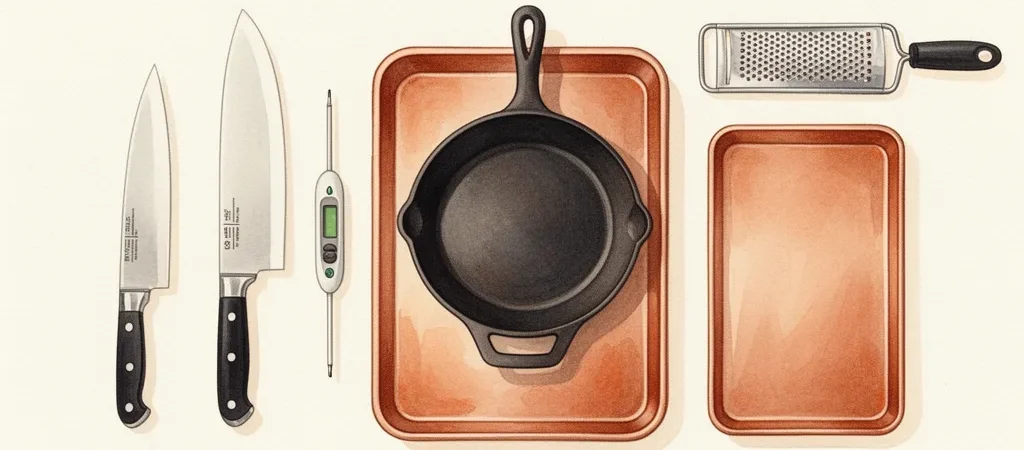
Most cooking gifts for beginners miss because they solve problems a beginner does not yet have. Stand mixers belong on the list of someone who bakes from memory on weekends. Knife blocks belong on the list of someone who already knows what a boning knife is for. An adult who just started cooking — or who cooks sporadically and wants to cook more — has three specific problems: they are afraid of undercooking protein, they do not know how to make food taste like something, and they are missing one foundational tool that keeps blocking them from finishing recipes.
This guide is built around those three friction points. Every pick here addresses at least one of them directly. Nothing on this list requires setup time, a learning curve, or a dedicated storage cabinet.
The guide works whether you’re buying for someone who has been “meaning to cook more” for two years or someone who just moved into their first place with a spatula and a sauce pan. These are the tools that actually get used.
How we select these gifts
- Specialty retailers and trusted editorial sources first: We start with what specialist cooking retailers, America’s Test Kitchen, and professional culinary supply channels actually stock and recommend. Businesses whose customers return for equipment year after year do not stock tools that disappoint at the beginner level.
- Community consensus: We cross-reference editorial picks against what home cooks recommend in their own communities — r/AskCulinary, r/Cooking, and ChefTalk beginner threads. Products that appear in both editorial and community signals get the heaviest weight.
- Skill-stage fit, not price filter: Every pick is evaluated against three specific beginner friction points: doneness anxiety (fear of undercooking protein), seasoning uncertainty (food that tastes flat), and missing foundational equipment. A $200 product that solves none of those problems does not make this list. A $14 product that eliminates a real barrier does.
- Budget range: Picks span $12.99 to $39.95, so the guide works whether you’re spending $13 or $40 — and the full seven-item kit costs under $170.
- Skip-this guidance: Where a popular pick is wrong for this specific stage — or wrong for a specific sub-type of beginner — we say so and explain why.
How We Pick Gifts for Beginner Cooks (It’s a Skill Filter, Not a Price Filter)
The most common mistake in cooking gift guides is treating “beginner” as a proxy for “cheap.” It is not. A beginner cook does not need affordable versions of every kitchen tool — they need the specific tools that remove the specific barriers keeping them from cooking more often. Those two things are different problems with different solutions.
Adult beginners occupy a narrow but well-defined skill window. They can follow a recipe from start to finish. They cannot yet improvise, adjust by instinct, or diagnose why a dish came out wrong. Their confidence lives or dies on two things: knowing the protein is cooked through, and knowing why the food tastes flat. Gifts that address those two anxieties deliver disproportionate return on the relationship.
Two product categories fail reliably at this stage. Single-use gadgets — avocado slicers, egg separators, strawberry hullers — communicate that cooking is complicated enough to require a specialized tool for every ingredient. They are also the first things cleared out in a kitchen drawer purge. Multi-function appliances — stand mixers, Instant Pots, food processors — are genuinely useful tools, but they require a level of cooking confidence to use regularly. A beginner who does not yet cook with a cast iron skillet does not need a 7-quart Dutch oven.
Every pick below is a tool a beginner will reach for in the first week and keep reaching for indefinitely.
The Tools a New Cook Will Reach for Every Single Day
The highest-value gifts for an adult beginner are not the most impressive ones — they are the most foundational. A sharp knife, a reliable pan, a flat surface to roast on, and a way to move food around a hot pan cover the widest possible range of recipes a beginner is actually going to cook.
The Victorinox Fibrox Pro 8-Inch Chef’s Knife is the near-universal first-knife recommendation in serious cooking communities precisely because it removes the one thing that makes cheap knives dangerous: unpredictability. A dull or sticky knife requires more force, more repositioning, and more improvisation — all bad for someone still learning basic cuts. The Victorinox is sharp out of the box, stays sharp longer than comparably priced knives, and forgives poor sharpening form without chipping.
The Lodge 10.25-Inch Pre-Seasoned Cast Iron Skillet is the pan that does the most things. A beginner who owns one good skillet can sear, roast, bake cornbread, fry eggs, and move from stovetop to oven — all with one piece of equipment, no temperature limits, no nonstick coating to protect. Coming pre-seasoned from the factory eliminates the intimidating “build the seasoning from scratch” step that stops beginners before they start.
The Nordic Ware Baker’s Half Sheet Pan is the lowest-skill, highest-return piece of cookware for a beginner: sheet-pan dinners require almost no technique, produce consistent results, and create minimal cleanup. America’s Test Kitchen’s own longevity testing has given this pan its rare “All-Time Favorite” designation — heavy-gauge commercial aluminum that will not warp, rust, or flake.
The OXO Good Grips 12-Inch Locking Tongs are the missing “third hand” in a beginner’s kitchen. Flipping chicken thighs, tossing pasta, pulling roasted vegetables off a sheet pan — all of these motions are awkward and borderline unsafe without tongs. The locking mechanism collapses them flat for drawer storage and opens with a one-handed tap — exactly the frictionless design a new cook needs.

Victorinox Fibrox Pro 8-Inch Chef’s Knife
The Victorinox Fibrox Pro is the single most recommended first chef’s knife across ChefTalk forums, r/AskCulinary, and America’s Test Kitchen. The non-slip Fibrox handle is ergonomically designed to minimize wrist fatigue, and the softer Swiss steel forgives poor sharpening technique without chipping. For an adult beginner, this is the one tool that unlocks the widest range of recipes at a price that doesn’t feel like a commitment.
- NSF-certified commercial-grade steel that stays sharp longer than similarly priced knives and re-sharpens easily at home
- Grippy, non-slip Fibrox handle is genuinely safer than cheap plastic handles when hands are wet or greasy
- Dishwasher-safe in a pinch — a forgiving detail for beginners
- Handle aesthetics are utilitarian — looks like a restaurant supply knife, not a showpiece
- Needs honing every few uses to maintain peak sharpness; beginners who skip this will notice dull performance within weeks

Lodge 10.25-Inch Pre-Seasoned Cast Iron Skillet
No other beginner tool offers this much range — searing, oven-roasting, cornbread, stovetop-to-table — at under $20. Coming pre-seasoned from the factory, the intimidating “seasoning from scratch” step is removed entirely — a confidence-building detail called out repeatedly in beginner threads. Made in the USA in Tennessee since 1896.
- Comes factory pre-seasoned with vegetable oil — ready to cook immediately with no prep ritual required
- Doubles as a stovetop and oven pan with no temperature limit, so a beginner can follow the widest range of recipes with one pan
- Made in the USA in Tennessee since 1896 — genuine quality signal, not marketing copy
- Heavy at 5 lbs — pouring off liquid or moving from stove to oven one-handed takes adjustment
- Requires hand-washing and a quick dry; a beginner who puts it through the dishwasher will deal with rust

Nordic Ware Baker’s Half Sheet Pan
Holds America’s Test Kitchen’s rare “All-Time Favorite” designation. For an adult beginner, a sheet pan is the lowest-skill, highest-return piece of cookware: roasted vegetables, sheet-pan dinners, cookies, and reheated leftovers all start here. The heavy commercial-grade aluminum resists warping at high heat — a real problem with cheaper nonstick sheet pans that buckle audibly at 425°F.
- 18×13-inch cooking surface fits a full dinner’s worth of vegetables in a single layer — no overcrowding that causes steaming instead of roasting
- Natural aluminum heats evenly and will never rust; encapsulated steel rim prevents warping even at 450°F+
- Made in the USA; ATK’s longevity data shows these outlast every nonstick sheet pan on the market
- Not nonstick — requires parchment paper or a silicone mat for sticky foods; raw aluminum will stain over time
- Cannot go in the dishwasher without discoloration (hand-wash only)

OXO Good Grips 12-Inch Locking Tongs
Cited by America’s Test Kitchen as their all-time top tong pick. For a beginner, tongs are the “third hand” that makes cooking on hot surfaces safe and controllable: flipping chicken thighs, tossing pasta, pulling vegetables off a sheet pan. The locking mechanism collapses them flat for drawer storage and opens with a one-handed tap — genuinely useful daily convenience.
- Pincer tips are precise enough to pick up a single green bean — beginners won’t knock food off the plate
- Locking ring clicks shut for compact storage and opens with one-handed tap
- Stainless steel construction is dishwasher-safe and won’t absorb odors or stain
- Stainless tips can scratch nonstick surfaces — grab the silicone-tipped version if your main pan is nonstick
- 12 inches can feel long for small stovetops with cramped burner spacing
The Confidence Tools: Solving Doneness Fear and Flat Flavors
Of all the gaps in a beginner cook’s toolkit, two stand above the rest in terms of psychological impact. The first is doneness fear — the genuine anxiety about cutting into chicken and not knowing whether to serve it. The second is flavor blindness — the inability to identify why food that followed a recipe tastes flat and what to do about it. These are not equipment problems. They are knowledge problems wearing the disguise of equipment problems. The right tools solve them.
The ThermoWorks ThermoPop 2 Instant-Read Thermometer is the highest confidence-per-dollar purchase on this entire list. The moment a beginner stops cutting into chicken to check the color and starts inserting a probe and reading a number, their entire relationship with cooking proteins changes. The ThermoPop 2 reads in 2-3 seconds with ±1°F accuracy — fast enough that you do not hover, accurate enough that you trust the number. The 360-degree rotating display is a genuine usability detail: the reading is always right-side-up regardless of the angle you approach the pan or oven from.
The Microplane Classic Zester/Grater is the insider pick — the tool that forum regulars in r/Cooking consistently name when someone asks what they wish they had bought sooner. For a beginner struggling to understand why their food tastes like the recipe but not like the restaurant version, the answer is almost always bright acid from citrus zest, or the depth of freshly grated parmesan or garlic. The Microplane delivers both. Under $15, used in nearly every cuisine, and one of the few tools where the impact is immediately and dramatically perceptible.

ThermoWorks ThermoPop 2 Instant-Read Thermometer
The instant-read thermometer is the most confidence-building tool a beginner can own — it replaces guesswork with certainty on the single biggest fear: undercooked chicken. The ThermoPop 2 reads in 2-3 seconds with ±1°F accuracy, is IP67 waterproof, and the rotating display works regardless of which hand you hold it in — a genuinely thoughtful design detail for beginners still figuring out their grip.
- 2-3 second read time eliminates the anxious hovering over a pan that slow thermometers require
- 360-degree rotating display means the number is always readable regardless of angle — no twisting your wrist in a hot oven
- IP67 waterproof rating survives direct water contact; battery lasts approximately 4,000 hours
- No backlight — reading in a dark oven or at a grill at night requires good ambient light
- Probe is fixed, not folding — requires a sleeve or separate holder for safe drawer storage

Microplane Classic Zester/Grater
This is the “underrated essential” pick that forum regulars champion specifically because beginners don’t know to ask for it. For a beginner, a Microplane unlocks lemon zest, freshly grated parmesan, garlic paste, ginger, and nutmeg — flavor-building moves that jump a dish from flat to restaurant-quality without technique. Photo-etched surgical-grade stainless blades made in the USA stay sharp for years of regular use.
- Photo-etched surgical-grade stainless blades are made in the USA and stay sharp for years of regular use
- Handles citrus zest, hard cheese, garlic, ginger, chocolate, and nutmeg — one tool replaces five single-purpose gadgets
- Under $15 with outsized impact on food flavor — the highest ROI purchase on this list
- Blade is very sharp — requires deliberate technique; beginners should always zest away from the fingertips
- Requires hand-washing (dishwasher dulls the fine teeth); drying before storage prevents moisture spots
The Supporting Cast: What Rounds Out a Sparse Kitchen
A beginner’s kitchen tends to have one of everything — one small bowl, one mediocre pan, mismatched utensils — which means prep work becomes an improvised puzzle before cooking even begins. Mixing bowls are the kind of tool that seems obvious until you try to whisk a vinaigrette in a cereal bowl that slides across the counter with every stroke.
The OXO Good Grips 3-Piece Stainless Mixing Bowl Set solves the foundational prep problem with one detail: the non-slip rubber base keeps the bowl stationary while you work. That single design choice removes a surprisingly common frustration that sends beginners back to restaurant apps. Three sizes — 1.5 qt, 3 qt, and 5 qt — cover the full range from whisking two eggs to marinating a whole chicken, and they nest flat for storage.
Stainless steel is the right material at this stage. It handles heat (useful for improvised double-boiler setups), survives acidic marinades, does not absorb odors, and is dishwasher-safe. A beginner will reach for these bowls in nearly every recipe they follow, which makes this set a quiet force multiplier for the rest of the kitchen.

OXO Good Grips 3-Piece Stainless Mixing Bowl Set
The non-slip base is a genuine safety and confidence detail — bowls that slide while whisking are a leading cause of beginner frustration and spills. Stainless steel handles heat, cold, and acidic marinades without absorbing odors, and nesting storage keeps clutter manageable in a small kitchen.
- Non-slip bottom stabilizes the bowl while whisking, stirring, or folding — eliminates the “chase the bowl around the counter” frustration
- Three sizes (1.5 qt, 3 qt, 5 qt) cover every beginner task from whisking two eggs to marinating a whole chicken
- Stainless steel is odor-neutral, dishwasher-safe, and compatible with double-boiler setups for melting chocolate
- No lids included — you’ll reach for plastic wrap or a plate to cover leftovers, which is mildly inconvenient
- Stainless is not microwave-safe, a minor limitation for beginners who like to reheat in the mixing bowl
Skip These: Gifts That Belong on a Different Cook’s List
The most popular cooking gifts — knife blocks, stand mixers, Instant Pots, pasta machines — are genuinely good products for the right person. They are wrong for a beginner, not because of quality, but because of timing. A 12-knife block set tells a beginner they need ten tools they do not recognize to do the work that one good chef’s knife already handles. A stand mixer is the right gift for someone who bakes bread every weekend from memory; it is the wrong gift for someone who is still learning to make a weeknight pasta sauce.
Single-use gadgets are the other category to avoid entirely. An avocado slicer, an egg separator, a strawberry huller, a spiralizer — each of these communicates that cooking is complicated enough to require specialized equipment for individual ingredients. They also communicate something worse to the recipient: that you do not think they can figure out a knife.
The principle is simple: at the beginner stage, fewer tools used more often beats more tools used never. Every pick in this guide was chosen because it gets reached for repeatedly, not because it covers a niche use case.
What to skip
Skip knife block sets (a beginner needs one great knife, not eleven adequate ones), single-use gadgets like avocado slicers and egg separators (they communicate that cooking is complicated and end up in a drawer within a month), and advanced appliances like stand mixers, pasta machines, and multi-cookers — save those for when the recipient is cooking confidently from memory, not from a recipe card on their phone. The surest sign a cooking gift will get used is that the recipient does not need to read the manual before they reach for it.
The best cooking gift for an adult beginner removes one specific barrier: the unfamiliar, the intimidating, or the missing tool that has been keeping them ordering takeout instead of cooking. A knife that does not fight back. A thermometer that answers the one question they are afraid to get wrong. A pan that works on the stove and in the oven so they do not have to stop mid-recipe to figure out what to do next.
If you are buying one thing, make it the thermometer or the knife — whichever the recipient does not already own. Both have an immediate, noticeable effect on confidence the first time they are used. That confidence compounds. A beginner who trusts their chicken is cooked through is a beginner who cooks chicken again next week.
If you are still deciding between two picks, ask which one removes a friction point the recipient has actually mentioned. Someone who complains about food tasting bland gets the Microplane. Someone who is nervous about raw meat gets the ThermoPop 2. The best gift is the one that already has context behind it.