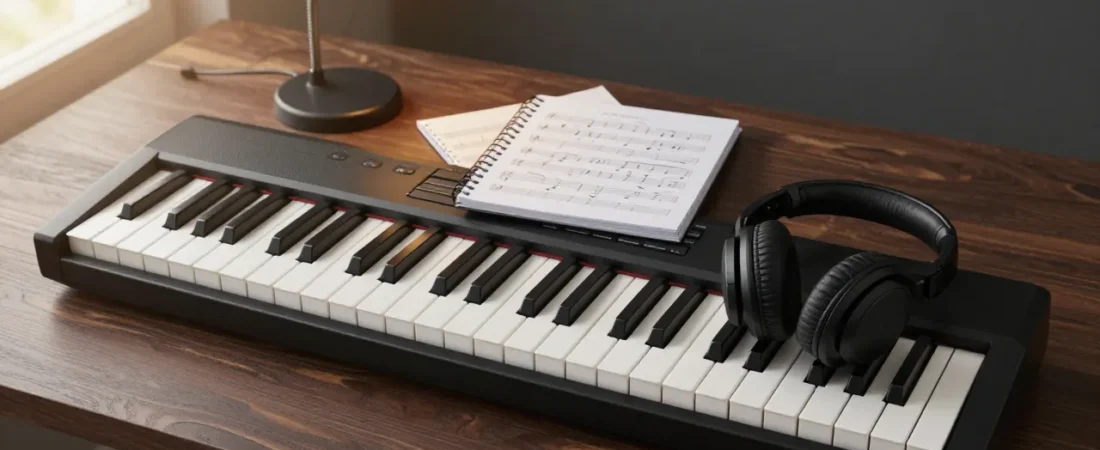
Most piano gift guides are written for people who already play. They recommend advanced repertoire books, brand-specific accessories, or specialized tools that mean nothing to someone who has been learning for three months. This guide does not do that. Every pick here is locked to year one: the adult who just got their first keyboard or recently sat down at an acoustic piano, is still building hand position habits, and still looks at the keys more than they look at the score.
The other problem with most piano gift lists is instrument dependency — they assume you know whether the recipient plays a 61-key keyboard, a weighted 88-key digital piano, or a hand-me-down acoustic upright. Almost every pick in this guide sidesteps that problem entirely. A bench, a method book, a music lamp, and key stickers work regardless of what the person owns. The two picks that are digital-only (headphones and sustain pedal) are clearly flagged.
What follows is a short list of things a first-year learner is almost certainly missing — not because they do not know better, but because first-year piano learners typically spend their limited budget on the instrument itself and assume the rest will follow. It rarely does on its own.
How we select these gifts
- Specialty retailers first: We start with what Austin-area specialty retailers actually stock — Strait Music on South Lamar is our primary piano and keyboard reference, and we cross-check against Austin Art & Frame for accessories. Stores whose business depends on return customers do not stock junk. Where Austin specialty coverage is thin for a specific category, we check national specialty retailers and manufacturer-direct sources.
- Community consensus: We cross-reference retailer inventory against what learners recommend in their own communities — Piano World's beginner setup threads and r/piano's weekly question threads surface the same products repeatedly. Items that appear in both retailer stock and community recommendations carry the most weight.
- Age and stage fit: All picks are calibrated to year one of adult piano learning — defined by the skill markers of still building hand position, still connecting note names to keyboard positions, and predominantly self-directed rather than teacher-led. Picks that work well at year two or beyond (half-damper pedals, advanced repertoire books, metronomes with subdivision training) are deliberately excluded.
- Budget range: Picks span $7.99 to $59.99 so the guide works whether you are spending $10 or $60.
- Skip-this guidance: Several picks are digital/keyboard-only and do not apply to acoustic piano owners. Where a popular-seeming gift is wrong for this specific stage, we say so and explain why.
What a First-Year Piano Learner Has (and What They Are Still Missing)
A typical adult beginner piano setup at the six-month mark looks like this: a 61-key or 88-key entry keyboard on an X-stand, a kitchen chair, a YouTube tutorial habit, and possibly a method book that got opened twice. If they have a teacher, they probably have an assigned book. If they are self-directed — which most adult beginners are — they have a method book they bought at the beginning and mostly ignored in favor of app-based learning.
What they almost never have: a properly adjustable bench, a quality sustain pedal if they are on a digital instrument, consistent task lighting over their sheet music, or headphones for practicing after the rest of the household has gone to bed. These are not glamorous gaps. They are the kind of gaps that accumulate silently, causing wrist fatigue, eye strain, and practice sessions cut short — all of which contribute to the attrition that takes a huge proportion of adult beginners out of the hobby before year two.
The critical thing to understand as a gift-giver: most of what a first-year learner is missing is not instrument-specific. An adjustable bench works with any keyboard on a stand or any acoustic upright. A method book and a music lamp are equally useful regardless of what they own. You do not need to know the make, model, or key count to give something that genuinely improves their practice life.
The Foundation Layer: Bench, Pedal, and Physical Setup
The On-Stage KT7800+ Adjustable Keyboard Bench is the highest-impact physical gift on this list, and it is also the most consistently skipped purchase by first-year learners who figure a chair is a chair. It is not. Seated height at the keyboard determines wrist angle, shoulder tension, and the distribution of arm weight across the keys — all of which directly affect technique development. An adult practicing from a kitchen chair at the wrong height is spending every session quietly reinforcing bad habits that a teacher would correct in the first five minutes.
Correct seated height puts the elbows roughly level with the keys, with the forearm nearly parallel to the floor. Most kitchen chairs put adult learners two to four inches too low. The KT7800+ covers the full adult height range with four discrete positions between 19.5 and 24.5 inches, and it folds flat for keyboard owners who store their instrument between sessions. This is an instrument-agnostic gift — it works under any keyboard on an X-stand and alongside any acoustic upright.
The Nektar NP-2 Piano-Style Sustain Pedal is the correct first upgrade for digital piano and keyboard owners, and it is a gift that makes a noticeable difference from the first session it is used. Digital instruments ship with a 1/4-inch sustain pedal jack, and beginners who attempt any legato passage — any held chord, any melody line that needs to ring — without a sustain pedal quickly hit a ceiling where the instrument sounds choppy and unmusical regardless of how well they play. The cheap stomp box bundled with some entry keyboards trains the wrong foot motion and does not transfer to acoustic piano technique. The NP-2 uses a proper piano-style action with a polarity switch that makes it compatible with Yamaha, Roland, Casio, Korg, and virtually every other brand. At under $20, it is the most obvious gap on any digital piano owner's setup. Note: this gift is irrelevant for acoustic piano owners, who already have a built-in sustain mechanism.
Learning Infrastructure: The App Subscription and the Method Book
Adult beginners are predominantly self-directed — app-based learning has essentially replaced private lessons as the default mode for adults who pick up piano later in life. The Simply Piano 3-Month Subscription, delivered as an Amazon physical card, is the most frictionless item on this list to give and to receive. The app listens via device microphone and provides real-time note-by-note feedback — the closest substitute to a teacher sitting beside you when you are self-directed. It is fully instrument-agnostic: it works via microphone with any acoustic or digital piano or keyboard, no MIDI cable required.
The three-month format matters specifically because of the motivational dip. The first four to six weeks of piano learning tend to go well — progress is visible and the novelty carries motivation. Around weeks six to ten, progress slows, practice plateaus, and cancellation rates on month-to-month app subscriptions spike. A gifted three-month subscription covers that window and then some, getting the learner past the dip and into the period where playing starts to feel like playing rather than drilling.
Apps underserve one critical skill: sight-reading. Real-time feedback tools are excellent at telling you whether you played the right note but do not build the underlying music theory and notation fluency that makes a learner independent of tabs and tutorials. The Faber Adult Piano Adventures All-in-One Book 1 fills that gap. It bundles lesson, theory, and technique into a single spiral-bound volume — a practical advantage for adults who do not want to manage three separate workbooks in year one. Piano World's long-running Alfred vs. Faber threads consistently point to Faber for self-teaching adults because the pacing is gradual enough that each concept is genuinely internalized before the next one arrives, without feeling patronizing. Included online audio access means every example can be heard, not just read, which matters particularly for adults without a teacher present to demonstrate.
The Practical Layer: Headphones, Lamp, and Key Stickers
For digital piano owners in shared living spaces, closed-back headphones are not optional — they are what separates late-night practice from not practicing at all. The Audio-Technica ATH-M20x Studio Monitor Headphones ship with both a 3.5mm cable and a screw-on 1/4-inch adapter in the box, which plugs directly into any digital piano headphone jack with nothing extra to buy. Strait Music Austin stocks these as their entry-level closed-back recommendation. The closed-back design keeps sound contained and external noise out, both of which improve focus during practice. This gift is digital/keyboard-only — acoustic piano sound is produced acoustically regardless of what is plugged into the headphone jack, because acoustic pianos do not have headphone jacks.
Home lighting was not designed for reading sheet music. A music stand or piano music rest in a typical living room sits in ambient light that is too dim for comfortable close-up reading and aimed at the wrong angle for printed notation. The Glocusent 57 LED Music Stand Light clips to any music stand, acoustic piano music rest, or keyboard stand and provides targeted task lighting with three color temperature modes and five brightness levels. The 140-hour USB-C rechargeable battery eliminates cord management during practice sessions. Eye strain from inadequate reading light is a real attrition factor in year one — it is not dramatic, but sessions that are uncomfortable end earlier than sessions that are not.
The steepest first-week frustration for adult beginners is the cognitive delay between reading a note name on the page and locating it on the keyboard. That delay interrupts rhythm, breaks concentration, and kills practice momentum during the exact window when habit formation is most fragile. Removable Multicolor Piano Key Note Stickers provide a temporary visual scaffold that collapses that delay. One set covers keyboards from 37 to 88 keys, the adhesive releases without residue, and the transparent base with printed note letters keeps natural key color identification intact while the labels are in place. The key word is temporary — these are a training tool for weeks one through eight, not a permanent fixture.

On-Stage KT7800+ Adjustable Keyboard Bench
A proper adjustable bench is the most overlooked first-year purchase — practicing from the wrong height creates posture and wrist habits that take months to undo. The KT7800+ is stocked at Austin's Strait Music and appears in Piano World beginner-setup threads as the sub-$70 benchmark that holds up over years of use. Four height positions (19.5–24.5 inches) cover the full adult height range, and the 2.5-inch leatherette cushion is thick enough for 45-minute practice sessions without fatigue.
- Four discrete height positions let the player dial in proper elbow-level positioning from day one, protecting wrist health during the high-repetition early learning phase
- X-frame folds flat in seconds — particularly useful for keyboard or digital piano owners who store their instrument between sessions
- Height adjustments are fixed positions rather than infinitely variable; players between settings may feel a gap of up to half an inch from their ideal height
- Cushion is firm rather than plush; those practicing two or more hours daily may want to add an aftermarket seat cover

Nektar NP-2 Piano-Style Sustain Pedal
Every digital piano and keyboard ships with a 1/4-inch sustain pedal jack, and beginners attempting legato passages without one quickly hit a ceiling. The NP-2 uses a proper piano-style action rather than a cheap stomp box, and the polarity switch resolves the backwards-pedal problem every beginner encounters when switching brands. At under $20 it is the correct first pedal — upgrade to a half-damper unit after year one when technique demands finer expression.
- Polarity switch on the housing means it works correctly with Yamaha, Roland, Casio, Korg, and virtually every other brand out of the box with no guessing
- Piano-style form factor trains the foot in the same motion used on an acoustic sustain pedal, building transferable technique from day one
- Rubber grip pad on the base can loosen after heavy use on smooth flooring — a small strip of grip tape resolves this permanently
- No half-pedaling capability; advancing students will want to upgrade to a continuous-response damper pedal within one to two years

Simply Piano 3-Month Subscription
A three-month subscription delivered as an Amazon purchase makes this the most frictionless item on the list — no shipping wait, no guessing about instrument type. Simply Piano listens via device microphone and gives real-time note-by-note feedback, which is the closest substitute to a teacher sitting beside a self-directed adult learner. The app's pop, classical, and film song library keeps the practice routine sustainable through the motivational dip that typically arrives around month two of year one.
- Instrument-agnostic by design — works via device microphone with any acoustic or digital piano or keyboard, no MIDI cable required
- Structured beginner curriculum provides the accountability of a syllabus without requiring in-person lessons, which suits adult learners managing their own schedules
- Microphone-based pitch detection can miss notes in noisy environments; MIDI USB connection dramatically improves accuracy but requires a compatible instrument and cable
- Three months is a sampler — the recipient will need to evaluate and subscribe independently after the gift period ends

Faber Adult Piano Adventures All-in-One Book 1
The Faber book bundles lesson, theory, and technique into one spiral-bound volume — a practical advantage for adults who do not want to manage three separate books in year one. Piano World's long-running Alfred vs. Faber discussions consistently point to Faber for self-teaching adults because its pacing is gradual enough to fully internalize each concept before advancing. Included online audio and instructional video access means every example can be heard, not just read, which matters for adults without a teacher present.
- All-in-one spiral-bound format eliminates the need to purchase supplementary theory or technique workbooks separately during the first year
- Flat-opening spiral binding keeps pages stable on a music stand without needing to hold them down — a practical detail that matters during actual practice
- Pacing is deliberately gradual; adults who already read music or have experience on another instrument may find the opening chapters too slow
- Physical book only — no interactive note-detection feedback; works best paired with a learning app rather than as a standalone tool

Audio-Technica ATH-M20x Studio Monitor Headphones
Digital piano owners who want to practice at night without disturbing others need closed-back headphones, and the ATH-M20x is the model Strait Music Austin stocks and audio communities reflexively recommend for sub-$60 closed-back practice monitoring. The included screw-on 1/4-inch adapter plugs directly into any digital piano headphone jack. Closed-back design keeps sound contained and external noise out, meaningfully improving focus during practice.
- Ships with both a 3.5mm cable and a 1/4-inch screw-on adapter in the box — plugs directly into a digital piano jack with nothing extra to buy
- Closed-back design provides passive isolation that is essential for late-night practice in shared living spaces
- Clamping force is firm for first-time wearers; the headband loosens naturally over a few weeks of regular use
- Completely irrelevant for acoustic piano practice — acoustic instruments produce sound acoustically regardless of headphone use

Glocusent 57 LED Music Stand Light (USB-C Rechargeable)
First-year students spend significant practice time looking between sheet music and the keyboard in home lighting that was never designed for close-up reading tasks. This lamp clips to any music stand, acoustic piano music rest, or keyboard stand. The 140-hour USB-C rechargeable battery eliminates cord management during practice, and three color temperature modes let the player choose warm light for printed sheet music or cool white for illuminating a tablet screen showing digital scores.
- Three separate physical buttons for power, color temperature, and brightness allow mid-session adjustments in seconds without cycling through combined modes
- USB-C rechargeable with 140-hour battery life eliminates cord clutter at the instrument and battery replacement costs
- Clip arm is stiff out of the box and requires a short break-in period before it pivots easily to the ideal angle
- Most users leave the lamp clipped to the stand permanently rather than using the included carry case

Removable Multicolor Piano Key Note Stickers
The steepest first-week frustration for adult beginners is the delay between reading a note name and finding it on the keyboard — it interrupts rhythm and kills motivation. These removable stickers provide a temporary visual scaffold that collapses that delay during the critical early weeks when habit formation is most fragile. With nearly 15,000 Amazon reviews, they fit every piano or keyboard from 37 to 88 keys, and the adhesive releases without residue on acoustic piano key surfaces.
- One set covers all keyboard sizes from 37 to 88 keys — the buyer installs only the portion matching their instrument
- Transparent base with note letters printed underneath keeps natural key color identification intact while the labels are in place
- Extended use beyond 6–8 weeks becomes a crutch that delays genuine note memorization
- On acoustic pianos with lacquered key surfaces, adhesive contact over extended periods in warm rooms can leave a faint outline; test one key first
What to skip
Three categories consistently miss for first-year learners. Advanced sheet music or graded repertoire collections — Chopin nocturnes, Beethoven sonata anthologies, anything labeled “intermediate” — land flat when the recipient is still building note-reading fluency; the gap between what they can currently play and what the book assumes is discouraging rather than aspirational. Roll-up keyboards or mini keyboards marketed as portable practice supplements actively hurt development because they have no key resistance, training a touch response that does not transfer to a real instrument. And a sustain pedal for someone who plays acoustic piano goes in a drawer — acoustic uprights and grands have sustain mechanisms built in. When you are uncertain: the bench, the Faber book, and the music lamp are safe for every first-year piano learner regardless of what they own.
The three gifts most likely to keep a first-year piano learner playing through year two are a proper bench, a structured method book, and a learning app subscription. A bench shapes every practice session from day one. A method book replaces YouTube channel-hopping with a curriculum that actually builds on itself week over week. An app subscription provides the real-time feedback that self-directed adults depend on in the absence of a teacher.
Give any one of these and you are giving something that actually gets used during every practice session — not something that sits on the shelf while they go back to YouTube. Give two or three together and you are building the infrastructure that separates the learners who are still playing at 18 months from the ones who quietly stopped after four.
If you are deciding between two picks and genuinely unsure, go with the bench first. It is the one gift that affects every single practice session regardless of what else they own, what they are learning, or whether they are on a keyboard or acoustic piano. The session quality goes up from day one, and that has a way of making everything else in year one work a little better.