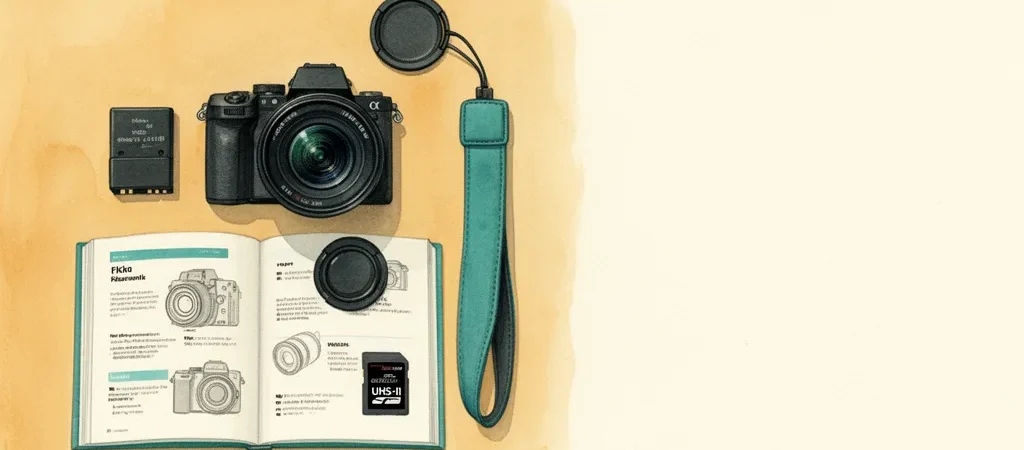
The single biggest mistake shoppers make with mirrorless camera gifts is buying the accessory before they know the camera. A filter, a lens, even a lens hood purchased without knowing the recipient’s exact mount is either useless or requires an adapter that costs as much as the gift itself. Canon RF, Sony E-mount, Fujifilm X, and Nikon Z lenses are not interchangeable. That mismatch is the number-one reason photography gifts get returned.
This guide is organized to prevent that. Before you look at a single product card, the ecosystem section below gives you a one-minute decision tree. If you already know which brand the recipient uses — or you’re buying the camera itself — skip straight to the picks. If you’re not sure, read the ecosystem section first. It will save you an awkward return conversation.
The picks here span $599 to $1,199 and cover body-only and kit-lens bundles across all four major APS-C mirrorless systems. Every entry includes a honest skip-if callout so you can match the body to what the beginner actually wants to do with it — stills, video, or both.
Why Brand Ecosystem Changes Everything Before You Buy
Every mirrorless system uses a proprietary lens mount. Buy a Canon RF-mount lens and it will not fit a Sony body. Buy a Sony E-mount lens and it will not fit a Nikon Z body. This is not a firmware problem or a cheap workaround situation — the mounts are physically different shapes with different electronic pin arrangements. The only way to cross systems is through a third-party adapter, which adds cost, bulk, and sometimes degrades autofocus performance.
The practical implication for gift shoppers: once a beginner owns a body, every future lens they buy is locked to that ecosystem. That commitment is not a trap — all four major systems are excellent — but it means the brand choice made at the beginning compounds over years. A $50 filter or a $400 prime bought for the wrong mount is money wasted.
Here is the fastest way to think about the four systems a beginner is likely to encounter:
| Brand | Mount | Best For | Third-Party Lens Availability |
|---|---|---|---|
| Canon | RF / RF-S | Stills-first beginners; guided menus; upgrade path to full-frame | Growing — Sigma and Viltrox have entered RF-S; first-party selection is strong |
| Sony | E-mount | Video-first and hybrid shooters; widest third-party lens ecosystem | Best-in-class — Sigma, Tamron, Viltrox, Tokina all have extensive E-mount catalogs |
| Fujifilm | X-mount | Stills-and-color-craft learners; Film Simulation fans; tactile controls | Moderate — Sigma and Viltrox cover the key primes; telephoto third-party is thin |
| Nikon | Z-mount | Vlog-first beginners; households inheriting Nikon F-mount glass | Limited but improving — Z DX native lens selection is small; F-mount adapter covers the gap |
| OM System | Micro Four Thirds | Outdoor, trail, and weather-variable shooters; lens-rich system for specialists | Excellent — 200+ compatible lenses from Panasonic, Leica, Sigma, and Olympus legacy |
Before you buy anything other than a complete camera kit, confirm which mount the recipient owns. A single text message asking “What camera do you have?” is faster than a return trip to the post office.
How we select these gifts
- Specialty retailers first: We start with what Austin-area specialty camera retailers actually stock — Precision Camera (North Lamar), The Camera Exchange (Burnet Road). These are businesses whose repeat customers are working photographers and serious hobbyists; they do not carry bodies they would not recommend. When a model is not stocked locally, we cross-check against B&H Photo and Adorama’s curated beginner sections.
- Community consensus: We cross-reference retailer inventory against what beginners are actually recommending to each other in r/mirrorlesscameras, r/SonyAlpha, r/fujifilm, and the Fujifilm Rumors forum beginner threads. Bodies that appear in both signals — retailer stock and forum consensus — receive the most weight.
- Stage fit for adult beginners: Adult beginners transitioning from a smartphone or point-and-shoot need a tightened feedback loop: autofocus that forgives missed manual focus attempts, in-camera JPEGs good enough to skip post-processing in the first months, and batteries that last a full day’s outing. Gifts that reduce friction beat gifts that add raw capability the beginner is not yet ready to use.
- Budget range: Picks span $599–$1,199, covering the entry tier (kit lens included at under $850), the mid tier ($849–$999), and the premium tier ($1,099–$1,199) — so the guide works whether you’re spending $600 or $1,200.
- Skip-this guidance: Where a popular body is wrong for a specific beginner’s goals — vlogger vs. stills shooter, outdoor vs. indoor — we say so and explain why, rather than hedging.
If You’re Buying the Camera Itself: Body, Kit Lens, or Fast Prime?
Most beginners start with a kit lens bundle — a body paired with an 18-45mm or 16-50mm zoom — and this is a reasonable entry point. The kit zoom covers the range a new shooter will actually use (casual portraits, street, travel), and it costs significantly less than buying body and lens separately. The tradeoff is optical quality: kit zooms are built to a price point, with variable apertures that shrink as you zoom in, limiting low-light performance.
The single most transformative upgrade a beginner can make — and the safest second gift if someone already owns a body — is a fast prime lens in the 35mm or 50mm equivalent focal length. A 35mm f/1.8 or 50mm f/1.8 does one thing that the kit zoom cannot: it makes the relationship between aperture and background blur immediately visible at an affordable price. When a beginner opens the aperture to f/1.8 and watches a background go soft behind a sharp subject, aperture stops being an abstract concept in a manual and becomes a controllable tool. That is a gear-enabled learning moment no camera body spec can replicate.
For every ecosystem represented in this guide, a fast prime equivalent exists under $300: the Canon RF 50mm f/1.8 at around $200, Sony E 50mm f/1.8 OSS at around $250, Fujifilm XC 35mm f/2 at $200, and the Nikon Z 40mm f/2 at $280. If you’re buying the camera as a gift, note which kit it comes with. If the recipient already has the kit zoom, a fast prime in their mount is a more educational second gift than a filter, a bag, or additional accessories.
Body-only purchases make sense in one specific scenario: when the recipient already has a specific lens in mind, or when they are upgrading from a prior body in the same ecosystem and already own glass. For first-time mirrorless buyers, the kit bundle is almost always the better value — the kit lens is not a lens they will regret buying.
Our Mirrorless Camera Gift Picks for Adult Beginners
Seven picks across four ecosystems, from $599 to $1,199. Each entry notes the mount and whether it ships with a lens — the two facts a gift shopper needs before clicking anything else.
Entry tier ($599–$799): the Canon EOS R100 with 18-45mm Kit, the Nikon Z30 with 16-50mm Kit, and the Sony A6400 body. Mid tier ($849–$999): the Canon EOS R50 with 18-45mm Kit and the Fujifilm X-T30 III body. Premium tier ($1,099–$1,199): the Sony ZV-E10 II with 16-50mm Kit and the OM System OM-5 Mark II body.

Canon EOS R100 with 18-45mm Lens Kit
The R100 is the cheapest door into Canon’s RF ecosystem — and that ecosystem argument matters more than the body spec at this price. Precision Camera Austin stocks it at $599 with the kit lens, and it sits at the top of Amazon’s beginner camera bestseller chart. Dual Pixel CMOS AF gives reliable subject tracking that DSLRs at this price simply cannot match. Canon’s Guided UI strips the menu down to decisions a first-time shooter can actually make sense of, which removes the paralysis that causes beginners to leave the dial on Auto and never learn. The fixed rear screen and simplified menu are genuine tradeoffs — but for a beginner whose goal is to shoot stills and learn the manual controls, they are not deal-breakers.
- Cheapest entry into Canon RF — every lens bought now works on every future Canon mirrorless body
- Dual Pixel CMOS AF delivers subject tracking that DSLRs at this price cannot approach
- Ultra-compact build encourages daily carry without commitment fatigue
- Fixed, non-touch rear screen limits selfie and vlog shooting angles
- 4K video uses a 1.5x crop, making wide-angle vlogging impractical without an ultra-wide lens add-on

Canon EOS R50 with 18-45mm Lens Kit
Stocked at Precision Camera Austin and consistently cited as the correct step-up when a beginner wants a viewfinder. The electronic viewfinder changes how beginners learn exposure: looking through the EVF, you see real-time histogram and brightness shift as you turn the exposure dial, which makes exposure compensation tangible rather than conceptual. The Dual Pixel AF II with 651-zone subject tracking is class-leading for stills at this price. The fully articulating touchscreen handles every shooting angle without needing a gimbal for basic vlogging. The $250 jump from the R100 buys the EVF, the articulating screen, and meaningfully better AF — for a stills-first gift buyer, it is a justified spend.
- EVF with 2.36M dot resolution shows real-time exposure preview — adult beginners learn faster with live histograms in-eye
- Dual Pixel AF II with 651 zones and subject detection gives professional-grade tracking in an entry body
- Fully articulating vari-angle touchscreen handles overhead, low-angle, and selfie positions without a gimbal
- RF-S third-party lens selection is still limited versus Sony E-mount; Sigma and Viltrox options are just beginning to arrive
- Battery rated at 370 shots per charge — a spare battery is a near-mandatory accessory for any day-long shoot

Nikon Z30 with 16-50mm Lens Kit
The Z30 is a deliberate design: Nikon removed the viewfinder to keep the body under 400g and the price under $800 with lens. That tradeoff makes sense for vloggers who compose on screen. The built-in stereo mic with three capsules and configurable wind filtering is genuinely better than what ships in competing bodies — beginners who record voice narration or ambient sound will notice the difference immediately. The Z-mount’s most persuasive beginner argument is the Nikon FTZ II adapter: it opens the entire Nikon F-mount DSLR lens library, which means a beginner who inherits old Nikon glass from a family member can use it on the Z30 with full autofocus on most modern F-mount lenses. Uncropped 4K/30p and 125-minute continuous recording cement this as the vlog-first pick in the entry tier.
- Uncropped 4K/30p and 125-minute continuous recording in a body under 400g
- Built-in 3-capsule stereo mic with wind filter sounds meaningfully better than competitors at this price
- FTZ II adapter opens the full Nikon F-mount library — inherited DSLR glass works immediately
- No electronic viewfinder — outdoor shooting in bright sun requires shading the rear screen or switching to the Canon/Sony alternatives
- Only three native Z DX lenses exist; third-party Z-mount APS-C selection lags behind Sony E-mount significantly

Fujifilm X-T30 III (Body Only)
Released November 2025, the X-T30 III is a meaningful step forward from the X-T30 II: the X-Processor 5 brings 6.2K internal video, two new Film Simulations (Reala Ace and Negative Film Base), and improved subject-detection autofocus. Fujifilm’s 20 Film Simulations are the defining reason this body keeps surfacing in beginner forums — a recurring pick across r/fujifilm and the Fujifilm Rumors community threads. They produce final-quality JPEGs in-camera, which means a beginner can hand results directly to friends and family without opening Lightroom. The tactile control layout — dedicated shutter speed dial, ISO dial, and exposure compensation dial — makes exposure theory learnable without navigating menus. This is the gift for a beginner who wants to understand photography as craft, not just capture.
- 20 Film Simulations produce final-quality JPEGs in-camera — beginners can skip post-processing entirely in early months
- X-Processor 5 enables 6.2K/30p internal video and subject-detection AF with meaningful improvement over the prior generation
- Dedicated shutter speed, ISO, and exposure compensation dials make exposure learning tactile without menu diving
- No in-body image stabilization — kit lens OIS helps for stills, but handheld video without IBIS requires electronic stabilization or a gimbal
- X-mount budget telephoto options are limited; for portrait and street work the lens ecosystem is plentiful, but reach requires spending more

Sony A6400 (Body Only)
The sleeper pick in this guide: a 2019 camera that still sets the autofocus benchmark for beginner stills shooters in 2026. Real-Time Eye AF with 425 phase-detection points delivers tracking accuracy that cameras in this price band genuinely cannot match — portrait beginners get professional locking performance without learning manual focus point selection. Stocked at The Camera Exchange on Burnet Road in Austin, which carries it for the same reason working photographers recommend it: the AF is simply reliable in a way that competitors at this price are not. E-mount’s third-party lens ecosystem (Sigma, Tamron, Viltrox) means affordable glass — including primes under $200 — is available the day the beginner unboxes the camera.
- Real-Time Eye AF with 425 phase-detection points acquires and holds focus on human subjects in 0.02 seconds — portrait beginners get professional tracking immediately
- 180-degree flip-up touchscreen covers selfie and vlog shooting angles
- 4K/30p uncropped with 11fps continuous RAW — stills-and-video hybrid capability at the entry price
- No in-body image stabilization — a recurring limitation across Sony’s APS-C lineup; handheld video at slow shutter speeds will show camera shake
- Aging 2019 design: menus are less intuitive than Canon’s Guided UI, and battery life at approximately 410 shots per charge is modest for a full day’s outing

Sony ZV-E10 II with 16-50mm Lens Kit
The definitive beginner pick for YouTube and social video creators who want a body they will not outgrow in year one. 4K/120p slow-motion, AI Subject Recognition AF, and a body built around content creator workflow — the vari-angle screen, directional microphone, and Subject Tracking button are all positioned for people shooting themselves, not through a viewfinder. The NP-FZ100 large-format battery rated at 570 shots is the only battery in this guide capable of lasting a full shooting day without a spare. For a beginner who already knows they want to make video, this is the pick that eliminates the “I need to upgrade” conversation six months later.
- 4K/120p slow-motion and uncropped 4K/30p — more video headroom than any other body in this guide under $1,100
- AI Subject Recognition AF handles face, eye, animal, bird, and vehicle tracking simultaneously without user configuration
- NP-FZ100 battery rated at 570 shots — the only body here that reliably lasts a full day’s shooting without a spare
- No in-body image stabilization — same Sony APS-C IBIS gap as the A6400; handheld video stability depends on lens OIS and electronic stabilization
- At $1,099 with kit lens, it’s the most expensive beginner entry here; the Sony A6400 body gives 90% of the stills capability at $350 less
OM System OM-5 Mark II (Body Only)
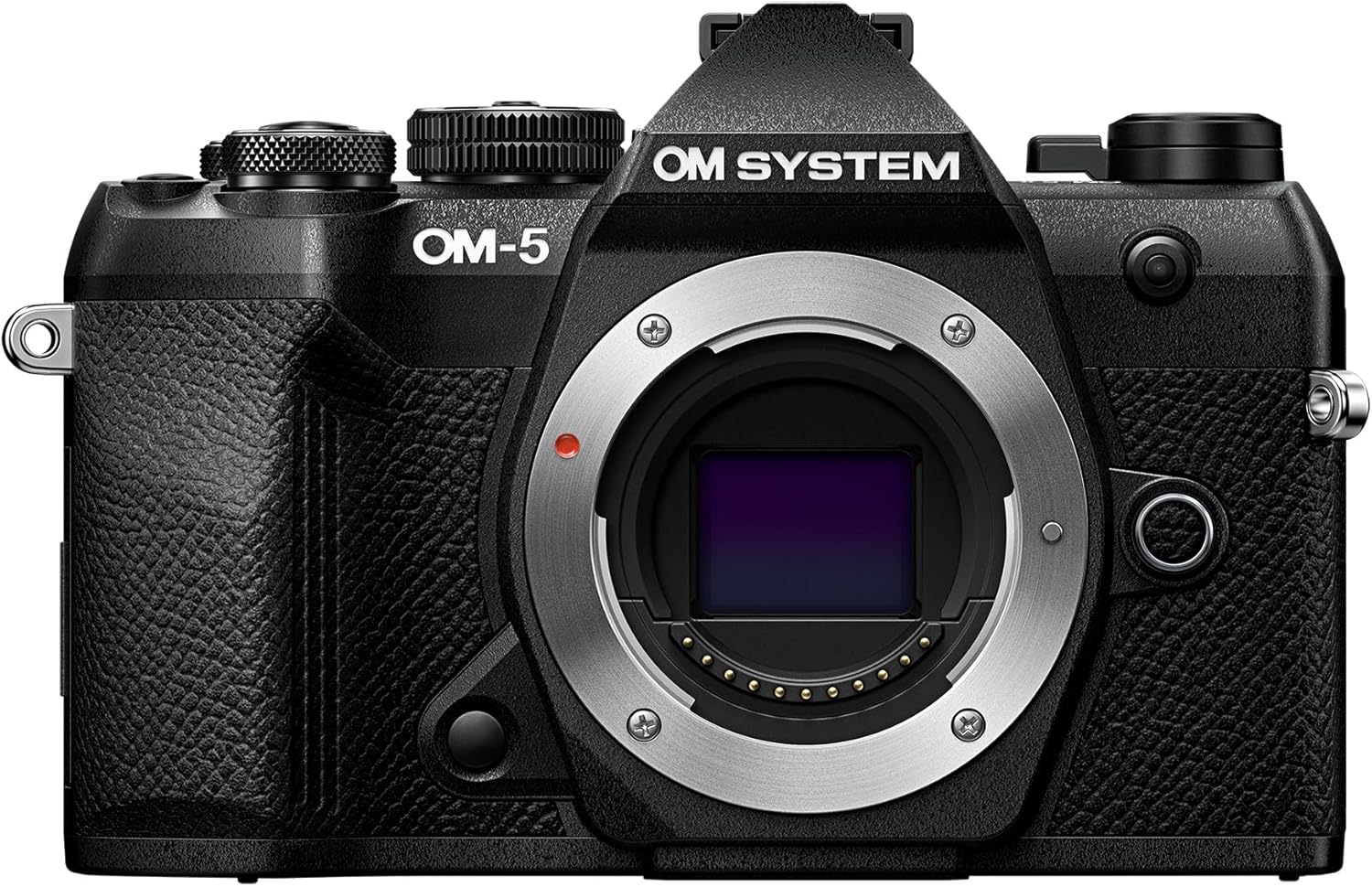
The only body in this guide built for beginners who shoot outside in variable conditions. IP53 dust-and-splash proof rating means it survives rain, dusty trails, and boat spray without a protective case. The 7.5-stop in-body image stabilization is not a marketing figure: handheld shots at 1/4-second are routinely achievable, which means low-light stills without a tripod become a real option rather than a lucky accident. No Sony APS-C body at any price comes close to that stabilization margin. The Micro Four Thirds ecosystem adds an unusual advantage for beginners: 200+ compatible lenses from Panasonic, Leica, and Olympus legacy glass are available immediately, including primes under $200 that outperform what the kit zoom can do.
- 7.5-stop IBIS — class leader; handheld shooting at 1/4-second is routinely achievable, opening low-light stills without a tripod
- IP53 dust-and-splash proof rating lets beginners shoot in rain, on boats, and at dusty outdoor events without hesitation
- Micro Four Thirds system gives access to 200+ compatible lenses from Panasonic and Olympus legacy catalog immediately
- Micro Four Thirds sensor is smaller than APS-C; high-ISO noise above ISO 3200 is more visible than in Canon, Sony, or Nikon APS-C bodies
- Body-only at $1,199 — the most expensive entry here, and requires a separate lens purchase to be usable out of the box
What to skip
Skip filter sets, remote shutter releases, lens hoods, and camera bags until the recipient has shot for at least a month and knows their exact lens diameter and shooting style. These are the most commonly returned photography gifts — not because they are bad products, but because each requires information only the shooter has after using the camera. A circular polarizer needs the correct filter thread diameter, which is printed on the lens barrel your recipient owns. A wireless remote trigger is mount-specific and often requires firmware matching. A camera bag bought before the recipient knows their full kit — one body, one lens, or two lenses and a flash? — is almost always the wrong size. Gimbal stabilizers are the specific product that looks like an accelerator and works like a tax: month-one beginners who receive a gimbal routinely report leaving it in a closet because they have not yet built the muscle memory to operate a camera body, let alone a camera mounted on a 3-axis stabilization rig simultaneously.
The question most gift shoppers arrive at after reading a guide like this is: “What if I get the brand wrong?” The honest answer is that you will not get the brand wrong if you buy a complete kit — body plus lens — from any of the four ecosystems represented here. All four autofocus systems are reliable enough for a beginner to learn on. All four sensor sizes produce files that look excellent on a phone screen and a monitor. The brand decision only becomes consequential after the first lens purchase, and at that point the recipient will know their system and can guide future gifts.
If you are genuinely uncertain whether to buy the camera itself or an accessory, buy the camera. A second battery in the right form factor is a useful follow-up gift for any of the Canon or Sony picks here — both the R50 and A6400 regularly run out of charge before the shooting day ends. Pair that with a 128GB UHS-I SD card and you have covered both of the practical frustrations a beginner shooter will hit in month one.
Whatever body the recipient ends up with, the most accelerating second gift is a fast prime in their mount. That one lens — a 35mm or 50mm equivalent at f/1.8 — teaches aperture, teaches light-reading, and produces a category of images the kit zoom cannot. If they have owned the camera for a month and are still using the kit zoom, that prime is a safe, researched, and genuinely useful upgrade that will not require a return trip.