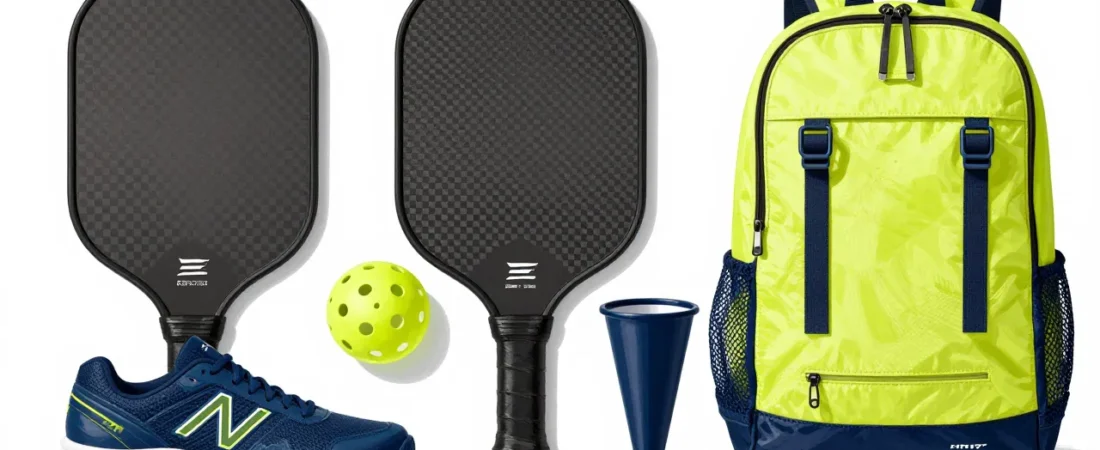
Buying for an intermediate pickleball player is harder than it looks. They already own gear, they have opinions about their paddle, and generic gifts feel condescending to someone putting in 10+ hours a week. The right approach is understanding what a 3.5-4.0 player is actively trying to fix and matching the gift to that gap.
The 3.5-to-4.0 transition is defined by specific development goals: consistent third-shot drops, reliable dink exchanges, smart court positioning. Three categories are genuinely safe for blind purchasing: consumables (balls they burn through constantly), footwear (the single most common equipment blind spot), and bags (built specifically for how pickleball players move between courts). Paddles require a separate conversation.
How we select these gifts
- Specialty retailers first: We start with what major pickleball specialty retailers actually stock — Pickleball Central, Rally, and established club pro shops.
- Community consensus: We cross-reference Pickleheads gear forums, r/pickleball intermediate threads, and the APP/MLP fan communities. Products that appear in both signals get the heaviest weight.
- Stage fit: Every pick is evaluated against the 3.5-to-4.0 development profile: understands kitchen play, can execute third-shot drops with moderate consistency, dinks with a plan, and plays frequently enough to burn through consumables.
Safe Wins: Consumables Every Intermediate Player Burns Through
The Franklin X-40 Outdoor Pickleballs are the Official Ball of the US Open Pickleball Championships and the default recommendation across every major enthusiast community for outdoor intermediate play. One-piece rotationally molded construction holds its shape longer and cracks less frequently than cheaper two-piece competitors. The 12-pack fills a full hopper load at a per-ball cost lower than buying singles at the courts.
Franklin X-40 Outdoor Pickleballs (12-Pack)
Official US Open tournament ball — practice reps transfer to match conditions. One-piece polyethylene construction cracks less frequently than cheaper two-piece balls. The 12-pack covers a full hopper load at the lowest per-ball cost available.
- Official US Open tournament ball — practice translates directly to match conditions
- One-piece construction cracks less frequently; 12-pack provides a full hopper load
- Plays slightly softer than Dura Fast 40; outdoor-only
Court Shoes: The Most Underrated Upgrade at This Level
Players past 3.0 who are still wearing running shoes are leaving lateral stability on the table. The K-Swiss Express Light Pickleball Shoe was built ground-up for pickleball, not repurposed from a tennis mold. The DragGuard 7.0 toe reinforcement handles the dragging kitchen pivot that destroys running shoe toe boxes within weeks at 3-4x/week play. Players who make this switch consistently report it’s one of the most tangible performance changes they’ve made — they only recognized the stability they were losing once it was gone.

K-Swiss Express Light Pickleball Shoe
Designed ground-up for pickleball with DragGuard 7.0 toe reinforcement protecting against kitchen pivot wear. The 180-degree plantar chassis provides lateral stability on every split-step direction change — the movement pattern running shoes actively work against. No break-in period.
- DragGuard reinforced toe protects against kitchen pivot wear
- 180-degree plantar chassis provides lateral stability; no break-in period
- Toe box runs slightly narrow — players with wide feet should size up half a size
The Bag Upgrade

Selkirk Core Team Bag Pickleball Backpack
Built for intermediate players who have accumulated enough gear that a basic backpack isn’t cutting it. The dedicated EVA-padded paddle compartment prevents carbon fiber face contact with court equipment — over time, that contact affects the face texture that generates spin. The fence-hanging clip is the detail that signals designed by pickleball players: at organized public courts, your bag goes on the fence, not the ground.
- EVA-padded paddle compartment protects carbon fiber face from incidental contact damage
- Fence-hanging clip for organized courts; protected laptop sleeve for work-to-courts commuters
- Fence clip reported as undersized by some reviewers; shoulder straps have limited padding when fully loaded
Solo Drill Infrastructure: The Ball Hopper

Tourna Pickleball Deluxe Caddy
Ranked #1 pickleball ball hopper by the enthusiast community. An intermediate player working on third-shot drops and dink consistency needs to feed themselves hundreds of balls per session — this is the infrastructure that makes solo drilling practical. The patented rolling bar pickup system retrieves balls without bending down, keeping drill blocks uninterrupted.
- Patented rolling bar pickup system retrieves balls without breaking posture between drill sets
- Holds 45-50 outdoor pickleballs; polypropylene construction handles outdoor courts
- Assembly instructions could be clearer; 45-ball capacity undersized for multi-player relay drills
Paddle Gifting: When to Try, When to Skip
The honest answer: only buy a paddle blind if you’ve confirmed the exact model. An intermediate player considering an upgrade has already researched weight, core thickness, surface material, and grip size. Three scenarios make a paddle gift defensible.
Buying blind, lowest regret: The Vatic Pro Flash Carbon Fiber 16mm — thermoformed with foam-injected walls at $100, same construction as paddles $60-100 more. Ships with a cover. At $100, the regret ceiling is lower than on any other paddle in this guide.
If they’ve asked for a control upgrade: The Selkirk SLK Halo Control Max — top pick in Pickleheads rankings for the 3.5-4.0 bracket. 16mm Rev-Core Control core tuned for the dink game and third-shot drops.
If they specifically want this model: The JOOLA Ben Johns Hyperion CFS 16mm — most-recommended carbon fiber step-up paddle in the Pickleheads community for this range. Buy this one only when you’ve heard the name come out of their mouth.

Vatic Pro Flash Carbon Fiber 16mm Paddle
The lowest-regret blind paddle pick. Enthusiast communities cite it as the honest answer for a thermoformed paddle under $150 — same T700 raw carbon face and foam-injected wall construction as paddles $60-100 more. Ships with a cover included, removing one accessory cost.
- Thermoformed with foam-injected walls — larger effective sweet spot than non-thermoformed carbon
- Includes paddle cover; strongest budget-tier thermoformed option across all sources at $100
- DTC brand — no retail demo available; slightly elongated 16.2-inch shape may feel unfamiliar

Selkirk SLK Halo Control Max Paddle
Top pick in Pickleheads community rankings for 3.5-4.0 players. 16mm Rev-Core Control core is tuned for the dink game and third-shot drops — exactly the skills this development stage is honing. T700 raw carbon face generates spin comparable to paddles priced $30-80 higher. Buy this when you know they want a control-oriented upgrade.
- 16mm control core produces forgiving feel at the kitchen — genuine upgrade from beginner graphite
- T700 raw carbon face; priced $30-80 below comparable carbon paddles from Joola or CRBN
- Spin ceiling slightly lower than pricier thermoformed paddles — 4.5+ players may outgrow it
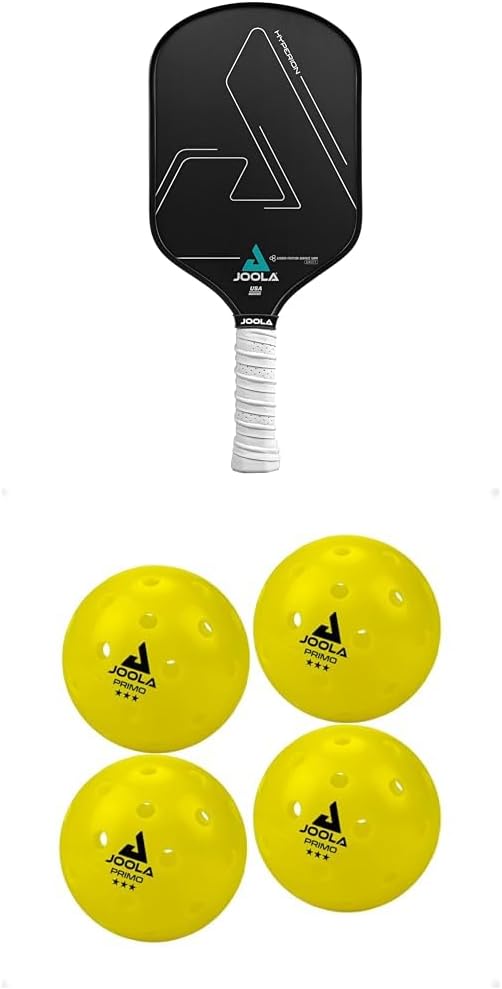
JOOLA Ben Johns Hyperion CFS 16mm Paddle
Most-recommended carbon fiber step-up paddle in the Pickleheads community for the 3.5-4.0 range. Carbon Friction Surface generates spin and touch that beginner paddles cannot replicate. The 16mm core produces the soft kitchen feel that players developing third-shot drops specifically need. The Swift version at 7.9 oz maintains hand speed in kitchen exchanges. Buy this one when you have heard the model name from the recipient directly.
- Carbon Friction Surface provides spin and touch that beginner paddles cannot replicate
- Largest sweet spot in its class; Swift version at 7.9 oz for faster hand battles
- Standard weight runs head-heavy; players not yet consistently dinking may not feel the CFS difference
What to skip
Skip novelty items (branded socks, pickle-themed mugs, decorative paddles) and beginner starter kits — they signal you didn’t research the recipient. Skip blind paddle purchases unless you’ve confirmed the specific model; intermediate players are opinionated about feel, weight, and shape. The Pickleball Central Neoprene Paddle Cover ($9.99) works as a low-cost add-on alongside a paddle gift but is too thin a standalone to feel intentional at this level.
The 3.5-4.0 player is in one of the most interesting stretches of the game — past the beginner learning curve, still finding their ceiling. The gifts that land are the ones built for how they actually train: solo drill sessions, multi-court commutes with two paddles in tow, and kitchen battles where proper footwear and a consistent ball make a measurable difference.
If you’re deciding between the consumables and the shoes: both are useful, but the shoes will be remembered longer. The balls will be gone in a month of hard drilling; the footwear change reshapes how they move on court for years. When in doubt between two options at the same price, lean toward the one that removes a friction point from their existing routine rather than adding something new.