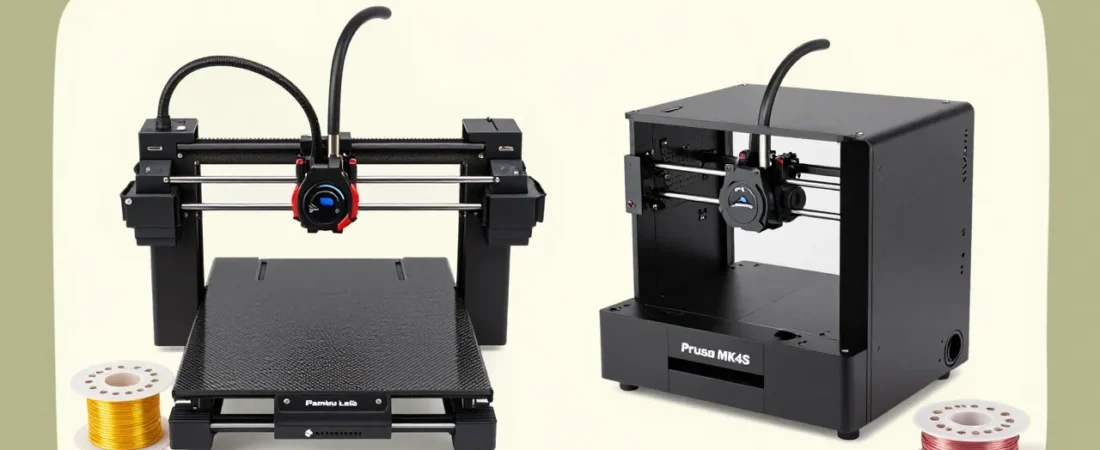
Expert FDM 3D printers print in engineering materials (PC, Nylon, CF composites), sell functional printed parts, modify printer firmware, or use multi-material systems professionally. They’ve outgrown basic PLA and need the machines and materials that handle professional workloads. Micro Center Austin and MatterHackers nationally stock the key picks in this guide.
The Expert Picks

Bambu Lab X1 Carbon Combo (with AMS)
The de facto standard for professional-grade desktop FDM that can run engineering materials without heroic effort. Stocked at Micro Center Austin. Hardened 300°C-rated tool head, enclosed passively-heated chamber, and LIDAR calibration eliminate the babysitting tax that kills productivity on open-frame machines. 600mm/s capable. AMS turns multi-material production workflows into a two-click operation.

Original Prusa MK4S Kit
For the expert who modifies printer firmware, writes custom Klipper macros, or needs a machine where every screw and line of code is auditable. Fully open-source firmware and hardware. Nextruder loadcell sensor for true force-based filament detection. Tom’s Hardware: 5/5 Editor’s Choice. Stocked at MatterHackers nationally.

Micro Swiss All-Metal Hotend Kit (Ender 3/CR-10)
For the expert running an Ender 3 or CR-10 who wants to print carbon-fiber, glass-fill, or abrasive composites. True drop-in replacement — unlocks 300°C operation in under 30 minutes with zero permanent modification. The PTFE-lined hotend is the physical ceiling on engineering material printing; this removes it. Stocked at Micro Center Austin. Made in the USA.

Polymaker PolyMax PC Polycarbonate Filament
The engineering community’s standard-reference polycarbonate for desktop FDM. Prints at a comparatively forgiving 250–270°C while retaining >110°C heat deflection and impact toughness that crushes PLA and PETG. Stocked at MatterHackers. CNC Kitchen’s independent mechanical testing confirmed PolyMax PC as one of the top-performing desktop PCs by static strength.

Polymaker Fiberon PA12-CF10 Nylon Carbon Fiber Filament
The underrated expert pick that the forum community consistently recommends over the more famous PA6-CF. PA12 absorbs roughly 1.5% moisture at equilibrium versus PA6’s 3-5% — parts printed in a real-world shop hold their mechanical properties over time. For experts printing jigs, fixtures, structural brackets, or drone frames. Stocked at MatterHackers.

Bambu Lab Genuine Hotend with Hardened Steel Nozzle (P1S/X1C)
The P1S ships with a stainless steel nozzle — not hardened steel. Any expert printing CF-PLA, PA-CF, GF-PETG, or metal-fill filaments on a P1S will wear that stock nozzle within 2-4 kg of abrasive material. OEM genuine assembly ensures LIDAR and AMS temperature sensing remain calibrated. Tool-change design allows cold-swap in under 5 minutes.
Rigol DHO924S 250MHz 4-Channel Digital Oscilloscope
Expert makers designing custom PCBs or debugging SPI/I2C/UART on custom hardware need a real oscilloscope. In 2025-2026 community consensus has moved from the DS1054Z to the DHO924S: 250MHz bandwidth, 12-bit ADC, IPS touchscreen with pinch-to-zoom, 50Mpt memory depth, and a built-in function generator. HobbyistScope: 9/10, ‘best oscilloscope under $500 in 2026.’
What to skip
Skip gifting a printer without knowing whether the recipient is Bambu-ecosystem or open-source — these are fundamentally different philosophies. Skip generic PLA filament for an expert — they already have it. Skip budget oscilloscopes under $100 for anyone doing serious hardware debugging.