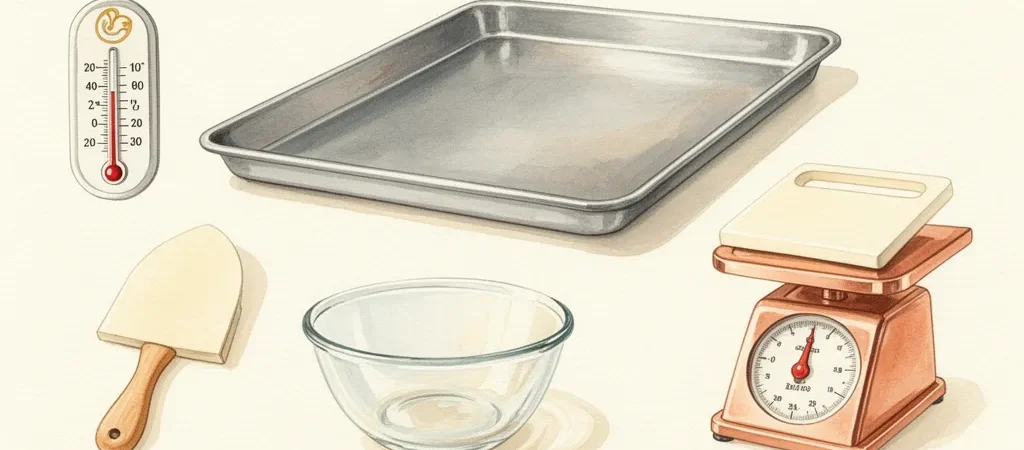
Most baking gift guides treat all bakers as interchangeable. They list KitchenAid stand mixers next to bench scrapers and call it a day, with no acknowledgment that the person who just made their first batch of cookies last weekend has completely different needs than someone on their hundredth loaf. An adult beginner in weeks one through eight faces a specific cluster of failures — flat cookies, sunken cakes, burnt bottoms, gummy centers — and almost none of those failures are about talent.
They are about tools. Specifically, about four gaps that the right $10 or $20 purchase closes permanently: an uncalibrated oven nobody told you about, a way of measuring flour that adds 50 extra grams every single cup, pans that scorch before the center bakes through, and a kitchen setup that makes every step harder than it needs to be. Fix those four gaps, and the next ten baking sessions work. Leave them open, and a beginner concludes they just aren’t a baker.
This guide is organized around those failure modes, not around product categories. Every pick maps directly to a named problem at this specific stage. If you want a low-risk gift under $15, there is one. If you want to hand someone a real foundation for their first year of baking, the full kit is here too.
How we select these gifts
- Specialty retailers first: We start with what Sur La Table Austin actually stocks — their inventory reflects what experienced retail staff have vetted for home bakers at every level. When a product sits on those shelves rather than in a mass-market big-box context, it signals a baseline quality threshold. We cross-check against national specialty retailer carry as a secondary signal.
- Community consensus: We cross-reference retailer inventory against what bakers recommend in their own communities — r/Baking beginner threads, the Sally’s Baking Addiction essentials list, King Arthur Baking’s equipment coverage, and America’s Test Kitchen testing results. Products that show up in both signals get the heaviest weight.
- Stage fit: Adult beginners in weeks one through eight need tools that close the specific gaps causing their actual failures — oven temperature inaccuracy, volumetric flour measurement error, pan hot spots, and missing foundational equipment. We explicitly excluded tools that require more baking experience to use effectively (no stand mixers, no decorating equipment, no specialty molds).
- Budget range: Picks span $10.99 to $55.95 so the guide works whether you’re spending $11 or $56.
- Skip-this guidance: Where a popular pick isn’t right for this specific stage, we say so and explain why — including some of the most-gifted baking products on Amazon.
Why Most Baking Gifts Miss the Mark for Beginners
The assumption buried in almost every baking gift guide is that the recipient’s failures are caused by missing equipment in a category sense — no stand mixer, no silicone mats, no decorating tips. That assumption is wrong for a true beginner, and acting on it leads to gifts that sit in the cabinet.
Adult beginners in their first two months are dealing with something much more basic. They are measuring flour by scooping the cup directly into the bag — a technique that packs the flour and adds 20-50 grams per cup, enough to turn a tender cookie into a dry one. They are setting their oven to 350°F and assuming it is actually 350°F, when most home ovens run 25-50°F off the dial setting. They are baking on whatever thin, dark pan came with a starter set, and that pan is conducting heat unevenly enough to scorch the bottom before the center cooks. These are not skill failures. They are information and equipment failures that have easy, cheap fixes.
The other category error in gift guides is the stage mismatch: gifting a $300 stand mixer to someone who has made three batches of cookies. A stand mixer is a real tool with real value — after the recipient has 20+ bakes under their belt and knows what they are doing. Before that point, it is a pressure object, something that implies a performance level rather than an invitation to practice. A beginner’s kitchen should feel approachable. The right gifts at this stage lower barriers rather than raise the stakes.
What follows is organized around what the first eight weeks of adult baking actually look like, and which specific tools change the outcome.
The Highest-Impact Gifts Under $30
Three tools determine whether a beginner’s results are consistent or erratic, and all three cost less than $50 combined. None of them look impressive. That is the whole point.
The Rubbermaid Commercial Oven Thermometer is the single most high-leverage purchase in this guide. It costs $11, hangs from any oven rack, and immediately tells you whether your oven dial can be trusted. Most cannot. Sally’s Baking Addiction puts it first on her essential tools list, and King Arthur Baking ran a feature specifically on oven calibration for home bakers. The minute a beginner puts this in their oven and sees the actual temperature versus the dial, they stop blaming their recipes and start baking accurately. That mental shift is worth more than any piece of equipment above $50.
The OXO Good Grips Bench Scraper is the tool beginners do not know exists. Serious Eats, Food & Wine, and The Kitchn have all called it the most underrated tool for new bakers, and they are right: it transfers soft cookie dough without smashing it, divides bread dough into equal portions by weight, cleans flour off the counter in one pass, and smooths frosting on cake sides. The fact that it costs $14 makes it easy to include as an add-on to any of the other gifts here.
The Nordic Ware Naturals Baker’s Half Sheet addresses the pan problem directly. Pure aluminum construction without dark coating means heat distributes evenly — no hot corners, no scorched bottoms while the center stays underdone. This is the pan Sur La Table Austin carries as their featured Nordic Ware SKU, and it shows up on virtually every “what to buy first” baker list from Sally’s Baking Addiction to Wirecutter. At $20, it is inexpensive enough to give alongside the thermometer without the gift feeling like a hardware store purchase.
Gift Sets and Standalone Picks in the $17–$56 Range
If the under-$30 trio is the foundation, the picks in this tier build toward a complete setup. They are also viable as standalone gifts for a buyer who wants something with more visible presence — a mixing bowl set or a kitchen scale reads as a “real” gift in a way that an oven thermometer does not, even though the thermometer may actually matter more.
The Pyrex 3-Piece Glass Mixing Bowl Set solves a quiet problem: most beginner bakers are working in opaque plastic bowls that give them no information about what is happening to the dough. Glass lets you see whether butter is fully incorporated, whether your dough has the right hydration, whether that egg white is actually forming stiff peaks. Pyrex’s made-in-USA glass is oven-safe, microwave-safe, dishwasher-safe, and freezer-safe, which removes every restriction beginners might worry about. The three-piece nesting set is $18 — low enough to pair with the thermometer or bench scraper for a sub-$30 total.
The OXO Good Grips 3-Piece Angled Measuring Cup Set fixes a measurement error most beginners do not know they are making. Standard opaque measuring cups require bending to eye level to read the graduation marks accurately; most people eyeball it from above and get a consistently inaccurate pour. The OXO angled interior surface lets you read the measurement looking straight down from a standing position, which is both easier and more accurate. America’s Test Kitchen uses these in their test kitchen, and the set handles every liquid measurement in standard home baking recipes across three cup sizes.
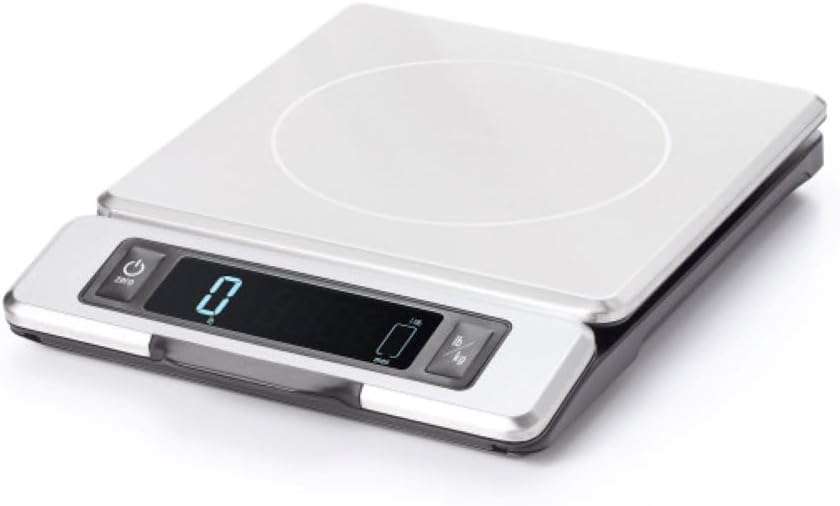
The OXO Good Grips 11-Pound Kitchen Scale is the splurge pick, and it is the right splurge. Switching from volume cups to weight measurement is the single biggest technique upgrade a beginner can make — a cup of all-purpose flour can vary by 50 grams depending on how it is scooped, and in baking that difference lands you somewhere between tender cookies and dry, dense ones. The pull-out display is the feature that earns this scale its place: large bowls no longer block the readout, so there is no guessing and no awkward craning. America’s Test Kitchen has named this their top kitchen scale across multiple testing rounds, and it is what Sur La Table Austin carries.
The Cookbook Angle: Gifts That Teach the Why
No affiliate product here, just an honest observation: a recipe book and a technique book are not the same gift, and for an adult beginner the difference matters significantly.
A recipe collection says “add 2 eggs.” A technique-first book explains what those eggs are doing structurally — why they need to be at room temperature, what happens chemically when they are cold, and how you can tell from the batter whether the emulsification worked. That context is the difference between a beginner who follows recipes and a beginner who understands baking well enough to diagnose their own mistakes. Look for titles with a dedicated fundamentals chapter or explanatory headnotes that go beyond the ingredient list. Sohla El-Waylly’s work, Claire Saffitz’s Dessert Person, and King Arthur’s published guides all lean into the why. Paired with any of the tools in this guide, a technique-first book turns the equipment from objects into a system.
If you are building a bundled gift, the cookbook is the element that signals “I thought about your learning, not just your kitchen.” It does not need to be expensive — a paperback from the library sale shelf works if the content is technique-forward. The tool kit handles the physical gaps; the book handles the knowledge gap.

Rubbermaid Commercial Oven Thermometer
Most home ovens are off by 25–50°F from their dial setting — beginners blame themselves when cakes sink or bread stays pale, but the culprit is often an uncalibrated oven. An oven thermometer costs $11 and tells you immediately if you need to compensate. Sally’s Baking Addiction puts it at the top of her essential tools list; King Arthur Baking ran a 2024 feature specifically on this topic. The Rubbermaid Commercial version has one of the largest review bases in the category (49,000+ reviews) and is NSF-certified, meaning it is built to stay calibrated through continuous commercial-use heat cycles.
- Reveals oven temperature truth immediately — beginners stop blaming recipes and start baking accurately
- NSF-certified for commercial use; stays calibrated through continuous high-heat cycles
- Hangs from oven rack or stands upright; large-print dial reads 60–580°F
- Analog dial only — no digital logging, no alerts; purely passive monitoring
- Needs 15–20 minutes inside a preheating oven to give a stable reading

OXO Good Grips Bench Scraper & Chopper
The bench scraper is the most underrated tool for beginner bakers — and the one they most frequently don’t know exists. It transfers cut cookie dough without smashing it, divides bread dough into equal portions by weight, cleans flour off the counter in one pass, and smooths frosting on cake sides. Stocked at Sur La Table Austin and repeatedly called the “single best tool beginners don’t know they need” across Serious Eats, Food & Wine, and The Kitchn. The OXO’s non-slip rubber handle and built-in measurement guide edges it above competing versions for beginners who are still building their hand-tool confidence.
- Stainless blade with built-in measurement markings — doubles as a ruler for portioning dough into equal pieces
- Non-slip rubber handle stays comfortable with floured hands
- Dishwasher safe; at $14, it costs less than most kitchen tools that get used far less frequently
- Does not replace a pastry cutter for cutting butter into flour — that is a different tool entirely
- Stainless blade has no flex — not suited for scraping curved bowl sides (use a silicone spatula for that)

Nordic Ware Naturals Baker’s Half Sheet
Every baker’s first session ends at a sheet pan, and most beginner failures trace back to thin, dark pans that burn bottoms before centers cook through. Nordic Ware’s pure aluminum construction distributes heat with none of the hot spots that cheap coated pans produce — stocked at Sur La Table Austin as their featured Nordic Ware SKU and cited in virtually every “what to buy first” baker list from Sally’s Baking Addiction to Wirecutter. The encapsulated steel rim prevents warping, so beginners aren’t fighting a bowed pan on their third bake. Made in the USA with a lifetime warranty.
- Pure uncoated aluminum conducts heat evenly — cookies come out with consistent browning edge to edge
- Made in the USA with a lifetime warranty; survives decades without buckling or peeling
- Works with parchment or Silpat mat, giving beginners a nonstick result without a degrading coating
- Uncoated surface requires parchment or a silicone mat for easy release — not a grab-and-go nonstick pan out of the box
- Hand-wash recommended; dishwasher use accelerates dulling of the aluminum over time

Pyrex 3-Piece Glass Mixing Bowl Set
Glass bowls remove two beginner anxieties at once: they are transparent so you can watch gluten development and dough hydration from the side, and they never leach flavors or stain from berries and cocoa. Pyrex made-in-USA glass is freezer-, microwave-, oven-, and dishwasher-safe, which means beginners can pre-measure dry ingredients into a bowl, cover it, and come back later with zero restrictions. At $18 for a three-piece nesting set, this is the most budget-friendly item in the mid-tier and one of the most consistently recommended beginner purchases across baking communities.
- Transparent glass lets beginners see whether butter is fully incorporated and monitor dough texture in real time
- Oven-safe, microwave-safe, dishwasher-safe, and freezer-safe — no temperature restrictions to remember
- Made in the USA; nesting design stores compactly in a single cabinet drawer
- Largest bowl is 2.5 quarts — fine for cookies and cake batter, tight for full batches of bread dough or large meringue
- Glass is heavier than stainless steel alternatives; not ideal for bakers with limited wrist strength

OXO Good Grips 3-Piece Angled Measuring Cup Set
Most adult beginners are still using opaque plastic cups and bending down to check measurements at eye level — and getting inaccurate reads every time. The OXO angled design lets you read the measurement looking straight down from above, eliminating the squat-and-squint routine that leads to consistent liquid mismeasurement. The three-size set covers 1-cup, 2-cup, and 4-cup, handles hot liquids including melted butter, and is made from BPA-free Tritan. America’s Test Kitchen uses these in their test kitchen, and they are stocked through Sur La Table.
- Patented angled interior surface — read measurements from above, no bending required, no parallax error
- BPA-free Tritan plastic is heat-safe to 212°F; handles hot liquids like melted butter without deforming
- Three sizes cover virtually every liquid measurement called for in home baking recipes
- Liquid measuring cups only — does not replace dry measuring cups for flour and sugar (though a scale makes both sets optional anyway)
- Plastic shows wear and scratching over years of heavy use, unlike glass alternatives
OXO Good Grips 11-Pound Kitchen Scale
Switching from volume cups to weight measurement is the single biggest technique upgrade an adult beginner can make — a cup of all-purpose flour can vary by 50 grams depending on scooping technique, and in baking that variance produces results that range from perfect to dry and dense with no obvious explanation. The pull-out display is the feature that earns this scale its position: large mixing bowls no longer block the readout, so there is no guessing. America’s Test Kitchen has named this their top kitchen scale across multiple testing rounds, and it is the OXO line Sur La Table Austin carries.
- Pull-out display solves the universal beginner problem of a large bowl blocking the readout screen
- Measures in grams, ounces, pounds, and kilograms; tares between ingredients without resetting
- Removable stainless steel platform wipes clean in seconds
- At $56, it is the priciest item in a starter kit — though it replaces the need for multiple measuring cup sets
- Requires 4 AAA batteries; no rechargeable or USB option
What to skip
Stand mixers are the most common stage-mismatch gift for beginner bakers: a hand mixer handles every recipe in the first year, and a $300 stand mixer sitting on the counter can feel like a pressure to perform rather than an invitation to explore. Silicone bakeware is another well-intentioned miss — its poor heat conduction produces pale, soft bottoms, and beginners will blame themselves rather than the pan. Oversized decorating kits add complexity before the fundamentals are solid; piped rosettes require a baker who can already produce a reliably flat, level cake worth decorating. All three of these are good gifts for someone 20+ bakes into the hobby. They are the wrong gift for month one.
The stage-first principle comes back to one question: will this gift make the recipient’s next ten baking sessions work better, or will it complicate them? The $11 oven thermometer that reveals a 35-degree calibration gap will be remembered far longer than a $300 appliance that got used twice. An adult beginner building a baking habit needs confidence in their results before they need more equipment options.
If you are spending one gift on one person and you want the lowest-risk, highest-signal move: the oven thermometer. It will immediately change how they understand their kitchen. If you want to give them a real foundation, combine it with the Nordic Ware half sheet and the bench scraper — three gifts under $45 that together close the most common failure modes in beginner baking.
If they are still in the exploratory phase and you are not sure the hobby has taken hold yet, start with the under-$15 picks. If they have made the same recipe three times and are clearly going to keep baking, the kitchen scale is the upgrade worth making. A gift that meets a baker at their actual stage signals that you paid attention — and that is a harder thing to give than any stand mixer.