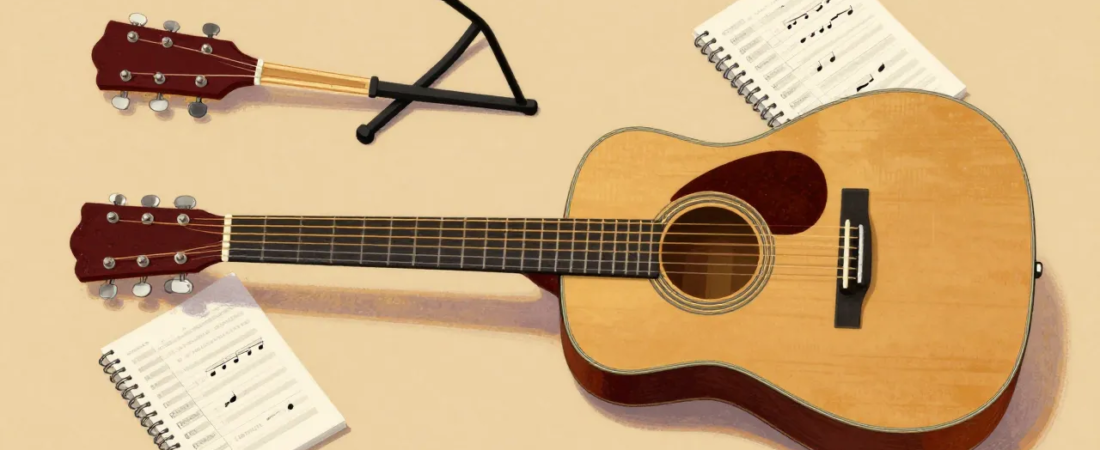
Most adult beginners quit guitar inside the first 90 days. The reasons are predictable and physical: fingertips that hurt, a guitar that won’t stay in tune, an action so high the F chord feels impossible, a body too big to play comfortably on the couch. Almost every quit story traces back to friction the gift-giver could have removed.
This guide is built around that reality. The picks below were filtered through three questions: does it survive a year of beginner use, does it remove a documented quit-trigger, and does an adult — not a 12-year-old — actually want to keep it on the stand. Solid-top guitars only. No starter bundles padded with junk. No “complete kit” math that hides a $79 guitar inside a $199 box.
If you’re shopping for a friend, partner, or parent who said “I want to learn guitar this year,” what follows is the short list that gives them the best odds of still playing on day 91.
How we select these gifts
- Specialty retailers first: We start with what Austin-area specialty retailers actually stock — Strait Music Austin in particular, which has been outfitting working musicians since 1963.
- Community consensus: We cross-reference retailer inventory against what guitarists recommend in their own communities — r/guitar’s recurring “first acoustic under $300” threads, the AcousticGuitarForum beginners section, and JustinGuitar’s gear discussions.
- Age and stage fit: Adult beginners need a full-scale neck (no 3/4 sizes), a nut wide enough for adult fingers to fret cleanly, and a body shape that’s comfortable for the 20 minutes after dinner — not the two hours a teenager has on a Saturday.
- Budget range: Picks span $13 to $549 so the guide works whether you’re spending stocking-stuffer money or anchoring a 50th birthday gift.
- Skip-this guidance: Where a popular pick — a big-box bundle, a 3/4 travel guitar, a beginner “learning kit” — isn’t right for an adult learner, we say so and explain why.
Best Acoustic Guitars for Adult Beginners Under $300
The single biggest gear decision is the guitar itself, and the rule for adult beginners is simple: solid top or don’t bother. A laminate-top guitar sounds the same on day one as it does on day 365. A solid spruce or cedar top opens up over months of play, which means your gift literally rewards the recipient for sticking with it. That feedback loop matters more than any feature spec.
The Yamaha FG800 is the default recommendation in nearly every r/guitar beginner thread for a reason. Yamaha’s QC at the $200–$230 tier is genuinely better than its competitors — guitars arrive playable out of the box more often than not, with relatively low action and accurate intonation. The scalloped bracing produces real dreadnought volume, which matters when the recipient inevitably wants to play loudly enough to feel something.
The Fender CD-60S is the sibling pick. It costs roughly the same and competes feature-for-feature, but adds two things the Yamaha doesn’t: rolled fretboard edges (the neck feels broken-in from day one, which adult hands appreciate) and Fender’s 2-year warranty. The tradeoff is wider QC variance — about one in five ships needing a basic setup. If the recipient knows a local guitar tech or you’re buying in person, lean Fender. If you’re shipping sight-unseen, lean Yamaha.
Below the $200 line, quit rate spikes. Guitars at $99–$149 ship with action so high that barre chords are physically discouraging, and the gap between “instrument” and “plywood with strings” gets wide. The $200–$300 zone is where solid-top construction, decent factory setup, and adult-credible build quality meet.
Step-Up Acoustic Guitars Under $600
If your budget runs higher — a milestone birthday, a serious “I’m finally doing this” gift — the step-up tier solves a different problem: the guitar your recipient won’t outgrow in two years.
The Taylor GS Mini is the most-recommended couch guitar in this price band, and Strait Music Austin keeps it on the floor for a reason. The body is smaller than a dreadnought but bigger than a parlor, which means it stays comfortable for the average adult’s actual practice posture without sounding like a kid’s guitar. Taylor’s neck geometry is the quiet superpower here — chord transitions are noticeably cleaner than on the entry-level dreadnoughts. And if the recipient quits, the GS Mini holds resale value better than almost anything else in the category. Reverb floor on a clean used GS Mini Sapele sits around $300.
The Seagull S6 Original is the underdog pick the forums love. It’s hand-built in La Patrie, Quebec, with a solid cedar top and wild cherry back and sides — a softer, warmer voice than the spruce dreadnoughts above. The 1.8″ nut is meaningfully wider than a standard dreadnought’s 1.69″, which gives adult fingers room to fret cleanly without muting adjacent strings. That single millimeter is the difference between a beginner thinking “I can’t fret this” and “I just need to practice this.”
Five Accessories That Actually Get Used
Most “beginner accessory bundles” are theater. A bag of 50 picks no beginner will ever use, a strap that won’t fit a body without strap pins, a tuner that drifts. The accessories below are ranked by how often they get used per practice session, and each one neutralizes a specific reason adult beginners stop showing up.
Top of the list, by a wide margin: a guitar stand. The On-Stage XCG-4 is the single biggest predictor of whether an adult beginner practices regularly. A guitar in a case in a closet gets played roughly once a week. A guitar on a stand in the living room gets played five-plus times a week — because picking it up takes one second instead of ninety. This is the gift you give if you only buy one accessory.
Second-most-used: a clip-on tuner. The D’Addario NS Micro is the right call because it disappears behind the headstock — beginners are self-conscious about their guitars looking like a beginner’s guitar, and a Snark on the front telegraphs “I just started.” The piezo vibration sensor works in noisy rooms.
Third: a one-handed capo. The Kyser Quick-Change is hand-built in Canton, Texas, and the spring-clamp action is exactly what a beginner with a small chord vocabulary needs — they’ll be moving the capo around constantly to play songs in their voice’s key, and a one-handed clamp means they actually do it instead of giving up on a song that “doesn’t work.”
Learning Resources Worth Gifting
JustinGuitar is free, structured, and genuinely excellent. So is the YouTube ecosystem around Marty Music, Andy Guitar, and Paul Davids. The honest answer is that an adult beginner with a working internet connection has more high-quality instruction available than any guitarist in history, at zero cost.
So why gift a book? Because adult learners overwhelmingly report better long-term progress when they pair video instruction with one structured paper resource that forces basic note-reading. Video teaches you to mimic; notation teaches you to understand. The Hal Leonard Guitar Method (Complete, Books 1-3) is the reference standard for that paper anchor. The spiral-bound complete edition combines the three method books, includes online audio with a PLAYBACK+ player that lets the learner slow tracks down without changing pitch, and forces actual notation reading from page one.
Build-Your-Own Bundle vs Big-Box Starter Pack
Here’s the math that big-box marketing hides. A typical $199 “complete starter pack” includes a laminate-top guitar (usually $89 standalone), a tuner that drifts after a month, a strap that won’t fit without modification, a bag of picks in random gauges, and a gig bag with foam thinner than a yoga mat. The guitar is the only piece you’re paying for; the rest is theater.
Build it yourself for ~$280 and you get: the FG800 ($229) + NS Micro tuner ($13) + XCG-4 stand ($17) + Kyser capo ($22). Every single piece works, every single piece survives a year, and the guitar alone is worth more than the entire bundle on the other side of the comparison. The $80 difference buys roughly two years of frustration removed. That’s the right trade.

Yamaha FG800 Solid-Top Dreadnought
The default “first real acoustic” for adult beginners — solid spruce top, full dreadnought body, and Yamaha’s QC at the $200 tier is uncontested. Recurring pick in r/guitar beginner threads.
- Solid spruce top means tone actually opens up over months of play
- Scalloped bracing produces real dreadnought volume and bass response
- Yamaha factory setup is consistently better than Fender’s at this price
- Stock satin finish and basic appointments — looks plain

Fender CD-60S Solid-Top Dreadnought
Direct alternative to the FG800 — choose this for rolled fingerboard edges Yamaha doesn’t offer at this tier. Adult hands appreciate the broken-in feel.
- Rolled fretboard edges feel broken-in from day one
- Solid spruce top + mahogany back/sides give a slightly warmer voice
- 2-year Fender warranty included
- Factory setup is more variable than Yamaha — about 1 in 5 ships needing a truss-rod tweak

Seagull S6 Original (Made in Canada)
Forum-favorite underdog. Solid cedar top, wild cherry back/sides, hand-built in Quebec. The 1.8″ nut gives adult fingers room to fret cleanly.
- Cedar top voices fingerstyle and softer strumming beautifully
- Slightly wider 1.8″ nut accommodates adult fingers fretting cleanly
- North American build quality at a Pacific-rim price point
- Headstock shape is polarizing

Taylor GS Mini Sapele
Premium pick. Confirmed at Strait Music Austin. Compact body solves the comfort problem without dropping into kid-guitar territory.
- Solid Sitka spruce top with Taylor’s neck geometry — cleaner chord transitions
- Smaller-than-dreadnought body sits comfortably for couch practice
- Holds resale value — recovers $300+ on Reverb
- At $549 it’s the budget ceiling for this niche

D’Addario NS Micro Clip-On Tuner
Behind-the-headstock profile so it stays clipped on permanently. Recommended in nearly every “beginner essentials” Reddit thread.
- Hides behind the headstock — guitar still looks like a guitar
- Piezo vibration sensing works in noisy rooms
- Small enough to leave clipped on permanently
- Smaller display than the Snark SN-5X

On-Stage XCG-4 Classic Guitar Stand
Single most important accessory for adult beginner adherence: a guitar on a stand in the living room gets played 5x more than one in a case.
- Padded yoke and arms protect nitro and poly finishes
- Folds flat for travel or storage
- Adjustable height fits dreadnought, GS Mini, or classical equally
- Tripod base footprint is wider than wall-hangers
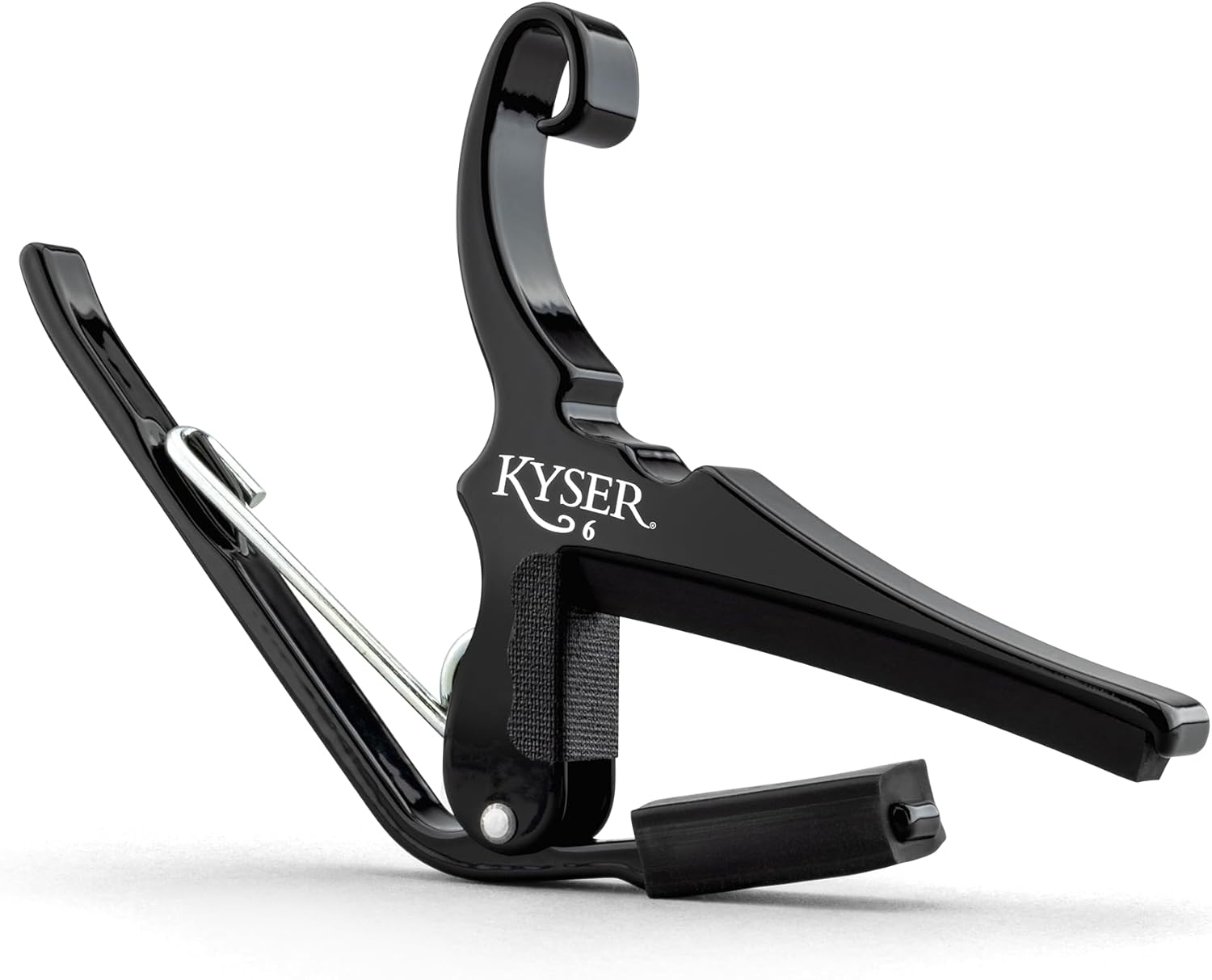
Kyser Quick-Change Capo (Made in Texas)
One-handed spring clamp is the right capo for a beginner with a small chord vocabulary. Hand-built in Canton, Texas.
- One-handed on/off — survives constant key-shifting
- Stores on the headstock when not in use
- Lifetime guaranteed, made in Texas
- Fixed tension can pull the guitar slightly sharp on lower frets

Hal Leonard Guitar Method (Complete, Books 1-3)
JustinGuitar is great, but adult learners report better progress when they pair YouTube/app instruction with one structured paper book that forces basic note-reading.
- Spiral-bound complete edition of Books 1-3
- Online audio with PLAYBACK+ player lets learners slow tracks down
- Forces actual notation reading
- Notation-first approach is drier than tab-based methods
What to skip
Skip the cheap dreadnought starter bundles from big-box retailers. The included tuner is inaccurate, the strap won’t fit a guitar without strap pins, the picks are random gauges nobody asked for, and — most importantly — the guitar’s action is too high to make F-chord attempts comfortable. Also skip 3/4-size travel guitars unless the recipient has explicitly small hands; for most adults, a 3/4 feels like playing a toy and gets shelved within weeks.
The right adult-beginner gift respects three things: limited practice time, adult-sized hands, and an adult ego that bruises when chords sound bad. A well-chosen $250 guitar that lives on a stand in the living room beats a $500 guitar collecting dust in a closet, every time.
The honest truth about gifting an instrument is that you’re not really giving them a guitar — you’re giving them permission to start, and removing the friction that would otherwise make them stop. Every choice above is a brick removed from that wall.