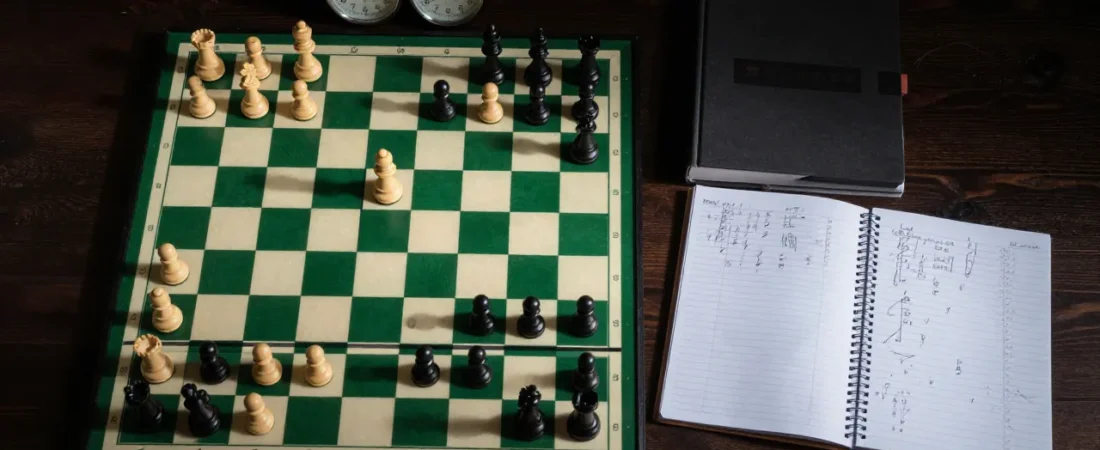
The gift-giver’s instinct is to buy something that looks impressive — a handsome wooden set with weighted pieces and an inlaid board. The problem: the person who is trying to get better at chess almost certainly already has a board. What they are missing is a clock, a tactics workbook, and the muscle memory of writing down their moves.
This guide is built around that distinction. One gift says “you look like a chess player.” The other says “I want you to actually become one.” Every pick here is scoped to year one of serious improvement — the player who knows the rules, has been playing online or casually with friends, sits somewhere around 400–1000 Elo on Chess.com, and is ready to study the game rather than just play it.
The recipient in question is not a collector. They are a competitor in training. What they need is regulation gear they can take to club night, books that explain the reasoning behind moves rather than just listing them, and the habits — notation, timed play — that separate players who improve from players who stagnate.
How we select these gifts
- Specialty retailers and club programs first: We start with what actual club programs stock and specify — in this case, the USCF (United States Chess Federation) equipment standards and what Austin Chess Club tournament directors recommend players bring to rated events. Organizations whose credibility depends on fair, regulation play don’t recommend equipment that underperforms.
- Community consensus: We cross-reference official recommendations against what experienced players recommend in their own communities — primarily r/chess, the chess.com improvement forums, and the chess.com “what should I buy” threads that surface repeatedly. Products that appear in both signals get the heaviest weight.
- Stage fit: All picks are calibrated to year one of serious improvement — roughly 400–1000 Elo, playing or planning to play over-the-board club chess. We explicitly exclude decorative sets, novelty sets, and gear that only makes sense at a later stage. The criterion for every pick: does this help the recipient actually get better?
- Budget range: Picks span $9.99 to $59.95, so the guide works whether you are spending $20 or $60. The full kit — set, clock, scorebook, bag, and two books — runs under $186 total.
- Skip-this guidance: Where a popular gift category is wrong for this specific stage, we say so and explain why. “Looks good” is not a selection criterion here.
Why Most Chess Gifts Miss the Point
Walk into any gift shop with a chess section and you will find the same thing: ornate wooden boards with deeply carved squares, pieces so heavy they feel substantial in the hand, and a price tag that makes the whole thing feel precious. These sets photograph beautifully. They are also exactly wrong for someone trying to improve.
The recipient this guide is written for — someone sitting around 400–1000 Elo, playing online, thinking about joining a club — does not need a set they are afraid to use. They need a set they can throw in a bag and bring to the Austin Chess Club on a Tuesday night. Club veterans there show up with roll-up vinyl boards and plastic tournament pieces. A beginner who walks in with regulation gear belongs immediately. A beginner who walks in with a handsome wooden board with non-regulation square sizes is already dealing with a disadvantage they did not know they had.
Non-regulation sizing is not a minor issue. USCF and FIDE both specify piece and square dimensions for a reason — a 3.75-inch king on 2.25-inch squares is the standard because those proportions allow fast, confident piece placement during timed play. Decorative sets routinely deviate from these specs, which means the player is learning spatial habits that transfer poorly to every rated game they ever play.
The gift that actually serves this recipient is unglamorous and specific: a USCF-spec set, an increment-capable clock, a tactics workbook, and the habit infrastructure to record games. None of it makes a great photo. All of it makes a better chess player.
The Three Things a Serious Beginner Is Actually Missing
Most beginners who have been playing online for any length of time have absorbed the rules and a rough intuition for piece value. What they have not developed — because online chess handles it automatically — is any feel for the clock. The first time they sit across from a physical clock in a club game, they are managing a dimension of chess they have never practiced. That cognitive load is a genuine performance drain.
The DGT North American Clock (2024) is the clock the Austin Chess Club 2025 Summer Open recommends bringing — it supports both delay and increment time controls, which are required for USCF-rated games. The cheaper DGT 1001, which shows up in a lot of gift guides, does not support increment. It is not legal for USCF-rated play. This is not a minor caveat; it determines whether the clock is actually usable at club events or not.
The second gap is tactical pattern recognition. Below 1200 Elo, the dominant variable in game outcomes is not opening theory or endgame technique — it is whether you see the fork before your opponent does. This is the near-universal consensus in r/chess improvement threads and among coaches working with club-level beginners. The leverage from a solid tactics workbook at this stage is outsized compared to any other study material. The key distinction is a workbook that teaches the pattern before drilling it, rather than raw puzzle apps where the learner just guesses until correct.
The third gap is equipment. Most beginners cobble together whatever is available — a travel set from a department store, a board that lives in a closet. The USCF Triple-Weighted Tournament Set solves this with a single purchase: regulation-spec pieces, a roll-up vinyl board, and 34 pieces including the spare queens you will need for pawn promotion. It is exactly what you see at every USCF club event and scholastic tournament.
Books That Change How Beginners Think About the Game
There are two ways to improve your chess understanding through books. The first is structured instruction — chapters on tactics, chapters on openings, chapters on endgames. The second is annotated games — watching strong players think their way through complete games with full explanations. Both approaches work. They work on different parts of the brain, and the best study diet for a year-one player includes both.
Logical Chess: Move By Move is the most consistently cited game-collection book for beginners across r/chess and chess.com threads, and the reason is specific: Chernev annotates every single move of 33 complete games in plain language. No gaps. No moments where a beginner is left to infer why a move was played. Other game collections explain the key moves and leave the rest as exercise for the reader; at the beginner stage, that exercise is usually just confusion. The algebraic edition uses modern notation, which matters because older printings use descriptive notation that nobody teaches anymore.
How to Win at Chess by Levy Rozman covers the other approach: structured instruction across openings, tactics, and strategy in a single volume, organized around the 0–800 and 800–1300 Elo bands. Rozman’s YouTube presence as GothamChess (4M+ subscribers) means a large portion of adult beginners in 2024–2025 already know his teaching voice — the book feels like a continuation of content they have already found useful, which lowers the friction of actually sitting down and reading it. The 4.8 Amazon rating across over 3,400 reviews reflects genuine instruction rather than hype.
As companion books, these two cover the full ground: Rozman for structural framework and opening orientation, Chernev for depth of reasoning through real games. A beginner who works through both will think about positions differently than one who only grinds puzzles.
The Gear That Makes You a Club Player
Showing up to a club night with a regulation set and a clock is the visible part of belonging. The less visible part — the habit that actually produces improvement — is recording your games. You cannot analyze your mistakes without a game record. You cannot submit a game to a coach for review. You cannot look back six months later and see how your decision-making has changed. At USCF-rated events, notation is not optional: both players are required to keep score.
The WE Games Chess Scorebook is the standard notation pad at club and scholastic events. The hardcover construction is the distinguishing feature — spiral-bound pads fall apart inside tournament bags within a few months, and the last thing a beginner needs during a rated game is a notation pad that has shed its pages. The pre-formatted move grids keep notation fast during timed play. One hundred games covers roughly six months of weekly club attendance.
The practical companion to the regulation set is a proper WE Games Tournament Chess Bag. A vinyl roll-up board has one serious vulnerability: if stored folded rather than rolled, it develops a permanent crease at the center that makes the board uneven. This sounds minor until you are trying to play a timed game on a board that rocks. The cylindrical main compartment keeps the board in tube form, and the secondary pockets fit a clock and scorebook alongside the pieces. Everything for a club night in one lightweight carry.

USCF Triple-Weighted Tournament Set
This is the exact kit — triple-weighted 3.75-inch Staunton pieces on a roll-up vinyl board with 2.25-inch squares — that USCF-rated club events and school programs use. Every Austin Chess Club tournament player will recognize these pieces on sight, which matters for a beginner learning to feel comfortable at the board. House of Staunton produces these to USCF and FIDE specification, and the set is the perennial first recommendation in r/chess “what set should I buy” threads. The 34-piece count includes two spare queens for pawn promotion, which beginners encounter more often than they expect.
- Triple-weighted bases give pieces the heft and stability of sets used at rated tournaments — no tipping on slight bumps, which builds confidence during timed play
- Includes 34 pieces (two spare queens for pawn promotion) and the standard 20-inch vinyl board — everything needed for USCF-legal rated club games right out of the box
- The roll-up vinyl board can develop a center crease if stored folded rather than rolled — always store it in tube form, ideally in the WE Games bag (pick #7)

DGT North American Clock (2024)
The Austin Chess Club 2025 Summer Open explicitly recommends bringing an increment-capable clock — and the DGT North American is the clock that recommendation is built around. The 2024 edition adds 30 preset time controls covering every format from G/5 bullet to G/90+d5 classical. The critical distinction versus the cheaper DGT 1001: the 1001 lacks delay and increment support, making it non-legal for USCF-rated games. A clock that cannot be used at club events is not a gift for someone who wants to play rated chess.
- Supports both delay and increment (Fischer) time controls — legal for all USCF-rated games, which the cheaper DGT 1001 cannot claim
- 2024 redesign features a larger, clearer display and faster button response, praised in chess.com forum reviews as easier to read across the board in ambient tournament lighting
- Button click is notably loud — can be distracting in a quiet tournament hall; quieter alternatives like the Chronos exist at higher price points

1001 Chess Exercises for Beginners
Tactics training is the single highest-leverage activity for beginner improvement — this is the consensus across r/chess, chess.com improvement threads, and coaches working with club-level players. What separates this New In Chess workbook from raw puzzle apps is that each tactical theme (pin, fork, skewer, back rank mate, discovered check) is explained before the exercises begin. The reader understands what pattern they are looking for, not just whether a move is correct. That distinction is the difference between training and guessing.
- Each tactical theme is explained before the exercises begin — the reader understands the concept, not just the answer
- Covers every foundational pattern at the right difficulty for beginner club players; completable in a realistic timeframe without feeling overwhelming
- Pure tactics — no openings or endgames; pair it with a game-collection book like Logical Chess for a complete study diet

Logical Chess: Move By Move
For a beginner who wants to understand why moves are good rather than just which moves are good, this is the most-recommended single book across r/chess and chess.com beginner improvement threads. Chernev annotates 33 complete games at a level of explanation no other game collection at this stage matches — every single move, not just the critical junctures. A beginner reading a typical annotated game is left to guess at the reasoning behind most moves; this book eliminates that gap entirely. The algebraic edition uses modern notation.
- Every move of every game is explained in plain language — no annotation gaps that leave beginners guessing, which is the fatal flaw of most game collections at this stage
- Covers opening principles, middle-game planning, and basic endgames through real games rather than abstract rules, building pattern recognition naturally across all phases
- Written in 1957 — some analytical assessments have been revised by modern engines; the principles remain sound but a few “best moves” are now known to be inaccuracies

How to Win at Chess (Rozman)
This is the holistic pick for someone in year one of serious improvement. Rozman explicitly targets the 0–1300 Elo range with structured chapters on openings, tactics, and strategy — covering the full game rather than one slice of it. His YouTube presence as GothamChess (4M+ subscribers) means a large percentage of adult beginners already know his teaching voice, which reduces the friction of actually reading and applying the book. The 4.8 Amazon rating across over 3,400 reviews reflects genuinely useful instruction at this stage.
- Covers openings, tactics, endgames, and strategic thinking in a single volume — the only pick on this list that gives a complete framework rather than depth in one domain
- Structured around the 0–800 and 800–1300 Elo bands, so the reader knows exactly which chapters apply to their current level
- Shallower on any single topic than a domain-specific book — 1001 Exercises goes far deeper on tactics, Logical Chess goes deeper on annotated games

WE Games Chess Scorebook
Recording games is the foundational improvement habit that separates players who get better from players who stagnate. You cannot analyze your mistakes without a game record. USCF-rated games require notation from both players — this is not optional gear for anyone playing in club events. WE Games hardcover scorebooks are the standard notation pad at club and scholastic events; the hardcover spine survives tournament bag compression that destroys spiral-bound alternatives within a few months of regular use.
- Hardcover construction with durable binding survives the rough treatment of a tournament bag far better than spiral-bound or paperback pads
- Pre-formatted with move number grids and result/date fields for 100 games — clean layout speeds up notation during timed play
- 100 games fills up in roughly six months of weekly club play — active players may want to order two; also lacks an annotation column for post-game notes

WE Games Tournament Chess Bag
A vinyl roll-up board has exactly one serious vulnerability: permanent creasing at the center fold when stored flat rather than rolled. A board that rocks during timed play is a genuine problem. The WE Games bag solves this with a cylindrical main compartment that keeps the board in tube form. Secondary pockets fit a DGT-sized clock and a scorebook alongside the pieces — everything for a club night in one lightweight carry. It is the practical bookend to the rank-1 tournament set.
- Cylindrical main compartment prevents the crease damage that ruins vinyl boards stored flat in backpack compartments
- Fits the full kit — board, 34 pieces, clock, and scorebook — in a single lightweight bag, eliminating the fumble of multiple pouches at club check-in
- Nylon construction is functional but not structured — does not protect pieces from hard impacts; purely a transport and storage solution, not a rigid case
What to skip
Three categories consistently miss for improving beginners. Decorative wooden chess sets with non-regulation sizing look impressive and play poorly — the squares are often the wrong dimension, the pieces are weighted for aesthetics rather than blitz, and the recipient will feel too precious about using a $150 set for fast casual games. Novelty themed sets (historical figures, Star Wars, animal characters) are conversation pieces, not study tools, and an improver knows the difference the moment they sit down to a serious game. Chess-themed merchandise — mugs, t-shirts, anything in the “World’s Best Chess Player” category — is appropriate for someone who wants to show enthusiasm for the hobby, not for someone actively grinding their rating. The ask you are answering here is “I want to get better,” not “I want to show I play chess.”
The right gift for a chess beginner who wants to improve does not photograph well. A clock, a tactics workbook, and a regulation set is the package that communicates something specific: I understand what you are actually trying to do. Most gift guides will steer you toward the beautiful box. The person trying to climb from 600 to 1000 Elo does not need a beautiful box. They need the tools that make the climb possible.
If you are choosing between two picks, lead with the tactics book. At the 400–1000 Elo stage, tactical pattern recognition is the dominant improvement variable — a player who can spot a fork or a back-rank weakness before their opponent consistently wins more games than one who has memorized five opening lines. A good tactics workbook will do more for their rating than any other single gift on this list.
If you want to give a complete package, the regulation set plus the clock plus either tactics book covers every gap a motivated beginner has. Under $120 total. Nothing on this list will sit in a closet.