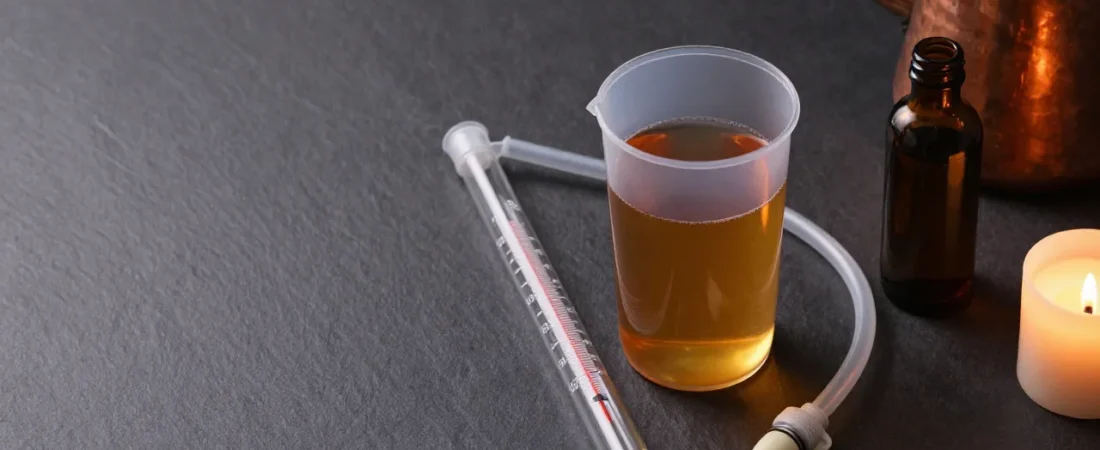
The gift-giver's blind spot is the starter kit. The person you're buying for either already has one or is about to receive one from someone else — and every generic roundup leads with exactly that. What first-year brewers actually lack are the specific tools that bridge the gap between a frustrating first batch and one they want to repeat. Those tools are not glamorous. They are a hydrometer with a test jar, an auto-siphon that starts without mouth contact, a bottle of sanitizer, and a capper ready for bottling day.
If the recipient is in Austin, there is an additional problem no starter kit addresses: summer fermentation temperatures. Indoor ambient temperatures regularly run 76–82°F without continuous air conditioning, and actively fermenting beer can push into the 80–85°F range. Most kit yeast strains are rated for 64–72°F. Fermenting outside that window produces fusel alcohols — a harsh, solvent-like finish that beginners blame on technique when the actual cause is heat.
This guide is built around what Austin Homebrew Supply and SoCo Homebrew actually stock at the beginner shelf: the items their staff hand to people who already have a kit and are trying to figure out why batch one tasted off. The picks span $11 to $40 and address the four most common first-batch failure modes directly.
How we select these gifts
- Specialty retailers first: We start with what Austin-area specialty homebrew retailers actually stock — Austin Homebrew Supply, SoCo Homebrew. Stores whose business depends on return customers don't stock junk, and their beginner shelves are a curated signal of what actually works at the entry level.
- Community consensus: We cross-reference retailer inventory against what brewers recommend in their own communities — r/homebrewing and HomeBrewTalk beginner threads. Products that appear in both signals get the heaviest weight. Star San, for instance, is stocked at Austin Homebrew Supply and is the single most-recommended product across r/homebrewing beginner threads — more frequently cited than any piece of equipment.
- Stage fit: Every pick is scoped to Year One extract brewing — the stage where someone has a kit, has brewed once or is about to, and is missing the accessories that determine whether the experience goes well. No all-grain equipment, no conical fermenters, no kegging systems. Those are deliberate upgrade decisions the brewer needs to make for themselves after developing process preferences.
- Budget range: Picks span $11 to $40 so the guide works whether you're spending $15 or $80. Most of the most impactful gifts here cost under $25.
- Skip-this guidance: Where a popular pick isn't right for this specific stage — or where the recipient might already own it — we say so directly.
The Problem with Most Starter Kits (and Why Your Gift Should Solve It)
A standard extract brewing starter kit covers the bare minimum: fermentation bucket, airlock, adhesive thermometer strip, racking cane with loose tubing, bottle brush, and bottle filler wand. That list looks complete on paper. In practice, it leaves four gaps that reliably produce off-tasting beer or a bottling-day crisis.
Gap one: no hydrometer, or a single-scale version without a test jar. Without accurate gravity readings, the brewer cannot confirm fermentation is complete before bottling — a common cause of over-carbonated or gushing bottles. Gap two: no auto-siphon. The racking cane plus bare tubing bundled in most kits requires mouth-starting, which introduces bacteria into finished beer. Gap three: no sanitizer. Fermentation infection is the most common cause of off-flavor in first batches, and it is almost universally missing from starter kits. Gap four: no capper. Many new brewers discover this problem on bottling day after filling 48 bottles.
Every product in this guide plugs one of those four gaps — or gives the recipient the ingredients to brew a second batch before the motivation from batch one fades. These are not impressive pieces of gear. They are the items most likely to determine whether the hobby continues.
The Short List: Accessories That Change Batch One
The Brewer's Elite Triple Scale Hydrometer is the first instrument a beginner brewer should own that most starter kits omit entirely. Measuring original gravity before fermentation and final gravity at the end tells the brewer when fermentation is actually complete — not when the airlock stops bubbling, which is an unreliable indicator. It also calculates actual ABV and catches early signs of infection before they ruin the batch.
The Fermtech 1/2" Auto-Siphon Deluxe Kit is the single most-discussed equipment upgrade on HomeBrewTalk and r/homebrewing. Every forum has a thread where a new brewer describes starting their siphon by mouth and either infecting a batch or losing it on the floor. The auto-siphon starts with a single pump stroke — no mouth contact, no aeration, no mess. Austin Homebrew Supply sells it as their standard racking tool.
Star San is the most recommended product in r/homebrewing beginner threads, cited more frequently than any piece of equipment. The no-rinse formula is critical for beginners who have been trained by kitchen cleaning products to rinse after every sanitizing step. The foam is harmless and does not require rinsing — a fact beginners have to be told repeatedly before they believe it. At 1 oz per 5 gallons, a 16 oz bottle covers an entire first year of brewing.
The FastRack Red Baron Bottle Capper and oxygen-absorbing bottle caps are best given together. A capper without caps, or caps without a capper, is an incomplete gift. The Red Baron is what Austin Homebrew Supply stocks as the entry-level handheld capper; the 144-count oxygen-absorbing cap bag covers two full 5-gallon batches with caps to spare.
The Austin Factor: Fermentation in Texas Heat Needs One Extra Thing
Austin summer indoor temperatures — even with air conditioning running — can hover around 76–80°F in rooms away from the main unit. A 5-gallon fermentation in active fermentation generates its own heat, pushing the internal wort temperature 5–10°F above ambient. American ale yeast rated for 64–72°F fermenting at 82°F produces isoamyl acetate and fusel alcohols: a banana-solvent combination that tastes like a chemistry experiment rather than a beer.
The Lavatools Javelin PRO Duo is the first tool for monitoring this problem. It doesn't solve fermentation temperature control — that requires a temperature controller and a dedicated refrigerator, a second-year investment — but it gives the brewer accurate, immediate temperature data at pitching time and during fermentation checks. Austin Homebrew Supply's Mad Brewer kit includes a folding digital thermometer in this category as the house-standard instrument, and the Javelin PRO Duo delivers 2-second readout at ±0.5°F accuracy with IP65 water resistance for a wet brew-day environment.
HomeBrewTalk regulars consistently point to the Javelin line as the thermometer that matches Thermapen-class performance at roughly one-third the price. For a beginner who may not yet know whether they will commit long-term to the hobby, that price-to-accuracy ratio is exactly right.
Ingredients and Consumables: The Gift That Reloads the Hobby
The most reliable predictor of whether a beginner brewer sticks with the hobby is whether they brew a second batch. Equipment gifts make the first batch better; an ingredient kit makes the second batch happen. Gifting a recipe kit eliminates the friction of deciding what to brew next, sourcing the ingredients separately, and buying specialty malts in quantities too large for a single batch.
The Northern Brewer American Amber Ale Kit is the community's gold-standard beginner style. American amber is forgiving at slightly imprecise temperatures, finishes cleanly at a familiar 5% ABV, and produces a beer that is easy to share confidently — the kind of homebrew people bring to a cookout rather than keeping to themselves. Austin Homebrew Supply's own extract kit catalog leads with their version of this style; the Northern Brewer equivalent ships the same BJCP 10B recipe with everything included except equipment, water, and time.
The Brew Tapper Dual Scale Refractometer is the right second gravity instrument once the brewer owns a hydrometer. Where the hydrometer needs a full cooled 100ml sample, the refractometer checks gravity with two drops taken directly from the boiling kettle spigot — a genuine quality-of-life improvement for mid-boil adjustments. Austin Homebrew Supply stocks a Brix refractometer at $49.99; the Brew Tapper delivers the same ATC dual-scale functionality at half that price. One important caveat: the refractometer is not a hydrometer replacement for post-fermentation readings. It requires a Brix-to-SG correction formula after alcohol is present, and beginners who skip that step get misleading final gravity numbers.

Brewer's Elite Triple Scale Hydrometer
Austin Homebrew Supply stocks a triple-scale thermohydrometer as their house entry-level gravity instrument, and every beginner thread on r/homebrewing and HomeBrewTalk places a hydrometer at the top of the must-buy list before any refractometer upgrade. The Brewer's Elite kit bundles the hydrometer with a plastic test jar, rigid hard case, and cloth — covering every beginner accessory in a single purchase for under $14. The triple scale reads specific gravity, Brix, and potential alcohol simultaneously, giving year-one brewers three reference points without conversion math.
- Color-coded triple scale makes reading SG, Brix, and potential ABV unambiguous without squinting at a single hair-thin line
- Rigid hard case dramatically reduces the most common beginner loss — a hydrometer shattered on a hard floor on brew day
- Glass instrument still breaks if mishandled; not as durable as a digital wireless option like the Tilt for long-term use
- Requires drawing a full cooled sample into the test tube, wasting several ounces of beer per reading

Fermtech 1/2" Auto-Siphon Deluxe Kit
Austin Homebrew Supply sells the Fermtech 1/2-inch Auto Siphon as their standard racking tool at $19.99, and Fermtech has been the brand HomeBrewTalk members cite in racking discussions since the forum's early years. The Deluxe Kit bundles food-grade transfer hose and a bottling wand — eliminating the beginner oversight of buying the siphon body and discovering tubing is sold separately. The 1/2-inch diameter moves a 5-gallon batch to the bottling bucket in minutes rather than the slow crawl of the 3/8-inch mini version.
- Single-stroke pump start requires no mouth contact — no aeration of finished beer, no bacterial introduction, no floor mess
- Bundled bottling wand fills bottles to a consistent level and automatically shuts off flow when lifted, making bottling day significantly cleaner
- The internal spring inside the outer tube can wear out after 2–3 years of regular use and will need replacement
- 1/2-inch diameter is too wide for 1-gallon jugs — brewers doing small batches need the 3/8-inch Mini version

Five Star Star San 16 oz
Austin Homebrew Supply stocks Star San as their house sanitizer across all beginner supply pages. It is also the single most-recommended product in r/homebrewing beginner threads — more frequently cited than any piece of equipment. A 16 oz bottle mixes at 1 oz per 5 gallons of water, yielding 80 gallons of sanitizing solution — roughly enough for a full first year of brewing. Starter kits almost never include sanitizer, which makes this a genuinely needed gift rather than a duplicate of something already in the box.
- No-rinse formula eliminates a rinsing step entirely — the foam dissipates harmlessly in the fermenter without affecting beer flavor
- Extremely concentrated: this single 16 oz bottle covers approximately 15–20 brew sessions before running out
- Phosphoric acid base means it cannot be used on aluminum or copper equipment — safe only on stainless steel, glass, and plastic
- Significant foam output alarms first-time users who haven't yet internalized the no-rinse principle

FastRack Red Baron Bottle Capper
Austin Homebrew Supply stocks a twin-lever handheld capper as their entry-level bottling tool at $21.99, and the Red Baron is the Italian-made equivalent distributed nationally — the same spring-lever mechanism with a magnetic bell that holds caps steady hands-free. HomeBrewTalk members describe it as the right first capper for any beginner, with a bench capper as a later ergonomic upgrade. At under $17, it caps standard 26mm crown caps and works on any hard countertop surface.
- Compact enough to store in a kitchen drawer or single-shelf brew closet — important for apartment brewers with no dedicated space
- Magnetic bell holds the cap in position hands-free while the brewer positions the bottle, reducing misfires on a first bottling day
- Lever action requires moderate hand strength and becomes tiring over a full 48-bottle session — a bench capper is considerably more ergonomic at high volume
- Not compatible with 29mm champagne or Belgian-style bottles without a separate bell adapter sold separately

144-Count Oxygen-Absorbing Bottle Caps
Austin Homebrew Supply stocks oxygen-absorbing caps as a standard consumable alongside every capper they sell. Plain liner caps allow micro-oxygen ingress that accelerates staling during the 4–6 week bottle conditioning period — a problem r/homebrewing threads note is easy to eliminate at this price point. At 144 caps per bag, this covers two complete 5-gallon batches (roughly 48 twelve-ounce bottles each) and pairs naturally as a companion gift to the Red Baron capper. No technique change required — oxygen-scavenging caps are used identically to plain caps.
- Oxygen-scavenging liner actively removes residual headspace oxygen after capping, protecting hop aroma and malt freshness during conditioning
- 144-count bag covers two full 5-gallon batches with caps to spare, eliminating a separate shopping trip before the first bottling day
- Oxygen-absorbing function degrades within 24 hours of opening the bag — the full bag should be used in one bottling session or stored immediately in an airtight container
- Benefit is most pronounced for hop-forward or long-conditioned beers; for fresh session beers, plain caps perform nearly identically

Lavatools Javelin PRO Duo Thermometer
HomeBrewTalk regulars point to the Javelin line as the thermometer that delivers Thermapen-class 2-second response and ±0.5°F accuracy at roughly one-third the Thermapen price — the precision beginners need to hit 150°F mash temperatures and 65–70°F yeast pitching windows. Austin Homebrew Supply's Mad Brewer kit includes a folding digital thermometer in this category as the house-standard instrument. The auto-rotating backlit display handles awkward probe angles into a kettle or dim lighting on brew day, and IP65 water resistance means steam, wort splashes, and wet countertops are a non-issue.
- 2-second readout eliminates the 10+ second wait of cheaper thermometers, enabling rapid checks during an active boil or while chilling wort
- IP65 water resistance survives steam, wort splashes, and wet countertops of brew day without corrosion or display fogging
- At $35, it is the highest unit-price single-function tool in this guide — a valid gift but harder for a beginner to self-justify at this stage
- 4.5-inch probe is shorter than some dedicated mash thermometers, which can make checking center temperature of a full 10-gallon kettle slightly awkward

Northern Brewer American Amber Ale Kit
Austin Homebrew Supply's own-brand American Amber Ale is one of their most-stocked extract kits for beginners, and the Northern Brewer version ships the same BJCP 10B style complete with malt extract, specialty grain steeping bag, hops, dry yeast, priming sugar, and instructions — everything added to equipment already owned. American amber is the community's gold-standard beginner style: simple grain bill, forgiving fermentation temperature range, and a Fat Tire-adjacent flavor that is easy to share confidently. At OG 1.047 and roughly 5.1% ABV, it finishes cleanly even at slightly imprecise pitching temperatures.
- All-inclusive recipe kit eliminates ingredient sourcing for a second batch — the brewer supplies only equipment, water, and time
- American amber ale is widely crowd-friendly, producing a confident first shared homebrew experience that reinforces motivation to brew again
- Included dry yeast is functional but not the ideal strain for nuanced character — upgrading to liquid yeast (Wyeast 1056 or White Labs WLP001) is the standard forum recommendation for subsequent batches
- Contains perishable ingredients: the recipient should brew within 6 months of receipt for peak hop freshness and yeast viability

Brew Tapper Dual Scale Refractometer
Austin Homebrew Supply stocks a Brix refractometer at $49.99 as an upgrade measurement instrument; the Brew Tapper delivers the same ATC dual-scale functionality at half that price — the accessible entry point to the refractometer category as a gift. HomeBrewTalk threads note that a budget ATC unit is accurate enough for pre-fermentation gravity checks where refractometers genuinely excel: two drops taken directly from the hot kettle versus cooling a full 100ml hydrometer sample. Best given alongside or after the hydrometer, not in place of it — post-fermentation readings require a Brix-to-SG correction formula once alcohol is present.
- Two-drop sample directly from the hot kettle eliminates the need to cool a hydrometer test tube during the boil — a genuine quality-of-life improvement on brew day
- Aircraft aluminum body and foam-lined carry case are substantially more durable than a glass hydrometer in a regular brewing environment
- Cannot deliver accurate final gravity readings on fermented beer without a Brix-to-SG correction formula — beginners who skip this step get misleading post-fermentation numbers
- Requires calibration with distilled water before first use and after temperature swings — a step novices frequently skip, leading to consistently offset readings
What to skip
Three gift categories consistently miss for first-year brewers. All-in-one electric brewing systems above $200 — Pico Brew, Grainfather, Robobrew — are second-year decisions that a committed brewer needs to earn their way into after developing process preferences; gifted to a beginner, they often sit unused. Novelty homebrewing merchandise — engraved pint glasses, branded aprons, “World's Best Homebrewer” anything — is the gift of someone who doesn't brew and knows it, and signals exactly that to the recipient. Advanced equipment like conical fermenters, kegging systems, or grain mills are all deliberate upgrade decisions the brewer must make for themselves once they understand their own process well enough to know what they actually want. When in doubt: give sanitizer, a recipe kit, and a capper. All three are consumable or enabling, all three are almost certainly missing, and none of them will duplicate something already owned.
The right gift for a first-year home brewer is not the most impressive piece of gear on the shelf. It is the item most likely to make batch two happen. Most people who brew once either get hooked or quietly shelve the equipment. The inflection point is almost always somewhere between the mediocre first batch and whatever they decide to do next — and the decision to do next is heavily influenced by whether batch one worked.
A quality auto-siphon, a bottle of Star San, a capper, and a recipe kit for the next style cost under $90 combined and directly address the four most common reasons first batches disappoint or bottling day turns into a crisis. Give any one of them and you are giving something that will be used on every single brew day. Give several and you are making a second batch substantially more likely — which is the only meaningful outcome for this gift category.
If you are still deciding between two picks, default to the consumable over the equipment. The auto-siphon will last five years; a recipe kit or a bottle of Star San will be gone before the next batch and will be appreciated immediately on the day they are needed.