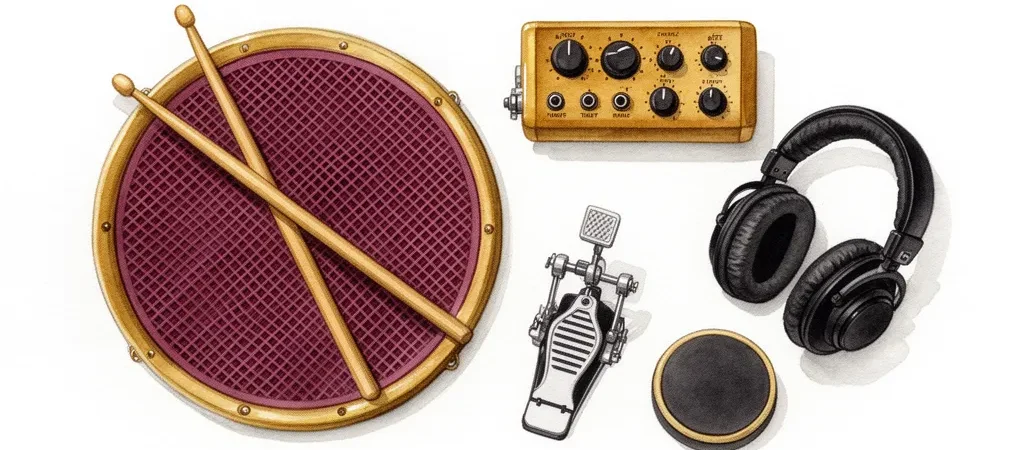
The real obstacle between an adult beginner and a drum kit isn’t skill, and it usually isn’t cost. It’s the neighbors — or the downstairs unit, or a partner trying to work from home in the next room. Buy the wrong kit and the gift turns into a source of guilt within two weeks, played for ten minutes at a time with one eye on the clock.
Every electronic kit on the market claims to be “apartment friendly.” Almost none of the marketing copy explains what that actually means — mesh pads versus rubber, kick tower vibration versus stick-on-pad sound, why the same kit gets five-star reviews from a house owner and one-star reviews from someone two floors up from a strict lease. Those are different products for different living situations, even when they’re the exact same box.
This guide ranks kits and accessories by what actually keeps a shared building quiet, not by decibel claims on a spec sheet. If you’re buying for someone who lives in an apartment, condo, or shared house and wants to start drumming without becoming that neighbor, start here.
How we select these gifts
- Specialty retailers first: We cross-check listings against what dedicated drum and music retailers actually stock and recommend for apartment buyers, not just what ranks highest in generic marketplace search. Kits that specialty drum shops steer beginners toward for noise-sensitive housing get priority over kits that only do well in broad “best electronic drums” roundups.
- Community consensus: We weigh what shows up repeatedly in r/drums and r/edrums apartment-noise threads, where actual downstairs-neighbor experience gets reported honestly — including the kits that looked quiet in a showroom and weren’t.
- Age and stage fit: This guide is built for adult beginners starting from zero, often self-taught via YouTube or an app rather than in-person lessons. That means usability of the module and onboard lesson content matters as much as the pads themselves — a kit that assumes prior reading-music knowledge is the wrong gift here.
- Budget range: Picks span roughly $13 to $500, so the guide works whether you’re buying the full kit or just filling a gap in a setup someone already owns.
- Skip-this guidance: Where a popular kit or accessory isn’t right for apartment use — or duplicates something else on this list — we say so and explain why.
How We Pick: Why “Electronic” Doesn’t Automatically Mean “Quiet”
Most buying guides treat “electronic drums” and “quiet drums” as synonyms. They aren’t. An electronic kit removes the acoustic shell resonance of a real drum — the boom you’d get from an actual snare or floor tom — but it does not remove the physical act of hitting something with a stick, or the physical act of stomping a kick pedal. Those two remaining noise sources behave completely differently, and conflating them is why so many apartment buyers end up frustrated.
Stick-on-pad noise is airborne. It’s the clack of a drumstick hitting a rubber or mesh surface, and it travels through air the way a knock on a door does — noticeable in the same room, faint through a wall, usually a non-issue through a floor. Kick pedal noise is different: it’s structure-borne. Every time the beater strikes the kick tower, that impact transfers directly into the floor, through the joists, and into whatever’s directly below. That’s the noise a downstairs neighbor actually complains about, and no amount of “quiet mesh pad” marketing on the snare and toms fixes it.
This is the single most-searched confusion in the category — “can neighbors hear electronic drums through the floor,” “are electronic drums actually quiet enough” — and the honest answer is: the pads are quiet, the kick tower is the variable. That’s why our criteria below weigh mesh-versus-rubber pad construction for airborne noise, but treat kick isolation and beater choice as the deciding factor for whether a kit is genuinely apartment-safe.
Build reliability and beginner usability round out the criteria, because a gift that breaks or confuses someone in month one gets the same outcome as a gift that annoys the neighbors — it stops getting played. We’re ranking for the full picture: quiet enough, sturdy enough, and simple enough that a self-taught adult actually sticks with it.
The Kits: Ranked by Neighbor-Safety
The three kits below represent three real trade-offs, not three tiers of the same product. Understanding what each one compromises on matters more than the price tag.
The Alesis Nitro Mesh is the default recommendation for a reason: every pad — snare and all three toms — is mesh, not rubber. Mesh heads have a small amount of give when struck, which does two things at once: it feels closer to an acoustic drum under the stick, and it produces meaningfully less airborne clack than a rigid rubber pad. This is the kit that shows up over and over in beginner apartment threads specifically because it doesn’t cut the mesh-pad corner that cheaper kits do.
The Alesis Nitro Max keeps that same fully-mesh construction and adds a real upgrade: a 10-inch dual-zone mesh snare instead of the base kit’s 8-inch single-zone pad. Dual-zone means the pad can distinguish a rim strike from a head strike, which unlocks rudiments and dynamics a beginner will actually want within the first few months, not features that sit unused. The bundled Drumeo trial is a genuine value-add for someone learning without an instructor, and Bluetooth audio-in means practicing along with real songs through the module instead of a separate speaker.
The Roland TD-02KV V-Drums takes a different approach entirely. Roland’s module and sound engine reliability are consistently rated above Alesis’s in long-term ownership discussions, and the KV variant’s mesh-head snare plus onboard coaching functions make it a strong self-teaching tool. The catch: the three toms are still rubber pads, not mesh. For a kit that costs roughly $100 more than the fully-mesh Nitro Max, that’s a real compromise on the exact noise criteria this guide is built around — worth naming clearly rather than burying in a spec sheet.
All three kits still transmit some kick pedal vibration through the floor. None of them solve that with pads alone — see the isolation guidance later in this guide.

Alesis Nitro Mesh Electronic Drum Kit
The recurring go-to recommendation for a first electronic kit — all eight pads (snare and three toms) are mesh, not rubber, meaningfully quieter and more responsive than rubber-pad kits. A regular pick in r/edrums apartment-buyer threads specifically for this reason.
- All-mesh pad construction — meaningfully quieter under a downstairs neighbor than rubber-pad kits
- 40 kits / 385 onboard sounds plus bundled drum lesson software
- 4-post rack is a known weak point — clamps can loosen over time
- Kick tower still transmits some low-frequency thump into flooring; isolation-pad upgrade recommended

Alesis Nitro Max Electronic Drum Kit
The upgraded sibling to the Nitro Mesh: still fully mesh, but with a larger 10-inch dual-zone snare and a bundled Drumeo lesson subscription — a real advantage for a self-taught adult beginner who won’t have an instructor correcting technique in person.
- Dual-zone 10-inch mesh snare gives noticeably better articulation than the base Nitro’s 8-inch pad
- Bundled Drumeo subscription and BFD Player sound engine
- Bluetooth audio-in lets you play along with songs through the module
- Same rack-stability concerns as the base Nitro line
- Drumeo trial eventually converts to a paid subscription

Roland TD-02KV V-Drums Kit
Roland’s noise-reduction engineering and module reliability are rated above Alesis’s in long-term ownership discussions. The KV variant upgrades the snare to mesh over the base TD-02K, and its onboard coaching functions suit a self-taught adult well.
- Roland’s noise-reduction engineering and V-Drums module reliability consistently rated above Alesis’s
- Mesh-head snare plus onboard coach functions useful for self-taught adults
- Compact, foldable footprint suits small apartment rooms
- The three toms are still rubber pads, not mesh — a real compromise versus fully-mesh Alesis kits
- About $100 more than the fully-mesh Alesis Nitro Max for a kit that isn’t fully mesh
What to Add So the Gift Works on Day One
A drum kit box rarely includes everything a beginner needs to actually use it quietly and comfortably from the first session. Headphones, a proper throne, the right stick weight, and something to practice on when the kit isn’t even plugged in — these are the accessories that determine whether the gift gets used daily or gets set up once and left alone.
Closed-back headphones are the single most important add for apartment practice, because they’re what let someone play at a reasonable module volume instead of cranking it to hear over their own pad noise. The Sony MDR7506 is the industry-standard studio monitor headphone for exactly this reason — strong sound isolation, decades of proven durability, and a flat, accurate sound that makes click tracks and lesson audio easy to follow. If a wired, non-detachable cable design isn’t the right fit, the Audio-Technica ATH-M40x is a comparable closed-back alternative at a similar price point with a detachable cable — pick one, not both, since they solve the identical problem.
A proper throne matters more than most gift-givers expect. Flat stock stools bundled with budget kits cause fatigue and bad posture habits within the first month, exactly when a beginner is building the muscle memory that will carry forward. The Roc-N-Soc Nitro Drum Throne uses a saddle-style seat that distributes weight properly for longer sessions, with a gas-lift height adjustment that takes a second to set.
Stick weight and off-kit practice round out the list. Vic Firth American Classic 5A sticks are the universal starting-point recommendation — light enough to build control without fatigue, and standard enough that every method book and online lesson assumes this weight by default unless told otherwise. And a Vic Firth 12-inch double-sided practice pad lets a beginner drill rudiments and stick control on a desk or couch, completely silently, without needing the full kit powered on — genuinely useful for a shared apartment where even mesh-pad practice isn’t always the right moment.

Sony MDR7506 Closed-Back Studio Headphones
Closed-back is the whole point for silent apartment practice — these are the industry-standard professional monitoring headphone, prized for strong sound isolation so the module’s click track and kit sounds stay audible without cranking volume.
- Industry-standard closed-back monitoring headphone with decades of proven durability
- Strong sound isolation — critical for hearing the module clearly over stick-on-mesh noise
- Clamping force can feel tight for long sessions until broken in

Roc-N-Soc Nitro Drum Throne
Posture and stamina are exactly what a true beginner struggles with — a flat drum stool causes fatigue and bad habits within the first month. This saddle-seat throne with gas-lift adjustment is what drum shops and forum posters point to over the flimsy stool bundled with cheap kits.
- Saddle-style seat distributes weight properly for long practice sessions, reducing lower-back fatigue
- Gas-lift height adjustment takes under a second — no wrench needed
- At $220 it’s a genuine expense on top of the kit itself

Vic Firth American Classic 5A Drumsticks
5A hickory is the universal starting-point recommendation for stick weight and diameter — light enough to build control without fatigue, standard enough that every teacher, method book, and forum guide references it as the baseline.
- Industry-standard sizing means every online lesson and method book assumes this stick weight by default
- USA hickory construction with a teardrop tip gives clean, readable articulation
- Wood tip version can chip on mesh pad rims faster than nylon tip

Vic Firth 12-Inch Double-Sided Practice Pad
Quiet, off-kit rudiment work — a practice pad lets a beginner build stick control on the couch, at a desk, or anywhere without needing the full kit powered on. The two surfaces cover both early technique work and later rudiment drilling.
- Two distinct playing surfaces in one pad — soft side for stamina/wrist work, firm side for rebound and stick control
- Genuinely silent — usable in a shared living space or late at night without headphones or the kit powered on
- Feel is noticeably different from an actual mesh drum pad, so it supplements rather than replaces on-kit practice
Setting Expectations: What a Beginner Can Realistically Play at 9pm
Even the best mesh kit, played through closed-back headphones, still transmits some pedal thump into the floor. That’s physics, not a product defect — the kick beater is striking a surface connected to a stand that’s connected to the floor, and no amount of headphone isolation changes what’s happening structurally beneath the kit. Setting this expectation upfront is what keeps the gift from feeling like a broken promise in week three.
The fix isn’t a quieter kit — it’s decoupling the kit from the floor. A dense isolation pad or thick rug placed under the entire rack and kick tower absorbs a meaningful amount of that structure-borne vibration before it ever reaches the joists. This is a five-minute, low-cost setup step that most kit boxes never mention, and it’s the difference between “the neighbors never noticed” and a passive-aggressive note taped to the mailbox.
Realistic timing matters too. Most apartment leases and simple courtesy suggest treating anything after 9 or 10pm as headphones-and-practice-pad-only territory, full stop — not because the kit is too loud, but because kick vibration doesn’t care what time it is. A beginner who understands this from day one builds a sustainable practice routine instead of an all-or-nothing one that gets shut down by a complaint.
None of this is a reason to hesitate on the gift. It’s context that makes the gift actually work — the difference between handing someone a kit and handing someone a kit plus the two or three things that keep it in daily use.
What to skip
Skip any kit that markets itself as “quiet” but ships with a stock rubber-tipped kick beater and no isolation guidance — it’ll pass the showroom test and fail the actual-apartment test within a month. Also skip doubling up on headphones: the Sony MDR7506 and Audio-Technica ATH-M40x solve the identical problem, so buy one, not both, and put the savings toward the throne or an isolation pad instead.
A genuinely apartment-safe setup removes the single biggest reason adult beginners quit drumming in shared housing: guilt over noise, not lack of interest. Someone who can practice at a reasonable hour without wondering if the people downstairs are glaring at the ceiling is someone who actually keeps showing up to the kit.
That’s what this gift signals, beyond the drums themselves — an acknowledgment that the hobby is realistic for where they live, not just something that would work in a house with a basement. Pair the kit with headphones and a practice pad from day one rather than treating those as someday-upgrades, since those two items are what make the first month frustration-free.
If you’re deciding between the Nitro Mesh and the Nitro Max and the extra $30 isn’t the issue, go with the Max — the dual-zone snare and Drumeo lessons matter more over the first year than they seem to on a spec sheet. When in doubt on any accessory, prioritize the isolation pad and headphones before the throne; comfort upgrades can wait, but noise control is what determines whether the kit gets returned.