The default aquarium gift is a betta bowl or a sub-5-gallon “starter” kit — small, cheap, and marketed as beginner-friendly because it looks simple. It isn’t. Most of those fish are dead within two weeks, and almost nobody explains why before the box gets wrapped.
The reason is chemistry, not neglect. A new tank has no bacteria colony to process fish waste, so ammonia builds up immediately. In a 1-2 gallon bowl, that ammonia concentrates fast enough to become lethal within hours of a single feeding. The gift-giver did nothing wrong except not know that “smaller and simpler” is exactly backwards for water chemistry.
This guide is built around the setup that actually works for an adult beginner: enough water volume to buffer chemical swings, filtration and heating sized correctly, and — the part every other gift guide skips — the supplies to run a proper fishless cycle before any fish goes in the tank.
How we select these gifts
- Real tank volume: 10-20 gallons minimum. More water dilutes waste faster than it accumulates, which makes a bigger tank more forgiving for a first-timer, not less.
- Filtration sized to the tank: We use the 4x-gallons-per-hour rule — a 20-gallon tank needs a filter rated for roughly 80 GPH minimum, more if it’s stocked. Undersized filtration is one of the most common invisible mistakes in beginner setups.
- Adjustable heating, not preset-and-forget: Tropical species need a stable 76-82°F. Store cups sit at room temperature, which misleads gift-givers into thinking a heater is optional.
- Liquid test kits over strips: Strips degrade within six months of opening and are unreliable at the low ammonia and nitrite levels that matter most during cycling. Liquid reagent kits don’t have that failure mode.
- Gear that supports fishless cycling, not gear that skips it: Every pick here either accelerates or protects during the 4-6 week nitrogen cycle. None of it lets a beginner shortcut that window.
- Budget range: Picks span $8.99 to $139.99, so the guide works as one full setup or as add-ons to gear someone already owns.
The Foundation: A Real Tank, Not a Bowl
The single highest-leverage gift in this guide is the Aqueon 20-Gallon Starter Kit, and the reason isn’t the LED hood or the included accessories. It’s the water volume.
A beginner’s instinct is that a small tank is easier to manage — less water, less cleaning, less commitment. Chemically, it’s the opposite. Ammonia from fish waste and uneaten food accumulates at the same rate regardless of tank size, but a 20-gallon tank dilutes that same waste load into ten to twenty times more water than a betta bowl. The swings are slower, the margin for error is wider, and a missed feeding schedule or late water change doesn’t turn into an emergency overnight.
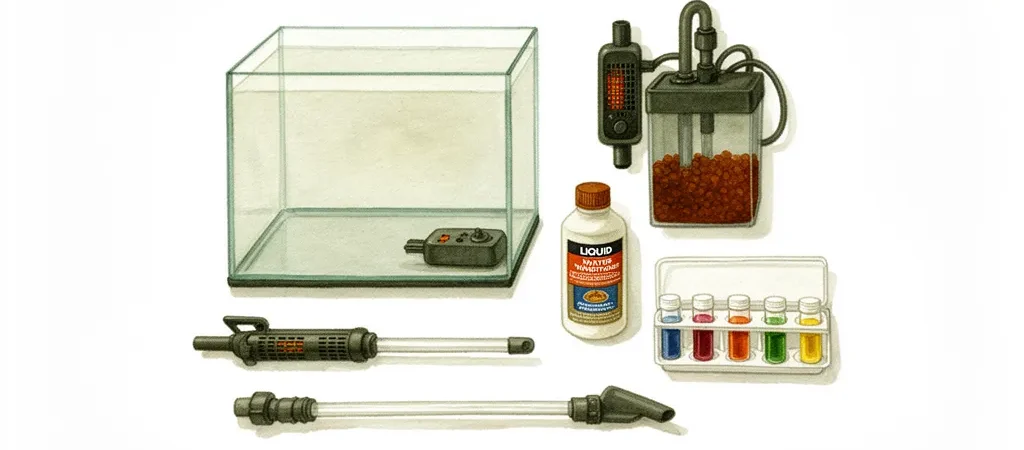
This kit includes a real glass tank, a QuietFlow filter, an LED hood, and a preset 100W heater — everything needed to run water before fish go in. That “before fish go in” period is the whole point of the next two sections, and it’s only survivable with a tank this size.

Aqueon 20-Gallon Starter Kit
A real 20-gallon glass tank with a QuietFlow filter, LED hood, and preset 100W heater replaces the bowl-and-vase trap with genuine chemical stability. The larger water volume means ammonia swings arrive slower and stay lower than in anything under 5 gallons — the exact opposite of what most gift-givers assume about tank size.
- Everything needed to run the tank pre-fish, in one box
- Water volume buffers beginner mistakes
- Preset heater isn’t adjustable — fine for most tropicals, limiting for some species
Heating and Filtration Done Right
The included filter and heater in a starter kit are functional, but two upgrades meaningfully change outcomes for a new keeper, and they’re cheap enough to gift alongside the tank without inflating the budget much.
Filtration should be sized to roughly four times the tank’s gallon volume in gallons-per-hour turnover. For a 20-gallon tank, that’s a minimum of 80 GPH, and more if the tank ends up moderately stocked. The AquaClear 30 Hang-On-Back Filter runs at 150 GPH — well past the minimum — and uses reusable media baskets instead of the proprietary disposable cartridges that lock a beginner into repeat purchases from one brand.
Heating has a blind spot most gift-givers don’t know exists: fish are sold in store cups sitting at room temperature, which makes it look like heating is optional. It isn’t. Tropical species like bettas, tetras, and guppies need a stable 76-82°F, and swings outside that range stress the immune system and invite disease. The Aqueon Pro Adjustable Heater lets a beginner dial in and hold that exact range, rather than trusting a fixed preset to match their specific stocking plan.

AquaClear 30 Hang-On-Back Filter
Rated for 150 GPH, comfortably past the 80 GPH minimum a 20-gallon tank needs. A recurring pick in beginner freshwater forum threads for its customizable, reusable filter media over proprietary disposable cartridges.
- Correctly oversized for a 20-gallon tank
- Reusable media cuts long-term cost
- Slightly louder intake than fully submerged canister filters

Aqueon Pro Adjustable Heater, 50W
Adjustable, not preset, so a beginner can hold a stable 76-82°F for tropical species. This closes the heating blind spot created by fish being sold in room-temperature store cups, which wrongly suggests heating isn’t necessary.
- Precise temperature dial, not a fixed target
- Rated correctly for up to 20 gallons
- Needs a separate thermometer to confirm accuracy — heaters can drift
The Part Nobody Gifts: Cycling Supplies
This is the section that separates a real starter kit from a gift-shop impulse buy. A brand-new tank has no bacteria to convert fish waste into less toxic compounds. Establishing that bacteria colony — the nitrogen cycle — takes 4 to 6 weeks of running the tank before a single fish goes in, and skipping it is the single biggest cause of dead beginner fish.
API Quick Start Nitrifying Bacteria seeds that colony faster than waiting on ambient bacteria alone. It speeds up the cycle — it does not replace it. A beginner still needs to test water weekly and wait for ammonia and nitrite to read zero before stocking fish, no matter what the bottle label implies about “instant” cycling.
Seachem Prime does two jobs during this window. It’s the required dechlorinator for every single water change, since tap water chlorine and chloramine kill the same bacteria the tank is trying to grow. It also detoxifies ammonia and nitrite spikes temporarily, which matters most in weeks two and three of a cycle when readings are highest and the margin for error is thinnest.
Gifting these two together — bacteria starter and conditioner — is a way of gifting the concept of the cycle itself, not just the bottles. It signals the giver understands that fish don’t go in on day one.

API Quick Start Nitrifying Bacteria, 4 oz
Jump-starts the beneficial bacteria colony that converts ammonia to less toxic nitrate. Genuinely speeds the 4-6 week fishless cycle — it does not let a beginner skip testing and waiting before adding fish.
- Meaningfully shortens time to a safe first fish
- Cheap enough to pair with every setup
- Marketing implies instant cycling — it isn’t; testing is still required

Seachem Prime Water Conditioner, 250mL
Dechlorinates tap water for every water change and also detoxifies ammonia and nitrite spikes while bacteria are still establishing. The highest-rated product in this entire guide, and one of the most consistently recommended items in freshwater keeping communities.
- Non-negotiable for every water change, not optional
- Extra safety margin during the cycling window
- Concentrated — easy to underdose without reading the label carefully
Testing and Maintenance Gear That Makes This Sustainable
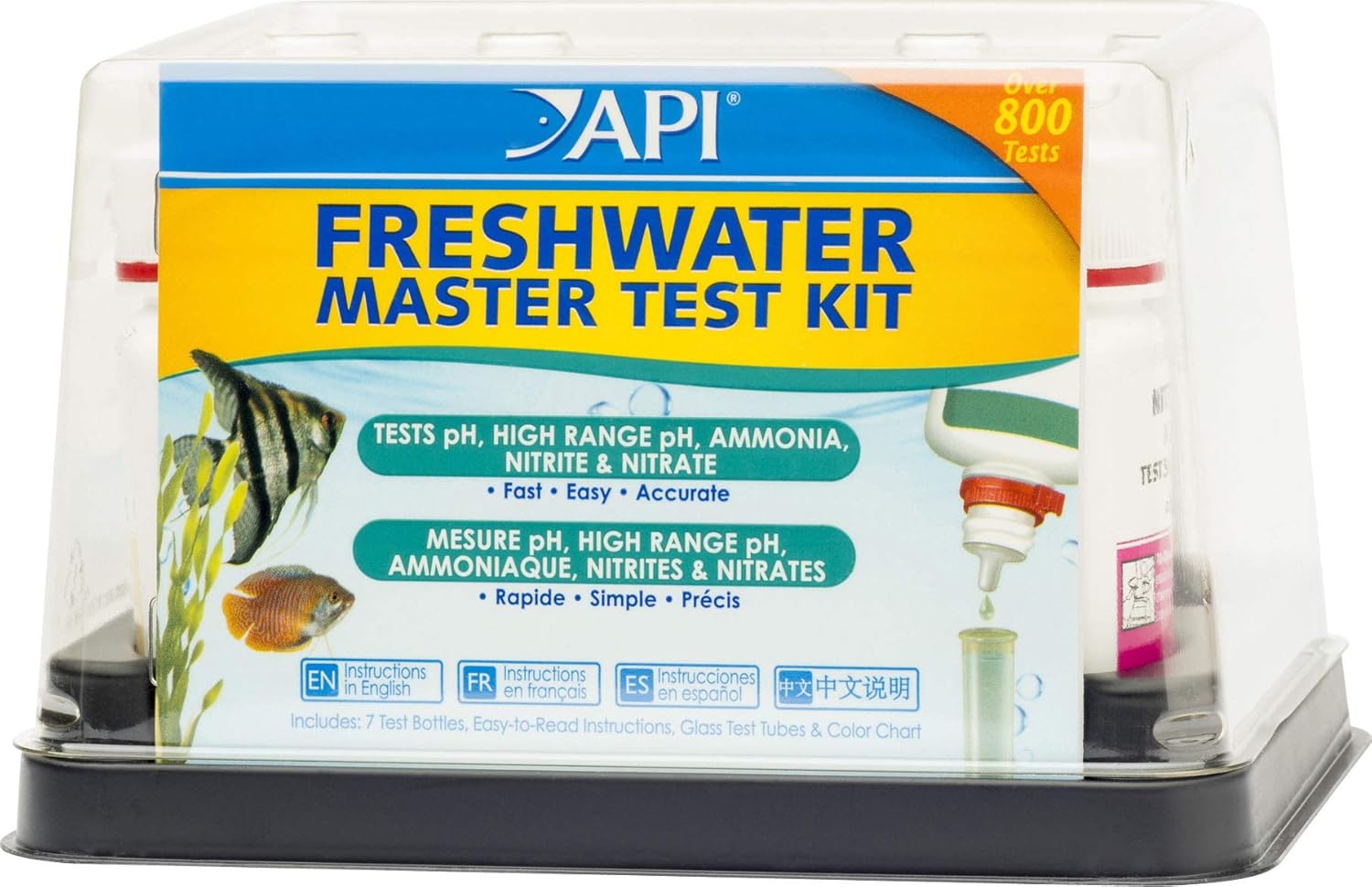
Test strips are the default gift-shop add-on, and they’re the wrong choice for exactly the moment they’re needed most. Strips degrade within about six months of opening — moisture in the air breaks down the reagent pads even in a sealed container — and they’re notoriously imprecise at the low ammonia and nitrite concentrations that define the cycling window.
The API Freshwater Master Test Kit uses liquid reagents instead, and the cost math favors it over the kit’s lifespan: roughly $0.30 per test versus about $0.84 per strip test, spread across 800 tests. Stocked consistently at specialty fish stores because the specificity is what a beginner needs during weeks one through six — vague “safe” or “unsafe” readings don’t cut it when ammonia at 0.25 ppm is meaningfully different from 1.0 ppm.
Testing tells a beginner what’s happening in the water. The Python No Spill Clean and Fill Gravel Vacuum is what makes acting on those readings realistic long-term. It connects directly to a faucet for both gravel vacuuming and water changes, which removes the bucket-hauling step that turns weekly maintenance into a chore people quietly stop doing. A tank that gets water changes stays stable; a tank that doesn’t slowly accumulates nitrate and eventually crashes.
Rounding out the setup, CaribSea Super Naturals Peace River Substrate is a natural, uncoated river-stone gravel that won’t leach dye or coating chemicals into the water column. It’s not a functional requirement the way filtration or conditioner is, but it’s the detail that shows the setup wasn’t assembled on autopilot.
API Freshwater Master Test Kit (Liquid, 800 Tests)
Liquid reagents reliably test pH, ammonia, nitrite, and nitrate — strips degrade within six months and miss trace ammonia exactly when it matters most during cycling. Also cheaper per test (~$0.30 vs. ~$0.84 for strips) across the kit’s 800-test life.
- Far more precise than strips at low concentrations
- Lower long-run cost per test
- Color-match reading takes more attention than a strip dip

Python No Spill Clean and Fill Gravel Vacuum, 50 ft
Connects directly to a faucet for gravel vacuuming and water changes, no buckets required. This is the tool that turns maintenance into a realistic weekly habit instead of the task that gets skipped until the tank crashes.
- Removes the bucket-hauling friction that kills maintenance habits
- 50 ft hose reaches most bathroom or kitchen faucets from a living room tank
- Requires a compatible faucet adapter — check threading before gifting

CaribSea Super Naturals Peace River Substrate, 20 lb
Natural, uncoated river-stone substrate that won’t leach dye or chemicals into the water. Not functionally required like filtration or conditioner, but it completes the setup without cutting corners on safety.
- Safe, uncoated material — no water column risk
- Natural look works with most stocking plans
- Needs a thorough rinse before adding — it runs dusty out of the bag
What to skip
Betta bowls, vases, and any all-in-one kit under 5 gallons. They’re marketed as beginner-friendly because they’re cheap and cute, but low water volume means ammonia can spike to lethal levels within hours of a single feeding. Pairing one with a test strip kit makes the problem worse, not better — strips degrade fast and miss the trace ammonia readings that would have given a warning in time.
These eight products aren’t eight separate gifts. They’re one coherent 20-gallon setup that gives a beginner every tool needed to succeed, instead of a bowl that sets them up to fail through no fault of their own.
The real gift underneath the gear is patience. This tank needs to run empty — or with a hardy starter fish at most — for 4 to 6 weeks while the nitrogen cycle establishes, before a full stocking plan goes in. That’s a hard thing to explain in a gift-wrapped box, which is exactly why a handwritten note about the cycle, or a standing offer to help with the first water change, means more than anything else in this list.
If deciding between two tank sizes, size up, not down. A 20-gallon tank with a lighter stocking plan is more forgiving than a 10-gallon tank pushed to its limit — and a tank that’s easy to keep stable gets kept. One that punishes small mistakes gets abandoned within a season.