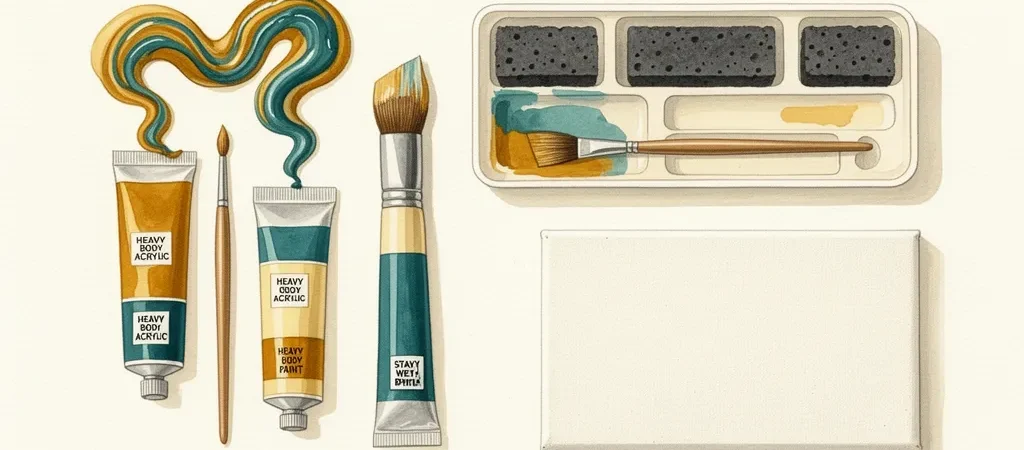
The most-gifted acrylic painting present is a 36-to-50-tube rainbow kit with a folding tabletop easel, and it’s also the acrylic gift most likely to end up in a closet by March. Those kits are filled with fluid craft-grade paint: low pigment, high filler, transparent where it should be opaque. The recipient mixes two colors, gets mud, tries a third, gets grayer mud, and quietly decides they’re “not a painter.”
They were never the problem. The paint was. An adult learning acrylics burns through a short list of specific things: heavy body paint with real pigment, three or four brush shapes that teach control, a stack of cheap surfaces so no single painting feels precious, and one unglamorous accessory that stops the paint from drying out mid-session.
This guide is built around that list. Every pick here is something a beginning painter will actually use up — which is the honest test of whether an art supply gift worked.
How we select these gifts
- Specialty retailers first: We start with what Austin-area specialty retailers actually stock — Jerry’s Artarama and Asel Art Supply, the stores where working painters and art teachers buy classroom supplies. Stores whose business depends on return customers don’t stock junk. When no Austin specialty store covers a niche, we check reputable national specialty retailers instead.
- Community consensus: We cross-reference retailer inventory against what painters recommend in their own communities — r/acrylicpainting beginner threads and the long-running WetCanvas acrylics forum. Products that show up in both signals get the heaviest weight.
- Age and stage fit: This guide is for adult beginners. They’re still learning color mixing (which is why paint quality matters more than color count), haven’t developed brush control (three good shapes teach more than twenty redundant ones), and are prone to precious-surface anxiety — the freeze that happens when the only canvas in the house cost $15. Every pick either builds skill or lowers the stakes.
- Budget range: Picks span $12 to $59 individually, with complete gift builds from under $40 to under $150.
- Skip-this guidance: Where a popular pick isn’t right for this specific stage, we say so and explain why — including one product category we cut from our own shortlist.
How We Pick: Quality Per Tube, Not Tube Count
Acrylic paint sold to gift shoppers splits into two categories that look identical on the shelf. Craft acrylics — the fluid paint in most all-in-one kits — use a small amount of pigment stretched with fillers and extenders. They’re made for stenciling terra cotta pots, and they’re fine at that. Used for painting, they dry patchy, shift color as they dry, and turn to gray-brown mud when mixed, because there isn’t enough pigment in the tube to survive the mixing.
Artist acrylics — even the student-grade tier — load the binder with real pigment. Heavy body versions have a buttery consistency that holds a brushstroke, covers in one or two coats, and mixes predictably. A beginner mixing student-grade cadmium red hue with titanium white gets pink. A beginner mixing craft-kit red with craft-kit white gets a chalky salmon that dries three shades darker. One of those experiences makes you want to paint again tomorrow.
The 50-tube kits sell because tube count photographs well. But the entire kit often contains less actual pigment than four tubes of student paint. Our criteria run the opposite direction: heavy body student-grade or better, essential brush shapes over bundle counts, surfaces cheap enough to encourage volume, and the one accessory that prevents acrylic’s most common quitting point.
Liquitex BASICS: The Right Paint, Full Stop
Ask a beginner acrylics thread what paint to start with and BASICS is the answer that comes back first, nearly every time. It’s Liquitex’s student line: real artist pigments at a lower load than their Professional range, in the same heavy body consistency. At roughly $1.20 per tube in the 48-set, it’s cheap enough that a beginner will use it freely — and using paint freely, not rationing it, is how beginners improve.
Is student-grade “good enough”? For this stage, yes, genuinely. The skills a beginner is building — mixing, brush control, value judgment — need predictable paint, not maximum pigment load. And because BASICS is fully intermixable with Liquitex Professional paints and mediums, nothing gets orphaned when they upgrade a few colors at a time later. It’s also stocked on the wall at Jerry’s Artarama, which is the retail equivalent of a reference letter.
One practical note for the gift-giver: beginners use three to five times more titanium white than any other color. When they mention they’ve run out of white in a month, that’s not a flaw — that’s the gift working. A single large tube of white makes a perfect follow-up.

Liquitex BASICS 48-Tube Acrylic Set
The exact ‘skip the craft-paint trap’ pick: real heavy-body student paint with artist pigments, the default answer in beginner acrylic threads. An adult beginner gets enough color range to learn mixing without the chalky, transparent frustration of dollar-store craft paint.
- Heavy-body ‘buttery’ consistency that actually blends and holds brushstrokes, unlike thin craft paint
- Intermixable with Liquitex Professional paints and mediums, so nothing is wasted when they upgrade
- 48 colors at roughly $1.20/tube — cheap enough to use freely, which is how beginners improve
- 22ml tubes run out fast on larger canvases — expect to rebuy white early
- Some hues are convenience mixes rather than single pigments
The Mixing Masterclass Alternative: Golden Heavy Body 6-Color Set
The other credible answer to “which paint” runs in exactly the opposite direction: fewer colors, better paint. Golden’s intro set gives you six professional-grade colors from the flagship American acrylic maker — no fillers, full pigment load, the paint that working painters use. Six colors means the recipient has to mix everything else, and mixing from a limited palette is the fastest way anyone has found to actually learn color.
Choose between this and the Liquitex set based on temperament, not budget. The methodical learner — the person who reads the manual, who wants to understand why — will get more from six professional colors than from forty-eight student ones. The instinct painter who wants to grab a teal and go will find six tubes confining and should get the Liquitex set. Both are right answers for different people.
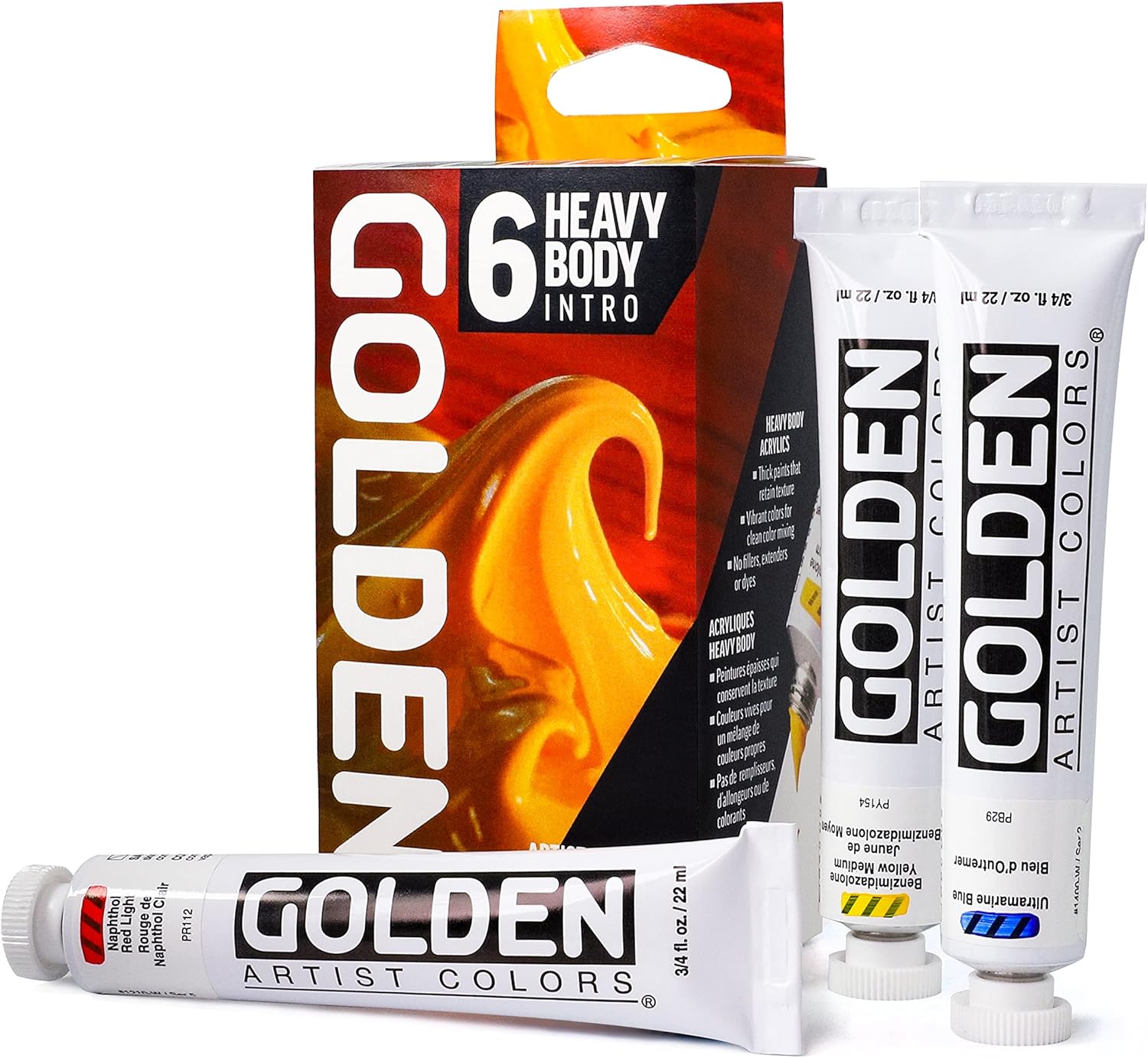
Golden Heavy Body 6-Color Intro Set
The classic limited-palette counterpoint to the 48-tube set: six professional-grade colors from the flagship US acrylic maker. Forum veterans consistently tell beginners that mixing from a small artist-grade palette teaches more than owning 50 pre-mixed student colors.
- True professional pigment load — no fillers — so an adult beginner feels what paint is supposed to do
- Limited 6-color palette forces color-mixing skills from day one
- Employee-owned US manufacturer with the best technical support docs in the industry
- Tiny 22ml tubes; this is a sampler, not a volume supply
- Thick heavy-body consistency can surprise someone expecting fluid craft paint
Three Brushes Beat Twenty: Princeton Velvetouch Set
The 20-brush bargain bundle is the paint kit problem in miniature. Most of those brushes are near-duplicates with floppy bristles that splay after two sessions, and a beginner facing twenty options learns nothing about what each shape does. Brush control comes from using a few shapes enough times that your hand knows them: a round for line and detail, an angle shader for edges and corners, a wash brush for covering ground.
The Princeton Velvetouch set covers exactly those essentials in four brushes. Princeton is the house synthetic on the brush wall at Jerry’s Artarama and most specialty stores, and Velvetouch is the line reviewers single out for holding its spring and point through acrylic’s abuse — which is considerable, because acrylic dries in the ferrule if you blink. At under $15, it pairs naturally with either paint set above.

Princeton Velvetouch 4-Brush Set (Series 3950)
Four good synthetic brushes beat the 20-brush Amazon bundle every time. Princeton is the house synthetic brand on specialty-store brush walls, and Velvetouch is the line community reviewers single out for spring and point retention at a student price.
- Covers the essential shapes (round, long round, angle shader, wash) for a first year of painting
- Durable synthetic filaments stand up to acrylic’s abuse far better than bargain-bundle bristles
- Under $15, so it pairs easily with a paint set as a gift
- Short handles — fine for tabletop work, less ideal for easel painting at arm’s length
Surfaces That Encourage Practice: Fredrix Panels and Strathmore Acrylic Paper
Precious-surface anxiety is real and it kills more beginner momentum than bad paint does. When the only surface in the house is one stretched canvas from a three-pack, every painting becomes an event — so the painting keeps getting postponed. The fix is volume: surfaces cheap enough that ruining one is a Tuesday, not a tragedy.
The Fredrix 8×10 canvas panel 12-pack handles the “real painting” side: genuine primed cotton canvas on rigid board, about $3 a surface, sized to finish in one sitting. Don’t let the sparse reviews on this particular listing worry you — Fredrix is America’s oldest canvas maker and these panels have been the classroom standard for decades; the review count is an artifact of how the listing is set up, not a verdict on the product.
The Strathmore 400 acrylic paper pad handles daily studies. Experienced painters keep steering beginners toward heavyweight acrylic paper for exactly this reason: at about $1.20 a sheet, a color-mixing exercise or a ten-minute value study costs almost nothing. The 246 lb linen-finish sheets take heavy body paint without buckling and mimic canvas tooth surprisingly well. Together, the pair removes every excuse not to paint today.

Fredrix 8×10 Canvas Panels (12-Pack)
Twelve real-canvas panels from the oldest canvas maker in America. Panels lower the stakes: an adult beginner will actually start painting when each surface costs $3, instead of freezing up in front of one precious stretched canvas.
- Genuine primed cotton canvas texture with proper tooth, not slick cardboard
- 8×10 size finishes in one sitting, which keeps motivation high
- Turned-and-glued edges resist fraying and warping better than bargain panels
- This specific listing has few reviews (the product is a decades-old classroom standard)
- Panels feel less ‘gallery-ready’ than stretched canvas

Strathmore 400 Acrylic Paper Pad, 9×12
The underrated pick: experienced painters keep telling beginners to do their daily studies on heavyweight acrylic paper instead of burning through canvas. Linen-textured 246 lb sheets take heavy-body paint without buckling.
- About $1.20 per sheet, making daily practice guilt-free
- 246 lb linen-finish sheet mimics canvas tooth surprisingly well
- Amazon’s Choice with a 4.8 rating — a quiet workhorse product
- Only 10 sheets per pad
- Paper studies can’t be varnished and hung as readily as panel or canvas work
The Accessory That Prevents Quitting: Masterson Sta-Wet Palette
Here is acrylic’s dirty secret: the paint on your palette starts skinning over in about twenty minutes. A beginner squeezes out six colors, spends fifteen minutes fussing over the drawing, and comes back to a palette of rubber. They squeeze out more, it happens again, and the whole session starts to feel like a race. Nobody warns gift shoppers about this because it’s not a product problem — until you buy the product that fixes it.
The Masterson Sta-Wet is that product, and it’s the brand WetCanvas regulars name first when the drying complaint comes up. A soaked sponge under a permeable paper sheet keeps paint workable for hours in session and for days with the lid on. Nobody thinks to gift a plastic box with a sponge in it, which is exactly why it makes a good gift — and it’s also insurance on the paint set you’re wrapping alongside it.

Masterson Sta-Wet Handy Palette
Acrylic’s number-one beginner frustration is paint drying on the palette in twenty minutes; the Sta-Wet solves it and is the brand WetCanvas regulars name first. The single accessory most likely to keep a new painter from quitting — plus it stops them wasting the paint you also gifted.
- Sponge-and-membrane system keeps acrylics workable for days with the lid sealed
- Compact 8.5 x 7 inch size suits kitchen-table painters; made in USA
- Refill paper and sponges are cheap and easy to find
- The palette paper needs proper soaking or paint gets watery — a small learning curve
- Sponge can mildew if stored wet and neglected
The Structured Path: Learn to Paint in Acrylics with 50 Small Paintings
Give an adult beginner good paint and good brushes and there’s still one obstacle left: what do I paint? Blank-canvas paralysis is a scheduling problem as much as a creative one — a vague ambition to “paint something” loses to laundry every time, but “do project 14, it takes an hour” gets done.
Mark Daniel Nelson’s book is built on that insight. Fifty projects, each about an hour, each on a 5-inch square, sequenced so color mixing and composition build progressively instead of arriving as isolated tips. It keeps resurfacing in recommendations for self-taught adults, and the finished squares accumulate into a wall grid that shows visible progress — a quiet motivator no techniques encyclopedia provides. It pairs directly with the panel pack and paper pad above.
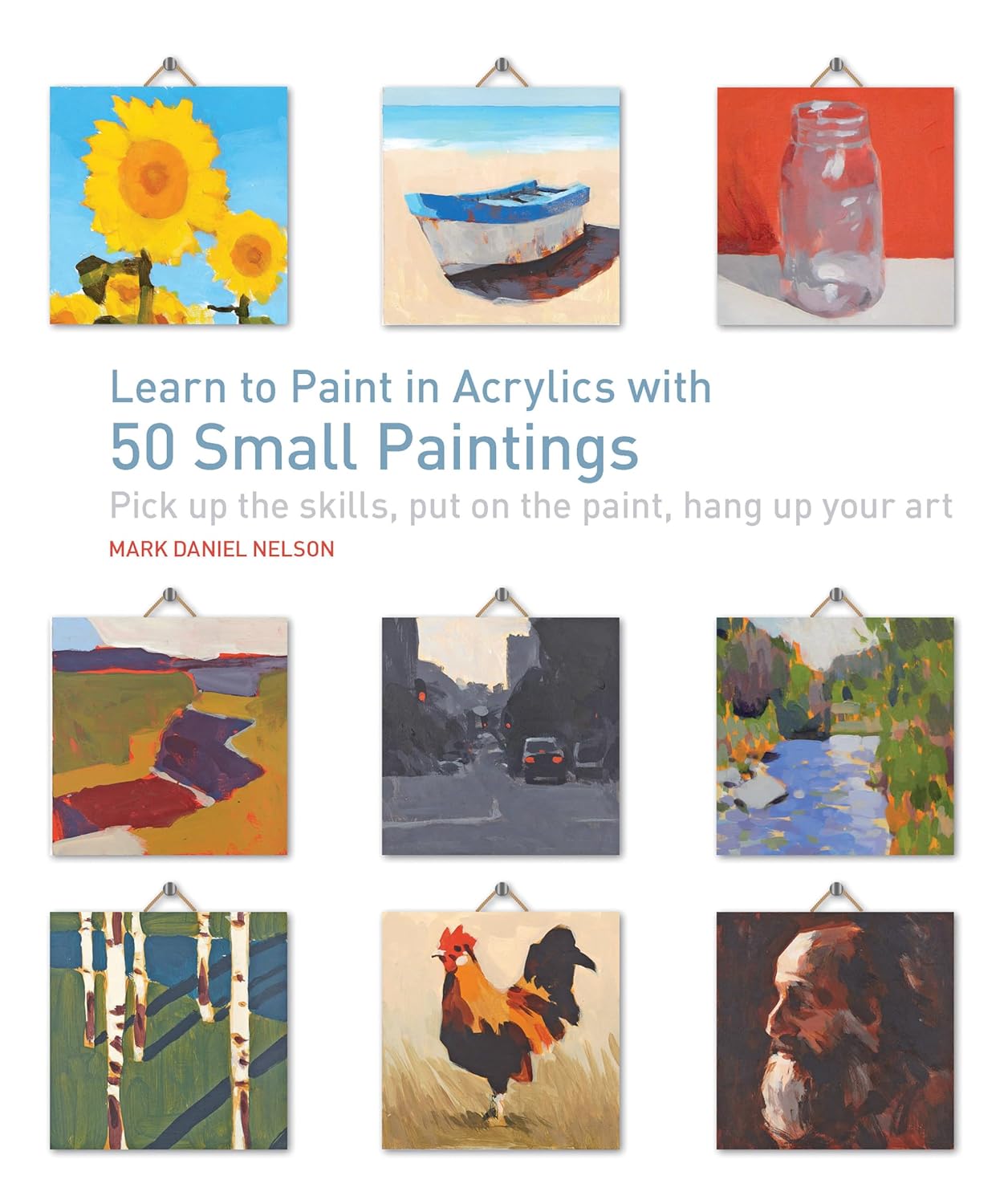
Learn to Paint in Acrylics with 50 Small Paintings
Fifty one-hour, 5-inch-square projects that build skills in sequence — exactly the structure an adult beginner needs instead of a generic techniques encyclopedia. Pairs perfectly with the panel pack and paper pad, and keeps resurfacing in community recommendations for self-taught adults.
- Each project takes about an hour, fitting adult schedules
- Small format removes blank-canvas paralysis; finished squares make a satisfying wall grid
- Teaches color mixing and composition progressively rather than as isolated tips
- Style leans graphic and simplified — less useful for someone chasing realism from day one
Complete Gift Builds by Budget: Under $40, Under $75, Under $150
Under $40 — the mixing starter: The Golden Heavy Body intro set plus the Strathmore acrylic pad comes to about $38. Six professional colors and ten heavyweight sheets is a legitimate first month of painting, and it teaches more than any $40 all-in-one kit on the market.
Under $75 — the color-range starter: The Liquitex BASICS 48-set plus the Princeton Velvetouch brushes lands around $73. This is the build for the instinct painter who wants to open a box and start immediately, with brushes that won’t fall apart by session five.
Under $150 — the no-quit setup: Liquitex BASICS, the Princeton brushes, the Sta-Wet palette, the Fredrix panel pack, and the 50 Small Paintings book total roughly $144. This build has an answer for every common quitting point: mud (real pigment), frustration (working brushes), dried palettes (the Sta-Wet), precious surfaces (twelve $3 panels), and blank-canvas paralysis (fifty sequenced projects).
Skip These: The Gifts That End Up in Closets
A note on our own editing: we had a tabletop easel on the shortlist and cut it. It’s not a bad product category, but a beginner can prop a panel against a stack of books, and every dollar spent on hardware is a dollar not spent on the consumables that actually get someone painting. The easel is a good second-year gift, once the habit exists.
What to skip
Skip the mega-count craft paint kit — those 36-to-50-tube bundles are fluid craft acrylic in artist packaging, with low pigment and high filler that mixes to mud and dries patchy. Skip the 20-brush bargain bundle, which is mostly floppy filler brushes around three usable ones. Skip the full-size standing easel, which commits your recipient to a studio corner before they know whether they’ll stick with the hobby. And skip paint-pouring kits: pouring is a different hobby entirely that gets mislabeled as beginner acrylic painting, and it teaches none of the brush skills a painter is trying to build.
The gift that works here isn’t the one with the most pieces in the box. It’s the one that quietly says “I expect you to actually paint” — paint that mixes predictably, few enough choices that starting is easy, and enough cheap surfaces that no single painting has to be good.
If you’re deciding between the two paint sets, ask yourself one question about the recipient: do they read instructions or ignore them? Readers get the Golden six; ignorers get the Liquitex 48. And if you’re not sure acrylic is even the right medium, consider whether they’ve mentioned watercolor — our watercolor beginner guide covers the same-budget alternative — or whether they spend more time on a screen than at a table, in which case the digital art guide is the better starting point.