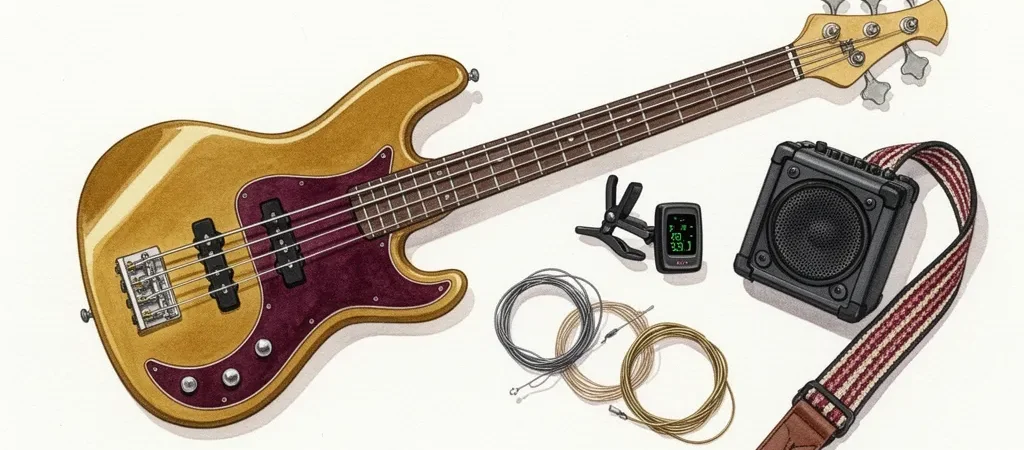
Most adult beginners who quit bass do it in the first eight weeks, and it’s almost never because they lost interest. It’s because their fretting fingers hurt too much to practice, or because they live in an apartment and there’s no way to plug in after 9pm without a neighbor knocking. Those two problems — sore hands and loud practice — kill more new bassists than any lack of talent ever will.
That reframes what a good gift is. You’re not shopping for a gigging bassist who needs their tone dialed in. You’re shopping for someone six weeks from quitting, and the right present is whatever removes a reason to stop. A silent-practice headphone amp does more for retention than a nicer instrument. A $12 tuner does more than a $200 one they’ll never learn to use.
Every pick below is judged on one question: will they still be playing this in three months? Gear that answers yes stays. Everything else — the novelty mugs, the loud amps, the five-string basses with necks that fight beginner hands — gets named in the skip list and left there.
How we select these gifts
- Specialty retailers first: We start with what music-specialty retailers actually keep in stock for beginners — the brands Guitar Center, Sweetwater, and Austin’s own Strait Music Company put in front of first-time buyers. Stores whose repeat business depends on students not quitting don’t shelve toy-grade junk.
- Community consensus: We cross-reference retail inventory against what bassists themselves recommend to newcomers in r/Bass and the TalkBass beginner forums. Picks that show up in both the store racks and the “what should my first bass be” threads get the heaviest weight.
- Age and stage fit: This guide is built for the adult beginner in weeks 1–8 — the callus-building window when fretting hurts and motivation is fragile. That means short-scale four-strings over full-scale fives, fresh flexible strings over the dead stiff sets cheap basses ship with, and silent-practice paths over gear that demands a room you can be loud in.
- Budget range: Picks span roughly $9 to $230 so the guide works whether you’re adding a $9 strap to a bass they already own or assembling a $350 complete first setup.
- Skip-this guidance: Where an obvious-looking pick works against a true beginner — a five-string, a big combo amp, an effects pedal — we say so and explain why.
First, One Decision Changes Everything: The Bass, or Gear to Go With It?
Before you look at a single product, answer one question: does the recipient already own a bass? This splits the entire guide. If they do, skip the instrument section entirely and spend your budget on the retention accessories — a quiet-practice amp, fresh strings, a proper strap, a method book. Those are what keep an existing bass in someone’s hands.
If they don’t own one, you’re buying the instrument, and there’s a second question worth asking them (or someone who knows their hands): are their hands on the smaller side, or average-to-large? Scale length — the distance the strings stretch across — is the difference between comfortable early practice and a reach that strains the fretting hand during the exact weeks it already hurts.
You don’t need to know bass to get this right. A two-line text — “Do you already have a bass? And are your hands smallish or average?” — resolves the only two variables that matter. Everything below is organized so that once you have those answers, the pick is obvious.
If You’re Gifting the Bass: Short-Scale 4-Strings That Suit Adult Beginner Hands
Two things make a first bass beginner-friendly: a short scale and four strings. Short-scale instruments (around 28–30 inches versus the standard 34) shrink the reach between frets, which matters enormously when the fretting hand is still building strength and calluses. Four strings keep the neck narrow — a five-string adds a whole extra string’s width that works against a hand still learning to place fingers cleanly.
The Squier Sonic Bronco is the safe default for average-to-large hands. At a true 30-inch scale with a slim C-shaped neck and a narrow 1.5-inch nut, it delivers reduced reach without feeling toy-like — it still plays like a real bass, which matters when the beginner graduates past month three. It’s Fender-family, so the quality control and resale value are real.
For smaller hands, the Ibanez GSRM20 miKro goes shorter still — 28.6 inches with the thinnest neck in the beginner field. With over 1,600 reviews it’s a proven beginner workhorse in the r/Bass first-bass threads. One honest caveat on both: budget basses frequently ship needing a basic setup (a tech adjusting the string height and intonation for around $40–60), which transforms how easy they are to play. Factor that in.

Squier Sonic Bronco Short-Scale Bass
A genuine 30-inch short-scale with slim C-neck and narrow 1.5-inch nut — reduced reach easier for adult beginner hands, less fretting-hand strain during the weeks 1-8 callus window. Fender-family QC, not toy-grade.
- True 30-inch short scale, lowest-strain full-featured 4-string in its price band
- Fender-family QC and resale value
- A safe, standard-feeling first bass
- Often ships needing a basic setup (action/intonation)

Ibanez GSRM20 miKro Short-Scale Bass
Thinnest, easiest-to-grip neck in the beginner short-scale field. 28.6-inch scale minimizes reach and grip strain in the first two months. Two P/J pickups give more tonal range.
- Ultra-short 28.6-inch scale and slim neck for smaller hands
- Two pickups (P/J) for more tonal range
- Proven beginner workhorse
- Very short scale feels less “standard”; some graduate from it later
The Quiet-Practice Unlock: Silent Midnight Practice in an Apartment
This is the single most powerful gift category in the guide, because it defeats the second dominant quit-driver: no way to practice without making noise. A beginner who can only play when the apartment is empty practices twice a week. A beginner who can plug in headphones at 11pm practices every night — and nightly practice is what builds the calluses and muscle memory that make bass stick.
The Fender Mustang Micro is the cleanest version of this. It’s a thumb-sized unit that plugs directly into the bass, streams any backing track from a phone over Bluetooth, and outputs to headphones — silent, latency-free, zero setup. For a solo beginner learning alone, playing along to real songs in headphones is the most engaging retention tool you can buy, and at over 4,200 reviews it’s the pick that shows up again and again in the r/Bass quiet-practice threads.
If the recipient can occasionally play out loud, the Fender Rumble 25 V3 gives them both modes in one box: 25 neighbor-safe watts for daytime, plus an aux-in to play along with songs and a headphone-out for silent night practice. Choose between the two on one variable — if they can never make noise at all, the Micro alone covers it; if they’d like to feel the low end in a room sometimes, the Rumble earns its place.

Fender Mustang Micro Headphone Amp
The quiet-practice path that defeats one of the two dominant quit-drivers for apartment dwellers. Plugs into the bass, streams a backing track over Bluetooth, outputs to headphones — silent, latency-free practice.
- Bluetooth play-along with any song — best retention tool for a solo beginner
- Rechargeable, pocket-sized, zero setup
- Beats the cheaper Vox amPlug on noise floor and build
- Guitar-first amp models slightly less full on bass

Fender Rumble 25 V3 Practice Amp
Apartment-friendly combo amp with the two features that matter for retention: aux-in to play along with songs and headphone-out for silent night practice. 25 watts stays neighbor-safe.
- Aux-in + headphone-out: play-along and silent practice in one box
- High review rating; not a disposable starter amp
- Light and apartment-sized
- 8-inch speaker a touch thin; Rumble 40 has more depth
The Under-$25 Gifts That Get Used Daily
These are the items a non-bassist would never think to buy, and they punch far above their price because they attack the sore-hands problem directly. A beginner uses all three of these every single session — which makes them the most-used gifts on the list, dollar for dollar.
Start with tuning, because a beginner who can’t tune quits fast — an out-of-tune bass sounds wrong no matter how well you play it, and that’s demoralizing in week one. The Snark SN5X clips to the headstock and tunes by sensing string vibration, which means it works silently even with headphones plugged in. It’s bass-tailored and sits at impulse-buy pricing with 15,000 reviews behind it.
Then the strings and the strap. Cheap basses ship with dead, stiff strings that make fretting physically harder — a fresh set of Ernie Ball Regular Slinky strings, the most-recommended beginner gauge, reduces the effort and buzz that frustrate new players and genuinely eases the callus weeks. And because a bass is heavy, an Ernie Ball Polypro strap at 2 inches wide spreads the weight off the shoulder and fretting hand during standing practice. Under $10, and exactly the kind of thing the buyer overlooks.

Snark SN5X Clip-On Tuner
A beginner who can’t tune quits fast. Vibration-based clip-on works even with headphones in. Bass-tailored frequency range, sub-$15.
- Vibration-based tuning works silently — pairs with headphone practice
- Bass-specific frequency range, beginner-proof
- Impulse-buy price
- Plastic clip isn’t the most durable

Ernie Ball Regular Slinky Bass Strings
Beginner basses often ship with dead, stiff strings that make fretting hurt more. A fresh set of the most-recommended 4-string gauge makes a cheap bass feel and sound dramatically better and eases the callus weeks.
- Fresh strings reduce effort and buzz that frustrate week-1 beginners
- Most common 4-string gauge — safe on any recommended beginner bass
- Under $25
- Requires a restring a brand-new beginner may need help with

Ernie Ball Polypro Bass Strap
A bass is heavy; standing practice with a thin strap adds shoulder and fretting-hand strain. This 2-inch strap distributes weight with secure leather ends. The kind of practical item the non-bassist buyer overlooks.
- 2-inch width distributes the bass’s weight
- Secure leather ends won’t slip off buttons
- Under $10
- Not heavily padded; weight-sensitive players may want neoprene later
Learning That Sticks: A Method That Turns Practice Into Progress
Gear removes reasons to quit; structure gives a reason to continue. Adult beginners who practice without a plan tend to noodle the same three notes for a month and then decide they’re not improving. A real curriculum turns those sessions into visible progress — which is its own retention tool.
The Hal Leonard Bass Method — Complete Edition by Ed Friedland is the standard here. It walks a beginner through note-reading, finger placement, and metronome-driven root-note exercises — precisely the skill markers an adult beginner needs to hit — and pairs the physical book with online play-along audio so practice never happens in silence. Friedland is one of the most respected bass educators in print, and this is the book music-store staff hand new students.
The one honest caveat: a book demands more self-discipline than video. If the recipient is clearly a video learner, point them instead to BassBuzz “Beginner to Badass” (at bassbuzz.com) — it’s not sold on Amazon, but it’s the video course that carries the same reputation the Hal Leonard book does in print.

Hal Leonard Bass Method – Complete Edition
Retention comes from structured progress. Ed Friedland’s method covers note-reading, finger placement, and metronome-driven root-note exercises — exactly the adult-beginner skill markers — with online play-along audio.
- Structured, metronome-oriented curriculum matching adult-beginner skill markers
- Ed Friedland is a respected bass educator
- Physical book + online audio, under $25
- A book demands more discipline than video
Budget Tiers: The $30 Add-On, the $150 Keep-Them-Playing Kit, the $350 Whole Setup
Around $30 — for someone who already owns a bass. The Snark SN5X tuner, the Ernie Ball Slinky strings, and the Polypro strap together run about $45 at list, or you can pick two for closer to $30. This trio attacks the sore-hands quit-driver directly: fresh strings that fret easier, a strap that takes the weight off, and a tuner so the instrument always sounds right. It’s the highest-impact-per-dollar gift on the page.
Around $150 — the keep-them-playing kit. Build it around the Fender Mustang Micro ($120) and add the Snark tuner and Slinky strings. This bundle defeats the loud-practice quit-driver: it turns any apartment, at any hour, into a place they can plug in and play along to real songs in headphones. For a beginner who already has the instrument, this is the setup that actually changes how often they practice.
Around $350 — the whole setup, from scratch. Pair the Squier Sonic Bronco ($200) with the Fender Rumble 25 amp ($150) — or swap in the Mustang Micro to save room and keep it silent — and tuck the Hal Leonard method book in beside it. That’s a complete, apartment-friendly first rig with a curriculum, every piece chosen so the first eight weeks hurt less and stall less.
What to skip
Skip the toy-grade no-name basses — they fight the player with high action and dead necks, and they hold zero resale value if the hobby sticks. Skip the novelty bass-clef mugs and socks; they’re thoughtful, but they don’t keep anyone playing past week three. And skip the three things that look like upgrades but work against a true beginner: heavy full-size amps that can’t be used in an apartment, five-string basses whose wider necks fight beginner hands, and effects pedals — there’s nothing worth plugging them into yet, and they only add confusion during the weeks that should be about calluses and root notes.
The best gift here isn’t the most expensive one — it’s the one that removes whichever reason this specific person would otherwise quit. If their hands hurt, it’s fresh strings and a proper strap. If they live in a thin-walled apartment, it’s the Mustang Micro. If they’ve got the instrument but no direction, it’s the method book. Match the gift to the obstacle and it stays in use.
What a well-chosen bass gift signals is that you saw past the instrument to the actual experience of learning it — the sore fingers, the late-night quiet, the fragile early motivation. That’s a rarer kind of thoughtful than a bass-shaped keychain.
If you’re still unsure, send the two-question text before you buy: do they already own a bass, and are their hands smaller or average-to-large? Confirm those two things and any gift on this list will still be in their hands three months from now. When in doubt on the instrument itself, size down — a short-scale bass that feels easy gets played; a full-scale one that strains the hand gets leaned in a corner.