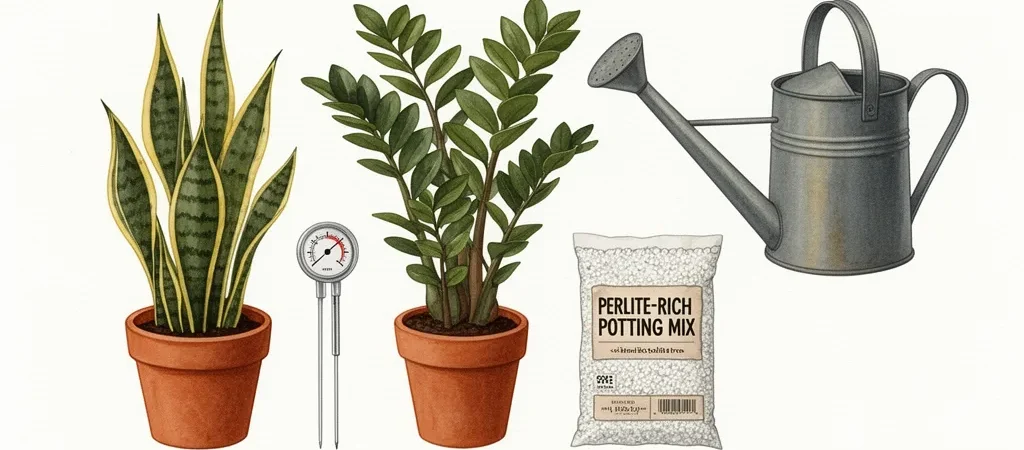
The person you’re shopping for isn’t going to kill their first plant by forgetting it. They’re going to kill it by loving it — with a watering can. Overwatering, not neglect, is the leading cause of death for beginner houseplants, and it happens for a cruel reason: the nurturing instinct and the watering instinct are the same instinct. A new plant parent who checks on their plant every day will water it every day, and most houseplants can’t survive that kind of attention.
That reframes what “best beginner plant” actually means. It doesn’t mean easiest to grow. It means hardest to accidentally drown — a plant that either stores its own water or fails so slowly and legibly that the giver’s friend has time to course-correct.
Every pick below is judged against one test: does it forgive or prevent the beginner’s guaranteed first mistake? That question sorts the gift plants from the death traps, and it’s why a $13 moisture meter earns a place next to the plants themselves.
How we select these gifts
- Specialty retailers first: We start with what serious plant sellers actually stock and ship well. Costa Farms is the grower behind most reputable garden-center and big-box live-plant tables, and Lechuza is the self-watering system independent plant shops stock when they want a planter that survives a customer’s first season. When a category (moisture meters, watering cans) isn’t a nursery item, we defer to the tool brands hobbyists actually buy.
- Community consensus: We cross-reference against what beginners recommend to each other in r/houseplants and r/plantclinic, where the same advice repeats in every “my first plant is dying” thread: snake plant, ZZ, pothos, and a moisture meter before anything fancier. Products that show up in both retail and community signals get the heaviest weight.
- Age and stage fit: This guide targets the adult total beginner — someone who has either never kept a plant or has killed the ones they tried. That stage needs forgiveness, not challenge. The right gift wins on the first attempt and builds the watering intuition that fussier plants assume the recipient already has.
- Budget range: Picks span $12.99 to $89.99, so the guide works whether you’re adding a stocking stuffer or building a near-unkillable plant-and-planter combo.
- Skip-this guidance: Where a popular “Instagram plant” is exactly wrong for this stage, we say so and explain which beginner behavior it punishes.
The Beginner’s Real Enemy: Why Overwatering Kills More Gift Plants Than Neglect
Ask a new plant owner why their last plant died and they’ll usually say “I forgot about it.” Ask what they did before it died and the real story comes out: they watered it every few days on a fixed schedule, whether the soil needed it or not. Roots need air as much as water, and soil that never dries out suffocates and rots them. The plant browns, droops, and dies looking exactly like a plant that’s thirsty — which is the trap.
There are three specific gaps behind almost every drowned gift plant. The first is watering on a calendar instead of checking the soil. The second is misreading “low light” as “any dark corner,” so a plant that merely tolerates shade gets parked somewhere it slowly starves. The third is the cruelest: reading a droop as thirst when it’s actually root rot, then watering more, which finishes the job.
You can’t fix a beginner’s instincts with a gift. But you can pick a plant that survives them, or a tool that overrides them. That’s the entire strategy here — hand someone a plant that wants to dry out, or a $13 meter that answers “is it actually wet down there?” before the watering can comes out.
Best Hard-to-Kill Plants to Gift: Snake Plant, ZZ, and Pothos
These three are the standard beginner recommendations for a reason, but they solve slightly different problems, and picking the right one depends on what you know about the recipient’s apartment and temperament.
The Costa Farms Snake Plant is the most overwatering-proof plant you can buy. Its stiff, succulent leaves store water, so it genuinely prefers to dry out completely between drinks — the exact opposite of the every-few-days habit that kills things. Forget it for three weeks and it’s fine. That makes it the safest default when you don’t know the recipient’s habits at all.
The Costa Farms ZZ Plant solves the light problem alongside the water problem. It stores water in thick underground rhizomes, so under-watering is a non-event, and its waxy leaves genuinely tolerate the dim interior corners where fussier plants stretch and thin out. If the recipient’s place is short on windows, the ZZ is the pick. Its one downside is patience: it grows slowly, so someone craving fast visible progress may feel it’s “doing nothing.”
The Costa Farms Golden Pothos is the teaching plant. Unlike the other two, it wilts dramatically and legibly when it’s thirsty, then perks back up within hours of watering — so the recipient learns to read the plant instead of the calendar. It also vines fast enough to feel rewarding. The catch is that it’s easier to overwater than the snake plant or ZZ, which is exactly why it belongs paired with the moisture meter below. One honest note across all three: snake plant and ZZ are mildly toxic to pets, and pothos is meaningfully toxic to cats and dogs, so factor in any leaf-chewing animals before you buy.
Gifts That Remove the Guesswork: Moisture Meters, Self-Watering Pots, and Long-Spout Cans
If plants are half the answer, tools are the other half — and the single most useful object in this entire guide costs less than lunch. The XLUX Soil Moisture Meter externalizes the one judgment a beginner hasn’t developed yet: is the soil actually wet an inch below the surface, where the roots are? Push the probe in, read dry/moist/wet, and the decision is made for you. It’s the whole thesis of this guide in a $13 object, and with over 60,000 ratings it’s the community default for diagnosing the “droopy but the soil’s still wet” plant that a beginner would otherwise water to death.
One step up in ambition (and price) is the Lechuza Cubico 30 Self-Watering Planter, which removes the watering schedule from the loop entirely. The plant drinks from a reservoir on its own timeline, and a visible level gauge tells the recipient exactly when to refill — no guessing, no calendar. Drop a snake plant or ZZ into it and you’ve built a combo that’s genuinely hard to kill. It’s a splurge for a single planter, but it scales to a mature plant and outlasts the beginner phase.
Finally, the humble Remiawy Long-Spout Watering Can does something subtle but real: its narrow spout delivers a slow, controlled stream at the soil line instead of a fast splash that floods the pot and wets foliage. It literally slows the pour that the overwatering instinct rushes, and it keeps water off the leaves where it invites rot. It’s the least glamorous pick here and the one a beginner is least likely to buy themselves — which makes it a good add-on gift.
The One-Box, Mistake-Proof Gift
If you want to make one confident purchase and be done, the Costa Farms ZZ in Self-Watering Pot is the answer. It stacks the two most forgiving things in this guide into one box: the most overwatering-resistant plant already potted in a reservoir system. The plant tolerates drying out, the pot meters the water, and the recipient does nothing but top up the reservoir when the indicator says so. No repotting, no sourcing a planter, no assembly.
This is the pick for the gift-giver who doesn’t know the recipient’s light or habits and doesn’t want to gamble. The ZZ’s dry-tolerance actually pairs better with a reservoir than a thirsty plant would — even an over-eager refill is hard to turn into a drowning. The only real tradeoff is size: it ships a bit smaller than the bare-root ZZ in a decorative pot at a similar price, because you’re paying for the self-watering system too.
Match the Gift to Their Light — and Be Honest About “Low Light”
“Low light” is the most misunderstood phrase in the houseplant world. It means a plant tolerates low light, not that it thrives in it — and it definitely doesn’t mean a windowless bathroom or a shelf ten feet from the nearest window. Every plant needs some light to photosynthesize; “low light” plants just die more slowly without it.
For a dim apartment with north-facing or blocked windows, the snake plant and ZZ are the honest picks — they’ll hold their own where other plants etiolate into leggy, pale versions of themselves. For a spot near a bright window that doesn’t get direct scorching sun, the pothos will reward the extra light with fast, trailing growth.
If you genuinely don’t know their light situation, default to the snake plant or the ZZ. Betting on the more shade-tolerant plant costs you nothing if their apartment turns out to be bright, but betting on the light-hungry pothos in a dark room sets the recipient up to fail.
Starter Bundles Under $50, $75, and $100
Under $50 — the “learn the basics” bundle. Pair the snake plant ($24.99), the XLUX moisture meter ($12.99), and — if you can stretch — you’re already at a complete beginner kit for under $40. The plant survives their instincts while the meter teaches them to check soil instead of the calendar. Add the long-spout can only if it fits the budget.
Under $75 — the “single confident buy plus insurance” bundle. The ZZ in a self-watering pot ($44.99) plus the moisture meter ($12.99) lands under $60 and is close to foolproof: a dry-tolerant plant, a reservoir pot that meters water, and a meter to double-check. This is the lowest-risk combination in the guide.
Under $100 — the “set them up for years” bundle. A snake plant or ZZ ($24.99–$34.99) dropped into the Lechuza Cubico 30 ($89.99) — with the moisture meter as a stocking-stuffer add — builds a plant-and-planter pairing that removes the watering schedule entirely and scales up as the plant matures. It’s the most expensive route and the one most likely to still be alive a year later.

Costa Farms Snake Plant (Sansevieria)
The single hardest houseplant to kill by overwatering: succulent leaves store water so it thrives on neglect and prefers drying out between waterings — the exact opposite of the beginner’s fixed-schedule instinct. It’s also the most consistently reviewed live-plant SKU on Amazon, and a permanent fixture in r/houseplants “safest first plant” threads.
- Tolerates deep neglect and low light, so a beginner who forgets it for three weeks still wins
- The most consistently reviewed live-plant SKU on Amazon
- Will rot if potted in a saucer that stays wet — pair with a well-draining mix or terracotta

Costa Farms ZZ Plant
Stores water in thick underground rhizomes, so it forgives — even rewards — the beginner who under-waters and punishes only the chronic over-waterer. Its waxy leaves also handle genuinely dim apartment corners, countering the “low light means any dark corner” misread.
- Rhizome water storage means a missed watering is a non-event
- Genuinely tolerates low interior light where fussier plants etiolate
- Slow grower — a beginner wanting fast visible progress may feel it’s “doing nothing”

Costa Farms Golden Pothos
The diagnostic beginner plant: it visibly wilts as a clear “water me” signal and recovers fast once watered, teaching the recipient to read the plant instead of the calendar. It vines and grows fast enough to reward attention.
- Wilts legibly when thirsty and bounces back within hours, building watering intuition
- Fast, trailing growth gives a beginner an early, motivating win
- Easier to overwater than the snake plant or ZZ — best paired with the moisture meter

XLUX Soil Moisture Meter (No Battery)
The thesis in a single 13-dollar object: it externalizes the one judgment a beginner has not yet developed — “is the soil actually wet below the surface?” — replacing the fixed-schedule instinct that causes overwatering with an instant dry/moist/wet reading. Analog and battery-free, with over 60,000 ratings making it the community default in r/plantclinic for diagnosing the “droopy but wet” plant.
- No batteries, instant read — removes the guesswork that drives root rot
- Over 60,000 ratings; the community default for diagnosing “droopy but wet” plants
- Measures moisture only — not a substitute for eventually learning the plant

Lechuza Cubico 30 Self-Watering Planter
The premium answer to the failure mode: the plant drinks from a reservoir on its own schedule and a level indicator tells the beginner exactly when to refill, so the fixed-calendar habit is physically removed from the loop. Pair it with the snake plant or ZZ for a near-unkillable combo.
- Reservoir plus visible water-level gauge externalizes watering timing entirely
- Scales up to mature plants, so it outlasts the beginner phase
- Expensive for a single planter; can still rot a plant if the reservoir is over-topped before the soil column establishes

Costa Farms ZZ in Self-Watering Pot
The single-box, mistake-proof gift: the most overwatering-resistant plant (a ZZ) already potted in a reservoir self-watering system, so both the plant and the pot forgive the beginner’s first error with zero assembly. The recipient does nothing but top up the reservoir.
- Overwatering-proof plant plus reservoir pot in one gift — nothing to source or repot
- Reservoir suits the ZZ’s dry-tolerance, so it’s hard to drown even with an eager refill
- Ships as a smaller plant than the bare-root decorative-pot version at a similar price

Remiawy Long-Spout Watering Can, 40 oz
The long narrow spout delivers water at the soil line in a controlled stream, so a beginner waters the root zone deliberately instead of dumping a fast splash that floods the pot or wets foliage and invites rot — it slows the pour that the overwatering instinct rushes.
- Precise low-flow spout encourages deliberate root-zone watering over volume dumping
- Stainless build and 40 oz size handle several plants without constant refills
- The narrow spout pours slowly — mildly annoying for anyone with many large pots
What to skip
Skip the impulse-buy “Instagram” plants a beginner can’t keep alive — calathea, fiddle leaf fig, maidenhair fern, and other high-humidity tropicals punish exactly the behaviors this guide is built around, browning at the edges the moment the humidity or watering isn’t perfect. They photograph beautifully and die fast, which is the worst possible first experience. Also skip misters and humidifiers as a starter gift: they signal a fussiness the beginner isn’t ready for and add another variable to get wrong when the goal is fewer decisions, not more.
The reason to get this right is simple: the first surviving plant is what turns someone into a plant person. A beginner who wins on their first try buys a second plant, then a fifth, then starts propagating cuttings for friends. A beginner whose first plant dies concludes they have a “black thumb” and never tries again. The gift you choose tips that outcome one way or the other.
What a forgiving plant signals from the giver is that you paid attention — that you picked something suited to their actual apartment and habits, not the prettiest thing on the shelf. That’s a better message than a fiddle leaf fig that guilts them every time a leaf drops.
If you’re unsure of their light or their habits, don’t overthink it: default to a snake plant in a self-watering pot with the moisture meter tucked alongside. That combination is nearly impossible to kill, works in almost any room, and needs no explanation. When in doubt, pick the plant that forgives the mistake they’re guaranteed to make.