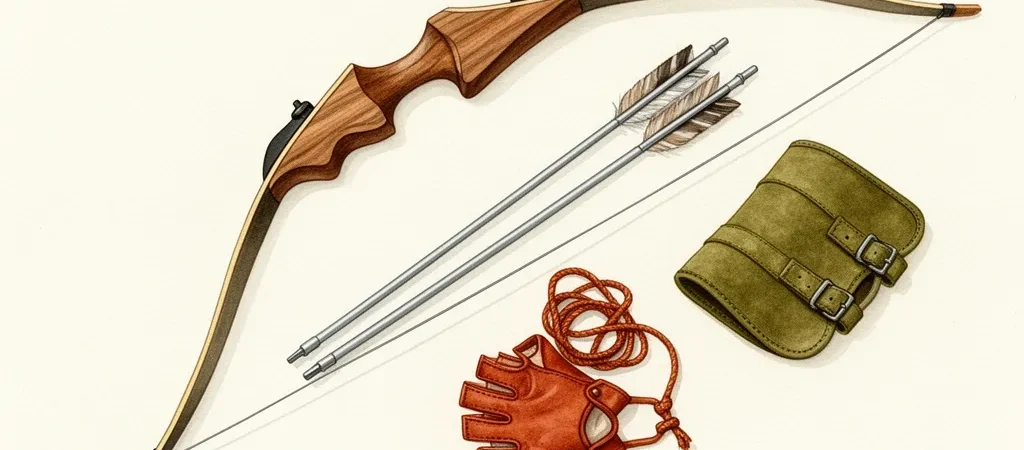
Every archery gift guide on the internet pushes the same thing: a $150 recurve set with “adult” stamped on the box. It’s the one gift you should almost never buy for someone else. A bow is fitted equipment — draw length and draw weight are personal measurements, like inseam and shoe size — and a well-meaning gift bow that’s too heavy is the single most common reason adult beginners quit before their form ever develops.
The good news is that almost everything else a new archer needs is completely safe to gift blind. Protection gear, range accessories, arrows deliberately built to fly from nearly any beginner bow, and the best instructional book in the sport all transfer between people with no measurements required.
This guide covers the gear that keeps a new adult archer shooting through their first 500 arrows — starting at $17 — plus the one correct escape hatch if a bow is non-negotiable for you.
Why a Bow Is the Worst First Archery Gift
Two numbers define whether a bow fits its shooter. Draw length is how far a person pulls the string before anchoring — it’s a function of their wingspan, and it determines what bow length and arrow length they need. Draw weight is the force, in pounds, required to hold the string at full draw. Neither number is printed on a person; both require a measurement, ideally at a pro shop.
Here’s the trap. Retail “adult” recurve sets ship at 40, 45, even 55 pounds — hunting weights — because heavier sounds more grown-up. But an adult beginner should start around 20-25 pounds. At that weight, they can hold at full draw long enough to build a repeatable anchor and release. Overbowed at 40+, they snatch, flinch, and develop shoulder pain, and the coaching forums are full of people who quietly quit because “archery hurt.” It didn’t. Their gift bow did.
So can you gift a bow without knowing draw length and draw weight? For a one-piece bow, honestly, no. Guess wrong and the fix is a whole new bow. There is one platform that dodges the problem — a takedown recurve with swappable limbs — and we cover the right way to buy one at the end of this guide. Everything before that requires zero measurements.
How We Pick: Safe to Gift Blind vs. Requires a Fitting
The organizing question for every pick in this guide: does this item need a personal measurement to work? Protection gear, consumables, range accessories, and instruction pass — they fit anyone or adjust to anyone. Fitted bows and cut-to-length arrows fail, so they’re either excluded or handled with an explicit workaround.
Within the safe-to-gift category, we weight two signals: what the specialty archery retailers stock, and what archers tell each other to buy when nobody’s earning a commission.
How we select these gifts
- Specialty retailers first: No Austin-area specialty shop anchors this niche deeply enough, so we lean on the national specialty retailers archers actually order from — Lancaster Archery Supply and 3Rivers Archery. Stores whose business depends on return customers don’t stock junk.
- Community consensus: We cross-reference retailer inventory against what archers recommend in their own communities — r/Archery beginner threads and the ArcheryTalk traditional forum. Products that show up in both signals get the heaviest weight.
- Age and stage fit: Adult beginners spend their first 3-12 months on borrowed or rented range equipment and haven’t been measured for draw length. String slap and sore fingers are the week-one quit triggers, so protection and comfort gear come first — and nothing here requires knowing their measurements.
- Budget range: Picks span $17 to $155, so the guide works whether you’re spending $20 on a stocking stuffer or $200 on a complete setup.
- Skip-this guidance: Where a popular pick isn’t right for this specific stage — including the bestselling bows themselves — we say so and explain why.
The Safe-Bet Gifts: Protection Every Beginner Needs
Two things make new archers quit in week one, and neither is boredom. The first is string slap — the bowstring raking the inside of the forearm on release, which leaves a bruise that looks like a bar fight. The second is raw string fingers, which turn a fun hour at the range into a countdown. Both are solved for under $40 total, and both solutions fit almost anyone.
The SAS suede armguard is the classic three-strap buckle design — it adjusts to real adult forearms, including over a long sleeve, which velcro guards handle poorly. Proper elbow rotation eventually makes string slap rare, but beginners don’t have proper elbow rotation yet. That’s the point.
For the string hand, the Damascus doeskin shooting glove has been the default traditional-archery answer for decades. The doeskin is thin enough to keep string feel — the thing bulky work gloves ruin — while the reinforced tips absorb the abuse of high-volume practice. It fits either hand, which removes one of the two things you’d otherwise need to know about the recipient.

SAS 7.5″ Suede Leather Armguard
String slap on a bare forearm ends more archery careers in week one than anything else — r/Archery treats an armguard as non-negotiable starter gear. Three adjustable buckle straps fit real adult forearms, including over a sleeve.
- Three adjustable buckle straps fit adult forearms, including over a sleeve
- Ventilated suede stays comfortable in summer sessions
- At $17, rounds out the full protection kit (glove + guard) under $40
- One-size design — very large forearms should verify strap reach
- Buckles are slower on/off than velcro
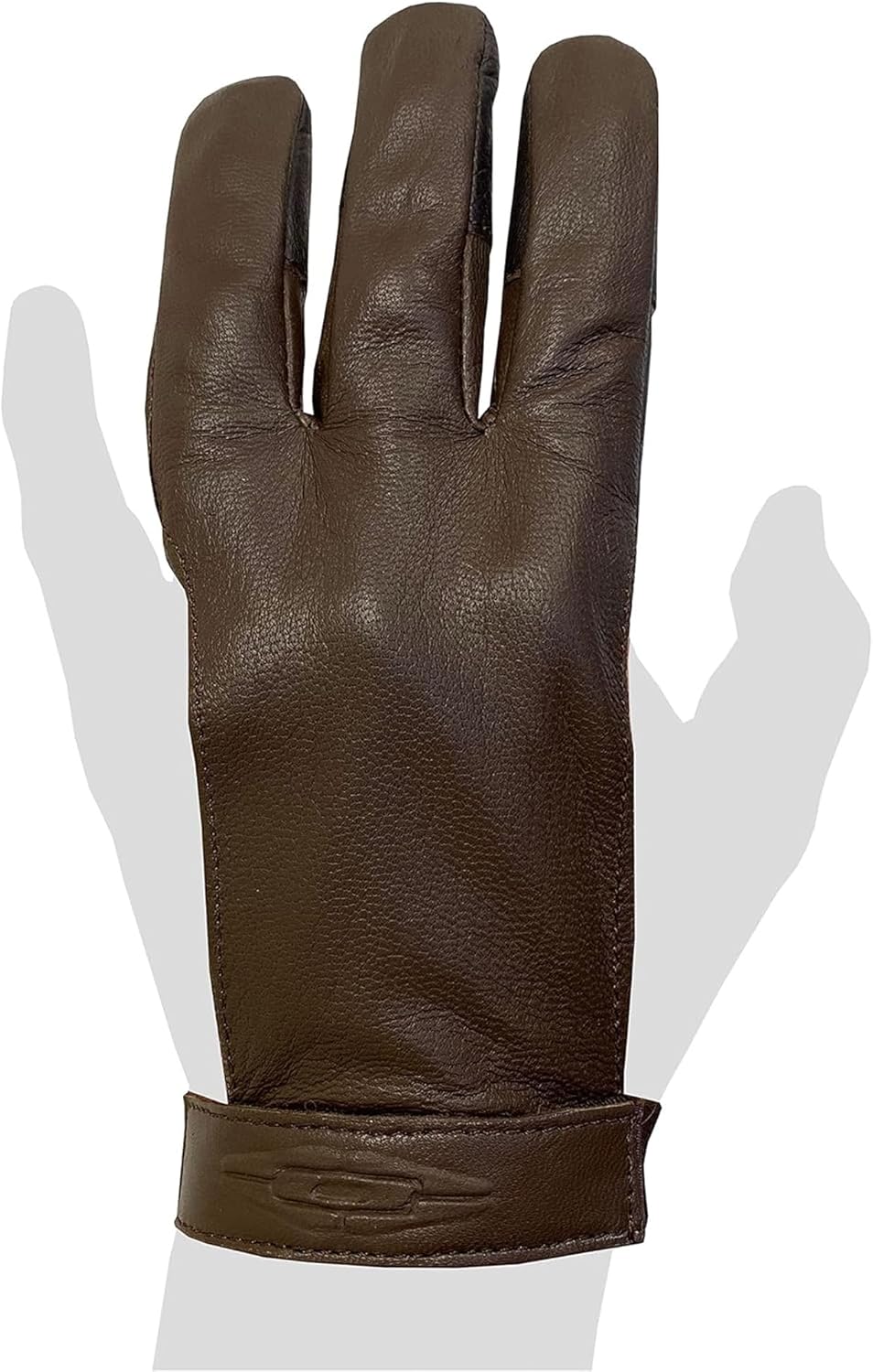
Damascus Doeskin 3-Finger Shooting Glove
String fingers give out long before enthusiasm does; this doeskin three-finger glove — stocked at 3Rivers Archery and recommended for decades on ArcheryTalk — preserves string feel while reinforced tips take the abuse of high-volume practice.
- Thin doeskin keeps string feedback that bulkier gloves lose
- Fits either hand — one less thing to get wrong when gifting
- Reinforced fingertips hold up to daily backyard sessions
- Sized S-XL, so you need a rough sense of the recipient’s hand size
Range-Day Gifts Nobody Thinks Of
Watch a public range for an hour and you can sort the archers by their accessories. Beginners lay arrows in the grass and hunt for them between ends. Everyone else wears a hip quiver. The Easton Flipside quiver is the one beginners end up buying themselves after a month — its flip design works for left- or right-handed shooters, and the zippered pocket holds the glove, wax, and tools, effectively becoming the range bag for this whole starter kit.
The Selway bow stringer is the expert tell in this guide. Stringing a recurve by muscling it against your leg — the way beginners improvise — twists the limbs over time and voids most warranties. A stringer prevents that for $21, yet it’s the item new archers most often skip because nobody told them it existed. If the person you’re shopping for owns or is getting a recurve, this is quietly the highest-value item on this page.
Arrows are supposed to be fitted equipment too — spine (stiffness) should match draw weight and length. The Easton Genesis XX75 arrows are the gift-giver’s cheat code: deliberately built with a spine tolerance wide enough to fly acceptably from almost any bow between 15 and 50 pounds, full-length, no pro-shop cut required. They’re the official arrow of the National Archery in the Schools Program precisely because they work across a room full of mismatched shooters.
Finally, practice frequency beats practice duration in archery, and frequency requires a target at home. The Morrell Yellow Jacket bag target is the one forum regulars point beginners to: 54 layers, two shooting sides, and — the detail that matters more than it sounds — two-finger arrow removal. Wrestling arrows out of a cheap foam block is a genuine motivation killer.

Easton Flipside 3-Tube Hip Quiver
Visible on every club range in the country — the quiver beginners end up buying themselves after a month of pulling arrows out of the grass. It reverses for left- or right-hand shooters, holds a dozen arrows, and the zippered pocket swallows the stringer, glove, and wax between sessions.
- Ambidextrous flip design removes the left/right-hand gamble
- Zippered pocket and tool grommets turn it into the range bag for the whole starter kit
- 975 reviews at 4.7 stars for around $21
- Belt clip works best on a real belt — less secure on athletic-wear waistbands

Selway Recurve Bow Stringer
The unglamorous gift that saves the glamorous one: forums are unanimous that stringing a recurve without a stringer twists limbs and voids warranties, yet it’s the item beginners most often skip. Selway’s block-style design has been the specialty-dealer standard since the mid-1990s.
- Nonslip rubber block design prevents the limb twist that kills takedown recurves
- USA-made, 1000-denier Cordura, lifetime warranty — a $21 tool that outlives the bow
- Handles bows up to 74 lb, so it survives every limb upgrade
- Recurve-only — not for longbows

Easton Genesis XX75 Aluminum Arrows (6-Pack)
The official arrow of the National Archery in the Schools Program, made from 7075 aerospace aluminum and deliberately spined to fly acceptably from almost any bow in the 15-50 lb beginner range. That wide tolerance is the gift-giver’s cheat code: full-length Genesis XX75s work out of the box, no pro-shop cut required.
- One-spine-fits-most design forgives the unknown draw length problem
- Aluminum is durable with replaceable nocks and screw-in points
- Easton is the arrow brand every specialty retailer stocks
- Some buyers report vanes needing re-gluing — a $5 tube of fletching glue fixes it
- Serious target archers eventually want arrows cut and spined to their measured draw

Morrell Yellow Jacket Supreme 3 Bag Target
Stocked at Lancaster, 3Rivers, and basically every archery specialty retailer — what forum regulars tell beginners to buy so practice happens at home, not just at the range. 54 layers, two shooting sides, ten bullseyes, and two-finger arrow removal.
- Easy two-finger arrow removal keeps practice fun instead of a tug-of-war
- Weatherproof and handled — lives outside, moves easily
- Replacement covers sold separately, so the target outlasts its skin
- Field points only — broadheads will destroy it
- At 28 lb it’s portable, not featherweight
The $30 Season of Coaching: Shooting the Stickbow
Every new archer hits the same wall of questions: What draw weight? What arrows? Where do I anchor? Gap aiming or instinctive? Most burn weeks piecing together answers from contradictory Reddit threads. Shooting the Stickbow answers all of them in one 563-page volume, written by Anthony “Viper” Camera — an ArcheryTalk fixture whose book the forum flatly treats as the beginner text without a peer.
It reads as instruction-in-a-box: equipment selection, form, anchoring, aiming systems, tuning, troubleshooting. For a recipient who learns from the page, it’s a season of coaching for thirty dollars.
Which raises the honest disclosure: the single best archery gift money can buy isn’t on Amazon at all. An intro course, a punch card at the local range, or a gift card to a pro shop that includes a draw-length fitting will do more for a new archer than any object in this guide. If there’s an archery shop within driving distance of your recipient, a lesson package pairs with anything here — or replaces it.

Shooting the Stickbow (3rd Edition)
563 pages by ArcheryTalk legend Anthony “Viper” Camera, and the forum’s flat verdict is that for beginners no other book compares. It covers exactly the decisions a new adult archer faces — draw weight, arrow selection, anchoring, aiming methods, tuning — effectively bundling a season of coaching for thirty bucks.
- The single most-recommended archery text on enthusiast forums
- Answers the equipment questions that otherwise send beginners down Reddit rabbit holes
- 4.9-star rating — rare air for any instructional book
- Recurve/longbow focused — minimal value for a compound-bow-only recipient
If You Must Gift a Bow: The Takedown Escape Hatch
Sometimes the bow is the point of the gift, and nothing else will land. There is one correct way to do it: a takedown recurve, where the limbs unbolt from the riser. The Southwest Archery Spyder is the standout — designed by the engineers behind the Samick Sage, the platform that’s been the default r/Archery beginner answer for a decade and one Lancaster Archery has called the best beginner recurve on the market.
The takedown design is what makes this giftable. Order it in 25 or 30 pounds — resist the listing’s 40-55 lb hunting weights, which are exactly the overbowing trap this guide opened with. When the recipient outgrows the starter weight in six months to a year, they buy $40 replacement limbs, not a $150 replacement bow. You’ve given them a riser that grows with them.
Recurve or compound for a first bow? Recurve. It’s a third of the price, it teaches form directly because there’s no let-off masking mistakes, and it doesn’t need pro-shop tuning to shoot. Compounds are genuinely fitted machines — draw length is set mechanically — which makes them even worse blind gifts than one-piece recurves. One measurement worth sneaking, though: if your recipient is tall with long arms (roughly 6’2″+, or a draw past 29 inches), order the 64-inch Spyder XL variant instead of the standard 62.

Southwest Archery Spyder 62″ Takedown Recurve
Designed by the engineers behind the legendary Samick Sage — the same takedown platform Lancaster Archery calls “the best beginner recurve on the market” and the default r/Archery beginner answer for years. Because it’s a takedown, you gift it in 25 or 30 lb and they buy heavier limbs later instead of a whole new bow — exactly how you dodge the overbowed trap.
- Takedown design means $40 replacement limbs, not a $150 replacement bow, when they outgrow 25-30 lb
- Real wood handcrafted riser with stabilizer/sight bushings — grows with them from bare-bow to accessorized
- Same Sage platform specialty retailers have stocked for a decade, so strings, limbs, and parts are everywhere
- Order 25 or 30 lb, not the 40-55 lb “hunting” weights — the listing makes it easy to overbuy
- Archers with a 29″+ draw length should get the 64″ Spyder XL variant instead
Archery Gifts by Budget: Under $25, Under $75, Under $200
Under $25: The SAS armguard ($17), Damascus glove ($23), Easton Flipside quiver ($21), or Selway stringer ($21). Any one of these is a complete gift on its own; the armguard-plus-glove pair is the strongest sub-$40 combination on this page.
Under $75: Shooting the Stickbow ($30), the Genesis XX75 arrows ($38), or the Morrell bag target ($62). The book suits the researcher; the target suits anyone with a backyard; the arrows suit anyone who already owns a bow of unknown specs.
Under $200: The Spyder in 25-30 lb ($155) plus the Genesis arrows ($38) is the complete escape-hatch bundle — a bow they won’t outgrow as a platform and arrows that fly from it on day one. Add the stringer if the kit you order doesn’t include one.
What to skip
Skip the Amazon-bestseller 40-50 lb “adult recurve sets” and anything marketed as one-size-fits-all — adult beginners should start around 20-25 pounds, and boxed sets that omit a bow stringer or bundle mismatched-spine arrows produce bruised forearms and bad habits in the same week. Skip novelty archery merch too — the mugs, the “may the odds be ever in your favor” t-shirts. That $25 covers half a lesson at most local ranges, and the lesson is the better gift by a wide margin.
The gift that keeps someone in archery isn’t the shiniest bow under the tree. It’s the armguard that means their forearm doesn’t bruise, the target that means Tuesday-evening practice actually happens, and the book that answers the question they were too embarrassed to post. Comfortable first-500-arrows gear is what separates archers from people who tried archery once.
Giving protection gear or a stringer also signals something a bow can’t: that you understood the hobby well enough to buy what shooters actually use. Any archer who unwraps a bow stringer knows immediately that someone did their homework.
If you’re still torn between two picks, choose the cheaper, less glamorous one and put the difference toward range time or a lesson. Give the fitting, not the fit — the bow they choose for themselves after ten lessons will be the right one.