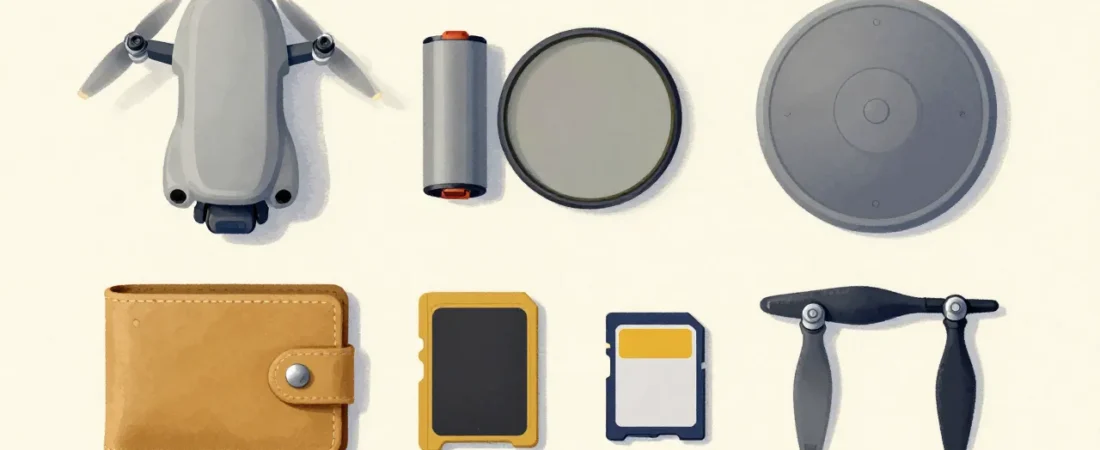
Most drone gifts fail before the first flight. The buyer picks a drone, skips the accessories, and ignores a regulatory layer that can ground the whole gift before it leaves the driveway. That pattern is fixable, but only if you understand the one specification that changes everything for adult beginners: the 249-gram weight threshold.
Every drone in this guide weighs under 249 grams. That single fact means your recipient can take it outside, charge the battery, and fly — the same day they open the box — without touching a government registration portal. That is not a minor convenience. For a gift, it is the difference between a hobby that starts immediately and a hobby that starts after a bureaucratic detour most beginners never complete.
This guide also addresses the quieter failure mode: gifting a drone without the accessories that make a session worthwhile. One battery, no microSD card, no landing pad — that is how a $300 drone becomes a $300 paperweight after two frustrating sessions. We cover the full stack.
How we select these gifts
- The 250-gram filter first: Every pick must weigh under 249 grams. This eliminates FAA recreational registration for US-based flyers entirely — no $5 fee, no FAA number to label on the drone, no portal to navigate. All seven drones in this guide qualify. This is non-negotiable for a gift that should fly on day one.
- Community consensus: We cross-reference Amazon review volume and rating against what pilots recommend in r/drones, r/dji, and dedicated beginner communities. Products with 600+ reviews and active forum presence get the heaviest weight — that depth of real-world feedback catches problems that spec sheets hide.
- Stage fit for adult beginners: Adults learning to fly have no prior stick-input muscle memory and routinely misjudge orientation when a drone is flying away from them. Every pick must have GPS-assisted auto-hover at minimum. No toy quads, no brushless drones without GPS stabilization — those require piloting competence the recipient does not yet have. Mechanical gimbals preferred over EIS for footage quality, but budget picks with EIS are included when the price justifies the tradeoff.
- Ecosystem depth: The brand must have a documented spare parts supply, firmware update history, and an accessible app. A drone from a brand that disappears in 18 months leaves the beginner stranded when props break — and props break.
- Budget range: Picks span $129 to $649 so the guide works whether you’re spending $130 or building a complete $600 kit. Each price point is editorially justified, not filler.
- Skip-this guidance: Where a popular pick isn’t right for this specific stage or use case, we say so and explain the exact reason. No hedging.
How We Pick: The 250-Gram Rule and Why It Drives Every Choice Here
The Federal Aviation Administration requires recreational drone pilots to register any drone weighing 250 grams or more. Registration costs $5 and covers three years, which sounds trivial — until you realize it also requires creating an FAA account, affixing a registration number to the aircraft, and understanding that flying in controlled airspace still requires separate LAANC authorization regardless of registration status. For a motivated adult who just wants to learn, that friction is manageable. For a gift recipient who received a drone unexpectedly and has no prior interest in FAA compliance workflows, it is a meaningful barrier that often delays or kills the hobby entirely.
Drones under 249 grams — specifically, drones that weigh less than 250 grams — skip recreational registration entirely under current FAA rules. The recipient still needs to follow basic safety rules (fly below 400 feet AGL, avoid controlled airspace without authorization, keep the drone in visual line of sight), but there is no paperwork, no portal, no label to affix. They can fly the day they open the box. That is what makes the sub-249g category the correct gifting framework for adult beginners in 2026.
All seven drones in this guide are under 249 grams. The lightest — the HOVERAir X1 — comes in at 125 grams. The heaviest — the DJI Flip — sits at exactly 249 grams. This is not a coincidence; it is the result of manufacturers deliberately engineering their beginner and prosumer products to hit this threshold because the market has made clear that registration-free operation is a selling point. Beyond weight, every pick here must clear three additional gates: GPS-assisted stabilization (auto-hover, no pilot input required to hold position), a brand with demonstrated parts and firmware support, and a community large enough that a beginner can find answers when something goes wrong.
The Best Drone Gifts for Adult Beginners in 2026
The seven picks below cover every meaningful decision a gift buyer faces: how much to spend, whether camera quality or crash-resistance matters more, whether the recipient wants to learn to pilot or just wants autonomous aerial footage of themselves. The ordering goes from lowest price to highest, not from worst to best — each pick is the right answer for a specific person with specific needs.
One note on DJI availability: DJI was effectively blocked from new US imports by an FCC decision in December 2025. Stock of the DJI Mini 4K and DJI Flip is finite and declining. Both are still available as of May 2026, but if you are reading this later and stock has dried up, the Potensic Atom 2 is our recommended backup for the Mini 4K, and the Autel EVO Nano+ covers the Flip’s obstacle-awareness use case at higher cost.

Holy Stone HS720E
The entry point where a beginner gets real GPS-assisted flight, brushless motors, Follow Me mode, and two batteries for $130. With over 7,700 Amazon reviews, this is the most-tested budget GPS drone on the market — that review depth means troubleshooting answers exist for virtually any problem a new pilot encounters. Integrated Remote ID is included, satisfying the FAA broadcast requirement that applies to most flights in 2026. At $129.99, it is the lowest-cost route to responsible GPS-stable beginner flying without toy-drone compromises.
- Lowest price in guide with real GPS, brushless motors, and 46-minute two-battery flight time
- Integrated Remote ID included out of the box
- 7,700+ Amazon reviews provide the deepest community troubleshooting pool in this guide
- No mechanical gimbal — EIS only, footage is soft and wobble-prone compared to gimbal competitors
- Holy Stone support and warranty reputation is weaker than Potensic or DJI

Potensic Atom SE
The most-cited budget non-DJI beginner pick across r/drones and beginner threads. Two batteries combine for 62 minutes of flight — more practice time per session than almost anything else at this price. Sub-249g means no FAA recreational registration, and GPS return-to-home provides a meaningful safety net against flyaways when the beginner loses orientation. At $199, this is the sweet spot for buyers who want something real without DJI pricing.
- 62 minutes combined flight time across two batteries — far more practice than single-battery competitors
- Sub-249g eliminates FAA registration; GPS return-to-home protects against flyaways
- Brushless motors deliver better durability and efficiency than brushed motors in toy-class drones
- EIS stabilization rather than mechanical gimbal — footage shows more distortion during aggressive maneuvers
- 4KM transmission range and app interface are noticeably behind DJI

DJI Mini 4K
The single most recommended beginner drone across every forum, subreddit, and specialty community over the past three years — a position earned, not marketed. The 3-axis mechanical gimbal and DJI’s GPS stabilization mean first flights look smooth even when the pilot is nervous and over-correcting on the sticks. The DJI Fly app is the most polished beginner interface available: guided tutorials, a clean heads-up display, and intelligent flight modes that produce compelling footage before the pilot has developed real skill. Under 249g means no FAA registration for recreational use. One honest note: DJI’s US import was blocked by an FCC decision in December 2025, and stock is finite. At $209 as of May 2026, it is still the top pick — but buy it now if you want it.
- Under 249g — zero FAA registration required for recreational use
- 3-axis mechanical gimbal produces smooth 4K/30fps footage from day one
- DJI Fly app is the most refined beginner interface in the category
- No obstacle avoidance sensors — beginners must fly with active attention
- DJI import uncertainty means stock is not being replenished

DJI Flip
Designed around one insight that DJI was honest enough to build into hardware: adult beginners crash. Fully enclosed propeller cages shield rotors from minor collisions that would shatter exposed props on any other drone in this guide. Palm takeoff removes the intimidating first-launch moment — you hold it in your palm, tap the button, it lifts off. At 249g exactly, it stays below the FAA registration threshold. Forward and downward infrared sensing adds a collision-warning layer beyond the physical guards. At $329, it is the lowest price since launch, and it is the right pick for gift buyers who cannot verify that the recipient will be a cautious, attentive pilot in early sessions.
- Fully enclosed propeller guards provide physical crash protection that no software can replicate
- Palm takeoff and intelligent flight modes produce compelling first-day footage
- Forward and downward infrared sensing adds a hardware collision-warning layer
- No omnidirectional obstacle avoidance — only forward-facing sensors
- Enclosed prop design creates slightly more drag in wind versus open-frame drones at the same weight

Potensic Atom 2
With DJI’s US import effectively blocked, the Potensic Atom 2 stepped into the gap and earned serious attention from forum testers who compared it directly to the DJI Mini 4K. The Sony 1/2-inch CMOS sensor paired with a 3-axis mechanical gimbal produces footage quality that reviewers in r/drones found genuinely competitive — not a consolation prize. Built-in Remote ID satisfies FAA broadcast requirements out of the box. No DJI account required, which matters to buyers who want to avoid that data relationship. This is the pick if DJI stock is gone in your region or you prefer to stay outside the DJI ecosystem entirely.
- Sony 1/2-inch CMOS sensor with 3-axis mechanical gimbal — best footage outside the DJI ecosystem at this price
- Built-in Remote ID module satisfies FAA broadcast requirements out of the box
- AI subject tracking and vertical shooting mode for social media content
- No obstacle avoidance sensors
- App stability and GPS acquisition lag behind DJI Fly in head-to-head comparisons

HOVERAir X1
A completely different conceptual category from every other pick in this guide. There is no controller. You hold it in your palm, tap the button, select a pre-programmed shot path — hover, orbit, zoom-out, bird’s-eye — and it executes autonomously, returns, and lands in your hand. At 125 grams it is the lightest pick here, fits in a jacket pocket, and its enclosed props make it the only drone in the lineup that is genuinely safe to fly indoors. The right recipient is an adult who wants compelling aerial footage of themselves without the learning curve of stick inputs — hikers, cyclists, travel bloggers, anyone who wants a camera that happens to fly rather than a drone they happen to carry a camera on.
- Zero-controller operation — palm takeoff, autonomous shot paths, no joystick learning curve
- 125g — lightest in the guide, fits in a jacket pocket, exempt from FAA registration
- Enclosed props make it the safest indoor and close-range drone in the lineup
- Approximately 11 minutes of flight per battery — shortest in the guide; the Fly More Combo is strongly recommended
- No manual flight control — limiting for pilots who want to actively frame shots beyond themselves

Autel EVO Nano+
The only drone in this guide with genuine 3-direction obstacle avoidance — front, rear, and bottom — in a sub-249g package. DJI reserves that feature for the Mini 4 Pro at significantly higher cost. The 1/1.28-inch RYYB sensor delivers the best low-light image quality at this weight class; dusk and golden-hour footage that looks muddy on other drones holds detail here. Autel Robotics is a US-based company and NDAA-compliant — no mandatory account creation, no data questions. For buyers who need maximum safety hardware, the best sensor in the sub-250g category, and no connection to a Chinese company, this is the answer. The $649 price is real and significant; it is only justified when those three requirements all matter simultaneously.
- 3-direction obstacle avoidance — the only sub-250g implementation in this guide, meaningfully reduces crash risk
- 1/1.28-inch RYYB sensor delivers the best low-light image quality at this weight class
- NDAA-compliant US company, no mandatory account creation
- $649 — most expensive pick in the guide, double the Potensic Atom 2
- Autel app and firmware maturity trail DJI — more calibration friction for new users
Beyond the Drone: The Accessory Stack Every Beginner Pilot Actually Needs
A drone without accessories is an incomplete gift. Most beginner drones ship with one battery providing 20 to 31 minutes of flight — enough to crash twice, not enough to develop the muscle memory that makes flying enjoyable. One battery means a session ends just as the pilot is getting comfortable.
The microSD card omission is the quieter failure. Most beginner drones — including the DJI Mini 4K and HOVERAir X1 — do not ship with a storage card. The recipient opens the box, captures footage they’re proud of, and discovers none of it saved. A 64GB Class 10 U3 card ($10–$15) prevents this entirely.
ND filter sets deserve more credit in beginner contexts. They are not advanced gear — they solve a specific problem beginners encounter immediately: footage that looks unnatural because the shutter speed is too fast in bright daylight. An ND filter slows the shutter, introduces the natural motion blur that makes drone footage look cinematic, and teaches the recipient the 180-degree shutter rule without any theory. A four-filter set (ND4, ND8, ND16, ND64) covers most lighting conditions for $30–$50.
A neoprene landing pad (30–60cm diameter) solves a problem invisible until it destroys footage: grass debris. Landing on grass kicks up dust and seeds that land directly on the lens. A pad gives the drone a clean surface and signals a level of seriousness that the drone alone does not. A carrying case or drone backpack makes the hobby portable and protects the investment.
What Your Recipient Needs to Know Before the First Flight
For recreational flyers in the US, drones under 250 grams do not require FAA registration. All seven picks in this guide qualify. No $5 fee, no account to create, no registration number to affix to the airframe.
Remote ID applies broadly in 2026. Most drones manufactured after September 2023 include built-in Remote ID — a broadcast module that transmits the drone’s location and operator location in real time. Every pick in this guide includes Remote ID either as standard equipment or as an integrated module. It is on by default; the only action required is keeping firmware current.
The TRUST safety test — the FAA’s free online knowledge test for recreational flyers — is required before flying in controlled airspace. It takes about 30 minutes, costs nothing, and never expires. Flying in uncontrolled Class G airspace (most open parks and fields away from airports) does not require it. The B4UFLY app shows airspace classifications and active TFRs for any location in real time — the practical daily tool every beginner should have on their phone before the first flight.
Complete Gift Bundles by Budget: $200, $350, and $600 Starter Kits
The $200 Starter Kit — For buyers who want the lowest responsible entry point:
- Holy Stone HS720E (includes 2 batteries) — $129.99
- 64GB microSD card (Class 10, U3) — ~$12
- Landing pad (30cm neoprene) — ~$15
- Propeller guards (if not included) — ~$10
Approximate total: $167. The HS720E ships with two batteries, so the bundle stays lean. Remaining budget covers a carrying case (~$25) if the recipient transports the drone regularly.
The $350 Starter Kit — The strongest value bundle in the guide:
- DJI Mini 4K (single battery) — $209.00
- DJI Mini 4K Intelligent Flight Battery (extra) — ~$49
- ND filter set (drone-specific, 4-pack) — ~$35
- 64GB microSD card — ~$12
- Landing pad — ~$15
Approximate total: $320. If the DJI Mini 4K is out of stock, substitute the Potensic Atom 2 — same price tier, same accessory stack applies.
The $600 Starter Kit — For serious gift budgets:
- Autel EVO Nano+ — $649.00
- Extra Autel EVO Nano battery — ~$59
- ND filter set (Autel-specific) — ~$40
- 128GB microSD card — ~$18
- Drone backpack — ~$45
Approximate total: $811 — this bundle genuinely overshoots $600. The honest path: buy the drone and one accessory that matters most. The Autel EVO Nano+ alone at $649 is a complete and appropriate gift; accessories can follow once they confirm they want to pursue the hobby.
What to skip
Skip any drone under $150 from a brand without a documented community presence — no-name GPS quads fly erratically, lack spare parts, and leave the beginner stranded after the first prop strike. Also skip gifting a drone without at minimum a microSD card: the recipient will not be able to save footage on day one, and most beginner drones do not tell you this anywhere in the box. Finally, skip any drone over 249 grams for a beginner gift unless you plan to walk them through FAA registration before they fly — the sub-249g category is strong enough that there is no need to accept that friction.
A drone gift done right sets an adult beginner up for a hobby with a real progression arc — cleaner footage as technique improves, more interesting locations as confidence with airspace tools develops, and an eventual Part 107 certification if they go commercial. Every pick here is under 249 grams, flies the day the box opens, and has a community that has already documented the learning curve. What remains is matching the pick to the person.