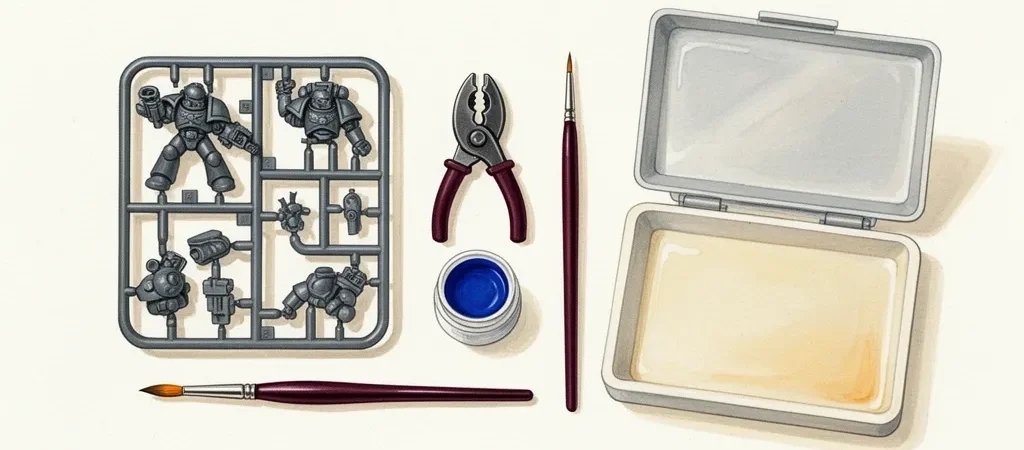
Most Warhammer 40k gift guides skip the one question that determines whether a $170 box becomes a treasured hobby anchor or an intimidating dust collector: does your recipient want to paint, play, or both? That distinction matters because the hobby has two genuinely different on-ramps, and the right gift depends entirely on which one your person is standing at.
The other trap is faction blindness. Warhammer 40k has dozens of armies, and a gift buyer who doesn’t know which one their recipient has chosen — or is leaning toward — risks buying faction-specific paints for entirely the wrong color scheme. This guide flags every point where faction choice changes the recommendation.
Everything here is targeted at adult beginners in their first six months. The picks solve specific friction points that cause people to stall before they finish their first model: assembly anxiety, primer confusion, brush choice paralysis. If you remove those friction points, the hobby tends to stick on its own.
How we select these gifts
- Specialty retailers first: We start with what established hobby retailers actually stock — Jerry’s Artarama Austin carries the Winsor & Newton Series 7 line and is a reliable signal that a product has earned shelf space with a serious crafts buyer, not just an algorithm. For Games Workshop products, authorized local game stores (LGS) are the community-trust equivalent. When no local specialty store covers a niche, we check national hobby specialty sources.
- Community consensus: We cross-reference retailer inventory against what hobbyists recommend in their own communities — r/Warhammer40k, r/minipainting, and the Warhammer Community beginner threads. Products that appear as consistent recommendations across multiple forum threads, not just single upvoted comments, carry the most weight. FauxHammer’s beginner tool reviews provided a second specialist opinion on the tools picks.
- Intent-matching framework: Adult beginners split into two groups: hobby-first (they want to paint) and play-first (they want to get to the table). A $170 Combat Patrol box is exactly right for a play-first beginner and potentially overwhelming for someone who hasn’t assembled a single miniature yet. Every pick here is labeled for which intent it serves.
- Budget range: Picks span $16–$170 so the guide works whether you’re spending $16 on a single high-impact tool or $170 on a complete starter force.
- Skip-this guidance: Where a popular pick isn’t right for this specific stage or this specific recipient, we say so and explain the exact condition that makes it wrong.
The Combat Patrol: Ultramarines — The Right Starting Point for Most Beginners
The hardest question a new Warhammer 40k player faces isn’t “which army should I pick?” — it’s “when do I stop buying before I’ve played a game?” Army building has no natural stopping point. A Combat Patrol box solves this problem by giving you a complete, legal force at a fixed price point with no supplemental model purchases required to play.
The 2025 Ultramarines edition includes 17 miniatures led by Chief Librarian Tigurius, a named character whose presence in the box signals Games Workshop’s intent: this is a proper army, not a sampler. At 420 points, it’s sized for Combat Patrol-format games — the fastest, lowest-overhead way to learn how 40k actually plays without a full 2,000-point matched-play commitment.
Ultramarines are the right default for a beginner gift for a specific reason: they are the tutorial army. Warhammer TV’s painting guides, GW’s YouTube channel, and most beginner content online defaults to Space Marines in Ultramarine blue. If your recipient hasn’t chosen a faction yet, this is the lowest-risk pick. If they have chosen a different faction, skip directly to the Paints + Tools Set — a $35 faction-neutral gift is far safer than a $170 box for an army they aren’t playing.

Combat Patrol: Ultramarines (2025 Edition)
The Combat Patrol format solves the adult beginner’s first friction point: not knowing where to stop buying. This box gives you a complete, legal 420-point force — 17 Ultramarines miniatures led by Chief Librarian Tigurius — designed to be played right out of the box with no supplemental purchases required. Ultramarines are generalists whose rules reward learning the game, and their tutorial ecosystem is the largest in the hobby.
- Self-contained army at $170 — 17 models including named character Tigurius; saves approximately $94 versus buying individually
- Space Marines have the widest beginner resource library: GW YouTube tutorials, Warhammer TV painting guides
- Includes Ultramarines Upgrade Frame and transfer sheet for customization
- At $170, a meaningful commitment before they have painted a single model; consider pairing with the paint set first
- Units come in half-squad sizes limiting matched-play expansion options
Paints and Tools: What the Citadel Paints + Tools Set Gets Right (and What It Leaves Out)
New painters face a specific problem at the paint rack: Citadel Colour sells over 300 paints, organized into categories — Base, Shade, Layer, Contrast, Technical, Air — with no obvious entry point. Buying the wrong paints at the wrong stage of the painting sequence produces muddy, uncontrolled results that feel like user error when they’re actually a workflow problem.
The Paints + Tools Set solves this by curating 13 paints tuned to the two most common starter factions — Ultramarines blue and Tyranid purple — in the correct sequence: Base paints first (opaque, for foundational coverage), Shade paints second (translucent washes that flow into recesses automatically), and Layer or Contrast paints third (for highlights and color variation). The sequence turns an otherwise opaque product line into a legible three-step system.
The included starter clippers and mouldline scraper bridge the gap between assembly and painting — you have the minimum tools to get a model off the sprue and clean before applying paint. The included brush is workable for a first session but expect to replace it after a few hours of use; a dedicated brush is covered separately below. At approximately $35, buying these 13 paints individually would cost significantly more.

Citadel Warhammer 40K Paints + Tools Set
Bundles 13 Citadel Colours tuned specifically to Ultramarines blue and Tyranid schemes, plus starter clippers and a mouldline scraper. The set is designed so each paint type is used in sequence — Base first, Shade second, Layer or Contrast third — making the system legible on first use without knowing Citadel’s full paint taxonomy.
- 13 paints curated for the two most popular starter factions, eliminating color choice paralysis at the paint rack
- Includes clippers and mouldline scraper — bridges assembly tools into the paint bundle
- At ~$35, buying these 13 paints individually would cost significantly more
- Included starter brush is adequate for first sessions but will need replacing within a few painting hours
- Paint selection locked to two faction color schemes; some colors may go unused for other armies
The Step Most Beginners Skip (And Regret): Citadel Chaos Black Primer
Primer confusion is the most consistent reason adult beginners abandon their first model half-painted. They skip primer because it isn’t labeled as mandatory, apply acrylic paint directly to bare plastic, and watch it bead, chip, or peel within a session. They conclude they did something wrong, when the actual problem was skipping a foundation step that nobody explained clearly.
Primer creates mechanical tooth on smooth plastic — a microscopic surface texture that acrylic paint bonds to. Without it, Citadel paints sit on top of the plastic rather than adhering to it. Chaos Black is the standard dark-armor recommendation because it simultaneously primes and pre-shades recesses, giving the subsequent Base coat something to work against.
Two practical constraints to name upfront: spray primer cannot be applied in high humidity or cold below 55°F — in Austin’s summer, morning application is strongly preferred. And spray cans are not refillable, though a single can covers dozens of miniatures at a high value-per-use ratio. For beginners planning lighter color schemes (White Scars, Sisters of Battle), substitute Citadel Corax White Spray, which serves the same function on light-armored models.

Citadel Chaos Black Primer Spray
Primer confusion is the most common reason adult beginners abandon their first model half-painted: they skip this step, the acrylic paint beads and chips, and they conclude they did something wrong. Chaos Black is the standard recommendation for dark-armored armies. A single can covers dozens of miniatures. A recurring recommendation in r/Warhammer40k beginner threads as the single most impactful first purchase after models.
- Formulated specifically for Citadel plastic miniatures — covers without obscuring detail, dries matte, creates ideal tooth for acrylic paint adhesion
- A single can covers dozens of miniatures; high-value on a per-use basis
- Universal recommendation across all beginner sources — removes one decision from a beginner’s first session
- Cannot be applied in high humidity or cold below 55°F — apply in morning hours in Austin summer
- Spray cans are not refillable
Assembly Anxiety: Why the Tamiya 74123 Changes Everything
Assembly anxiety is the specific fear that afflicts adult beginners the moment they open a $170 kit: the worry that one wrong cut will damage a model they can’t replace. This fear is rational when you’re using the wrong tool. Cheap clippers leave white stress marks where they compress plastic before cutting — a phenomenon called stress-whitening — and the cut line is rarely clean enough to avoid visible scarring on the finished model.
The Tamiya 74123 Sharp Pointed Side Cutter eliminates this problem with a slim blade jaw that cuts within 0.5mm of the attachment point without applying lateral pressure to the plastic. The geometry matters: standard side-cutters compress and shear, which causes whitening. The Tamiya blade shears cleanly. For Space Marine kits with tight clearances around faces, weapon accessories, and backpack vents, that slim profile is not optional — it’s the difference between a clean part and a damaged one.
At 9,597 Amazon reviews at 4.7 stars, this is the most broadly validated tool in the guide. That’s not a statistic to gloss over: hobby tools rarely accumulate review counts at that scale, and it reflects a decade of consistent recommendation across every major miniature painting community. The included GW clippers in the Paints + Tools Set are adequate for very early use, but this is the clear upgrade gift for someone who has already started.

Tamiya 74123 Sharp Pointed Side Cutter
Assembly anxiety — the fear of damaging a $170 kit during the very first step — is why adult beginners freeze. A proper flush-cut sprue cutter eliminates the rough, jagged marks that cheap clippers leave on plastic. The Tamiya 74123’s slim jaw cuts within 0.5mm of the part without stress-whitening the plastic. At 9,597 Amazon reviews at 4.7 stars, it is the consensus pick across every major hobby tool list.
- Slim jaw blade geometry allows cutting close to the part on sprues with tight clearances — critical for Space Marine faces and weapon accessories
- 9,597 Amazon reviews at 4.7 stars; consensus pick across every major hobby tool list
- Lasts years with basic maintenance — far more cost-effective than cheap clippers replaced every few months
- At ~$42, one of the pricier single-use tools; the included GW clippers in the Paints + Tools Set are adequate early on
- Plastic-only — not designed for metal or resin models
The Mould Line Problem Nobody Tells You About: Citadel Mouldline Remover
Every plastic miniature comes out of its mould with a seam running along it — a raised line left where the two halves of the casting mould meet. On a 28mm Space Marine, mould lines cross faces, helmets, shoulder pads, and weapon barrels. Painted over without removal, they look like raised scars on an otherwise clean model. New painters consistently mistake this for a technique failure; it’s actually a prep failure.
The Citadel Mouldline Remover is a purpose-built scraping tool with a blade angle optimized for dragging across rounded plastic surfaces without digging in. A hobby knife achieves the same effect but requires controlled pressure that beginners often misjudge, resulting in gouging. The mouldline remover’s geometry is more forgiving — you scrape along the seam rather than shaving across it.
FauxHammer rates this best-in-class for dedicated mould line removal among beginner-appropriate tools. At $16, it is the lowest-cost item in this guide and arguably the highest visible-impact tool relative to its price — the difference between a model that looks finished and one that looks rushed is often entirely in prep work.

Citadel Mouldline Remover Tool (2022 Edition)
Mould lines are the seams left from the casting process that run across every miniature. Painted over without removal, they look like raised scars on finished models. FauxHammer rates this best-in-class for dedicated mould line removal. At $16, it is the lowest-cost tool in this guide with the highest visible impact on finished model quality.
- Dedicated blade angle for dragging across rounded plastic surfaces without digging in — more controlled than a hobby knife for beginners
- Notched backing cleans tapered edges of model bases
- Lowest-cost tool in the kit with the highest visible impact on finished model quality
- Experienced hobbyists often prefer a sharp hobby knife as it is faster and more versatile
- Blade can dull over time; not user-replaceable
One Good Brush Beats a 20-Brush Set Every Time: Winsor & Newton Series 7 #1
The 20-brush set is one of the most common Warhammer gift mistakes. It looks generous — more brushes, more options. In practice, 18 of those brushes are sizes and shapes that are useless at 28mm miniature scale. Most end up in a drawer unused while the painter struggles with a mediocre synthetic size 0 that won’t hold a point.
A single size #1 Kolinsky Sable does 70% of all miniature painting work: basecoating armor panels, applying washes, layering highlights, and painting faces. Kolinsky Sable is a natural hair that holds both a perfect point and a large enough belly to carry paint without constant reloading. Synthetics at the same price point can’t replicate this — the hair springs back between strokes in a way that gives you controlled, consistent contact with the model surface.
FauxHammer names the Series 7 “the most popular choice for miniature painters by a clear margin” in their brush round-up. Stocked at Jerry’s Artarama Austin, which means it’s available same-day if you’re buying locally rather than online. The one genuine care requirement: never leave the brush standing in water, and clean thoroughly after every session. A neglected Series 7 splays permanently within a few weeks; a well-maintained one lasts years.

Winsor & Newton Series 7 Miniature Brush (#1)
The standard beginner mistake is buying a 20-brush set where 18 brushes are unusable for miniature scale. This single size #1 Kolinsky Sable handles 70% of all painting tasks on a 28mm miniature. FauxHammer names Series 7 “the most popular choice for miniature painters by a clear margin.” Stocked at Jerry’s Artarama Austin — available for same-day purchase if you’re buying locally.
- Kolinsky Sable holds a perfect point and snaps back between strokes — critical for controlled application on small faces and weapon details
- Size #1 holds enough paint for medium areas while still coming to a sharp point for detail work
- Stocked at Jerry’s Artarama Austin — available for same-day purchase
- At ~$27, a meaningful upgrade price for a single brush
- Natural hair requires proper cleaning — don’t leave in water or the bristles will splay permanently
The Underrated Upgrade Experienced Painters Wish They’d Found Sooner: Redgrass Games Everlasting Wet Palette (Painter Lite)
Beginners consistently report the same mid-session collapse: they mix a color on a dry palette, get into a rhythm, then watch the paint dry on the palette within five minutes. They reload, mix again, try to match the previous consistency — and can’t. The session ends in frustration rather than a finished model. A wet palette eliminates this problem entirely.
A wet palette is a shallow tray with a damp foam base and a hydration membrane on top. Paint placed on the membrane stays workable for hours because moisture wicks up through it constantly. The Redgrass Games Painter Lite adds one critical feature over DIY versions: an airtight lid. Custom color mixes survive multiple painting sessions, not just one, which is the practical difference between finishing a unit in two sessions and starting from scratch on color matching each time.
This is the tool that experienced painters most consistently identify as the thing they wish beginners knew about earlier. The learning curve is small but real: too much water in the foam causes paint to over-thin on the membrane. Wring the foam before the first use, and most beginners calibrate quickly. At ~$23, the functional improvement per dollar here is the highest in the kit after primer.

Redgrass Games Everlasting Wet Palette (Painter Lite)
Beginners consistently report their first painting session grinding to a halt because Citadel paints dry on a dry palette within minutes. A wet palette keeps paints workable for hours. The Painter Lite is correctly sized for a single miniature or small unit, with an airtight lid for sessions spanning multiple days. This is the tool experienced painters most often say beginners discover too late.
- Dramatically reduces mid-session frustration from dried-out paint
- Airtight lid preserves custom color mixes across multiple painting days
- At ~$23, highest functional-improvement-per-dollar item in the kit after primer
- Hydration sheets are consumable and need replacement (50 sheets included; refill packs available)
- Small learning curve: too much water causes paint to over-thin; wring the foam lightly before first use
What to skip
Avoid random paint sets without faction alignment — a 30-paint starter collection that doesn’t match the army your recipient is building turns into a shelf of colors they never open. Skip faction-specific codex books before they’ve painted a single model; codexes reward players who already understand the basics, not people who haven’t assembled their first miniature yet. Generic 20-piece brush sets from non-hobby brands, airbrush kits, and large army boxes priced for experienced collectors building toward 2,000-point matched play are all gifts that create pressure rather than momentum. The right gift removes one specific friction point — the wrong gift adds three new ones.
The best Warhammer 40k beginner gift removes friction from the part of the hobby your recipient actually wants to do. A paint-first beginner needs primer and a good brush before they need more models. A play-first beginner needs a Combat Patrol box and an opponent. These two paths don’t require the same gifts, and buying for the wrong path is how a thoughtful present becomes an obligation.
If you’re buying for someone who hasn’t started yet and you don’t know their faction, the Paints + Tools Set at $35 is the lowest-risk entry — faction-neutral, immediately useful, and cheap enough that if they pivot to an army with a completely different color palette, the loss is manageable. The Combat Patrol box is the right escalation once you know the faction and know they’re ready to commit.
If you’re still deciding between two tools-focused gifts, default to the one that solves the earliest step in the workflow. Primer comes before painting; clippers come before primer; the mouldline remover comes right after the clippers. A gift that removes a day-one friction point gets used immediately — which is the difference between a hobby that sticks and a kit that sits unassembled on a shelf for six months.