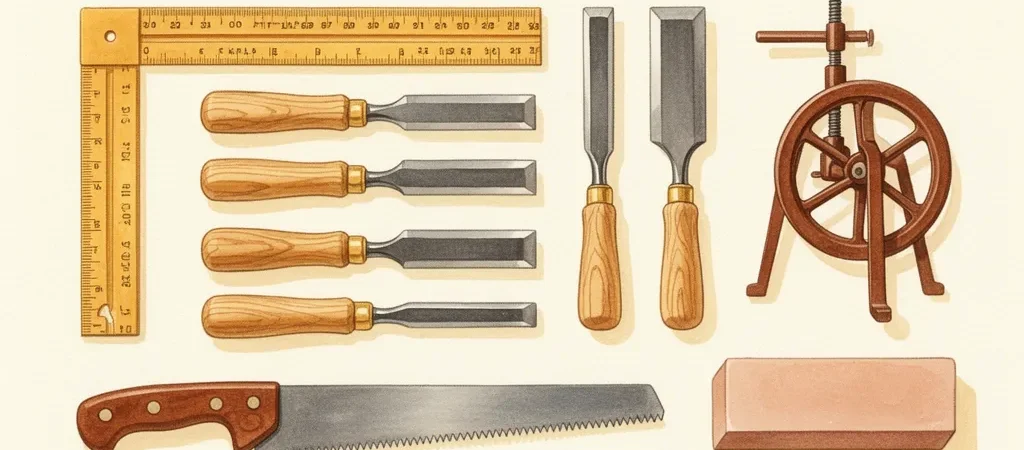
Most woodworking gift guides sort by price and call it a day — leaving gift buyers to guess whether a pocket hole jig or a router bit set makes sense for someone who has only built one or two projects. This guide starts from a different place: what does a first-year adult woodworker actually lack, and what gift closes that gap fastest?
The answer is almost never a power tool. A beginner woodworker typically owns a drill, a circular saw, and maybe a jigsaw. What they do not own is a combination square that is actually square, chisels that hold an edge, or any means of sharpening the tools they already have. Those absences are why their joints do not fit and their surfaces do not look the way they pictured.
Every pick in this guide is a precision or technique tool priced between $15 and $129. Together they cover the layout, cutting, and sharpening gaps that define first-year frustration — and they are stocked at Austin-area specialty retailers where the recipient can get hands-on support.
How we select these gifts
- Specialty retailers first: We start with what Austin-area specialty retailers actually stock — Woodcraft Austin and Rockler Round Rock. Stores whose business depends on return customers do not stock junk. Every tool in this guide appears on at least one of their shelves, which means in-person support is part of what you are giving.
- Community consensus: We cross-reference retailer inventory against what experienced hobbyists recommend in their own communities — r/woodworking, Sawmill Creek, and LumberJocks. Products that show up in both retailer stock and hobbyist recommendation threads carry the most weight.
- Stage fit: Every pick targets the specific gap of a first-year adult woodworker: they can rough-cut but cannot achieve joinery precision, and they often use dull tools without knowing it. Gifts that address calibration and sharpness are developmentally appropriate at this stage; tools that presuppose technique the recipient has not yet built are not.
- Budget range: Picks span $14.99 to $129 so the guide works whether you are spending $15 or building a curated set near $200.
- Skip-this guidance: Where a popular pick is wrong for this specific stage — or where the recipient is likely to already own something equivalent — we say so and explain why.
Why Gifting a Beginner Woodworker Is Surprisingly Easy to Get Wrong
The instinct when buying a woodworking gift is to go big: a router, a track saw, a biscuit joiner. These feel substantial and shop-worthy. They are also almost always the wrong call for someone in their first year. Power tools at this stage assume a level of design clarity, shop space, and foundational technique the recipient has not yet developed. A router without understanding grain direction and climb cutting is a tool waiting to bite.
What first-year woodworkers actually struggle with is precision. They have cut lumber; they have assembled boxes. But their joints gap, their surfaces show tearout, and their measurements drift across a project. The root cause of almost all of this is not a lack of power — it is a lack of calibrated layout tools, sharp chisels, and a reliable way to hold sharpening angles. They frequently do not know their tools are dull, because they have never felt a sharp tool.
A gift that fixes that problem is more useful than any power tool you could hand them. A verified-accurate combination square, a set of chisels that hold an edge, and the means to sharpen them will make every project they attempt this year — and every year after — noticeably better. That is a different category of gift than a gadget that sits on the shelf waiting for a skill they have not reached.
Foundation Hand Tools Worth Gifting
Three tools form the core of what a first-year woodworker needs: a combination square they can trust, chisels worth sharpening, and a saw that is forgiving to use. The Starrett 12-Inch Combination Square is the first precision tool most serious hobbyists own — and the gap between it and a hardware-store square is not aesthetic, it is functional. A square that is off by two degrees means every joint referencing that line is off by two degrees. There is no technique correction for a bad tool.
The Narex 4-Piece Premium Bevel Edge Chisel Set is the perennial top recommendation across Sawmill Creek, LumberJocks, and r/woodworking for adults entering hand tool work. The distinction between Narex and a big-box combo set is steel hardness: Narex runs 59 HRC versus roughly 52 HRC in budget sets. That difference means an edge that lasts through a full session rather than dulling after twenty minutes of mortise work. Rockler Round Rock stocks them, so staff can walk the recipient through first sharpening in person.
The Gyokucho Razorsaw Ryoba 180mm rounds out the trio. Woodcraft Austin stocks and recommends it specifically as a first saw because the pull-stroke cut keeps the blade in tension — beginners track a line far more reliably with a pull saw than with any push saw, where blade flex under compression is constant. The dual-edge design (crosscut on one side, rip on the other) means a single $35 purchase replaces two Western saws.

Starrett 12-Inch Combination Square
A combination square that is not actually square produces joints that never fit — teaching the beginner that technique is at fault when the tool is. The Starrett holds tolerances no budget square reliably matches. Stocked at both Woodcraft Austin and Rockler Round Rock. 4.7 stars across 2,510 reviews. American-made since the 1880s.
- Reversible lock bolt — blade rotates without disassembly, used constantly by experienced woodworkers
- Built-in scriber and spirit level add genuine utility
- American-made to reference-grade tolerances since the 1880s
- At $129, three to five times a budget square’s price — the accuracy premium is real and justified
- Cast iron head can chip if dropped on concrete

Narex 4-Piece Premium Bevel Edge Chisel Set
Narex is the perennial top recommendation across Sawmill Creek, LumberJocks, and r/woodworking for adults entering hand tool woodworking. Czech chrome-manganese steel hardened to 59 HRC holds an edge far better than big-box combo sets. Hornbeam handles with brass ferrules built for mallet work. Stocked at Rockler Round Rock.
- Chrome-manganese steel at 59 HRC — holds an edge through a full session, unlike 52 HRC steel in sub-$40 sets
- Hornbeam handles with brass ferrules built for mallet work without cracking
- Stocked at Rockler Round Rock — local staff can advise on sharpening and first use
- Arrive needing sharpening before first use — pairs naturally with the Norton and Veritas picks
- Four sizes only; no 3/8-inch chisel

Gyokucho Razorsaw Ryoba 180mm
Woodcraft Austin stocks and recommends this as a first saw because the pull-stroke cut is dramatically easier for beginners to start and track than a Western push saw. The dual-edge design (19 TPI crosscut, 9 TPI rip) replaces two Western saws. Replaceable blade (~$17) means never resharpening.
- Pull-stroke keeps blade in tension — beginners get straighter cuts faster than with any push saw
- Dual-edge design replaces a crosscut and rip saw in one $35 tool
- Replaceable blade extends life indefinitely without sharpening skill
- Teeth cannot be resharpened — blade replacement only
- Brief adjustment period for anyone conditioned to Western push saws
The Tool They Do Not Know They Need: Layout and Marking
If you ask a first-year woodworker what a marking gauge does, they will likely say it marks lines. That is true, but it misses the point. A Veritas Standard Wheel Marking Gauge scribes a knife line — a thin groove cut across the grain — not a pencil mark. That groove registers the edge of a chisel at the exact depth of a mortise shoulder or the wall of a tenon cheek. A pencil line cannot do that. The chisel sits on the scribed line; there is nowhere for it to wander.
This is the difference between joints that fit and joints that require gap-filling. Beginners who do not own a marking gauge use a pencil and wonder why their dovetails close with visible gaps. They blame their sawing. The actual problem is that a pencil line is 0.7mm wide and the chisel finds a different part of it every stroke. A knife line is 0.1mm wide and it is the same line every time.
The Veritas wheel design is the standard recommendation at Woodcraft Austin because the hardened steel wheel cuts cleanly at any grain angle, including across end grain where pin gauges tear fibers. The O-ring friction system holds the fence setting one-handed while you adjust — a detail that sounds minor until you have reset a pin gauge for the fourth time in a session.

Veritas Standard Wheel Marking Gauge
Layout precision separates tight joints from gappy ones. A marking gauge scribing a knife line is not optional for hand tool joinery — the knife line registers the chisel precisely, a pencil line does not. The Veritas wheel cuts cleanly across any grain direction. O-ring friction system holds settings one-handed. Stocked at Woodcraft Austin.
- Hardened steel wheel cuts a clean knife line at any grain angle — eliminates tearing from pin gauges
- Cutting edge extends to rod tip for mortise depth gauging
- O-ring friction holds settings one-handed without drift
- Wheel needs occasional touching up on a fine stone
- Imperial markings only on the standard model
Sharpening: The Skill Gift That Pays Off Every Session
Sharpening gear is the gift that multiplies every other tool the recipient already owns. A dull chisel requires more force, wanders off the line, and tears fibers instead of slicing them. Most first-year woodworkers are working with tools in exactly this condition — not because they are careless, but because nobody told them what sharp actually feels like. A sharp chisel should pare end grain with almost no downward pressure. If it takes effort, it needs sharpening.
The Norton Waterstone Sharpening Starter Kit covers the full grit range in two combination stones — 220/1000 and 4000/8000 — and includes the silicon carbide flattening stone most starter kits omit. That omission matters: waterstones dish with use, and a dished stone hollow-grinds edges rather than flattening them. The flattening stone is not a luxury addition; it is what keeps the system honest. Rockler Round Rock stocks the kit.
Waterstones work, but they require a consistent angle — and maintaining a consistent angle freehand takes months of deliberate practice. The Veritas Mk.II Honing Guide closes that gap immediately. The eccentric roller system sets the primary bevel and micro-bevel without resetting, which means sharpening maintenance takes under two minutes per chisel. Woodcraft Austin stocks the full Veritas line. Paired with the Norton kit, this combination produces a sharp chisel on the first attempt rather than after weeks of trial and error.
The Bahco 474 Card Scraper sits at the other end of the sharpening story: it is not a sharpening tool, but it is the tool that eliminates the need for aggressive sanding on hardwood surfaces. A properly turned scraper removes plane tracks and tearout in thin, precise shavings. Paul Sellers reaches for one in nearly every finishing phase of a hand-tool project. At $15, it is the highest return-on-investment tool in this guide.

Norton Waterstone Sharpening Starter Kit
Sharpening is not optional for hand tool woodworking. The Norton kit covers the complete grit range (220 to 8000) in two combination stones and includes the silicon carbide flattening stone most starter kits omit — the component that keeps waterstones accurate. Stocked at Rockler Round Rock.
- Complete 220-to-8000 grit progression — no additional purchases needed from chipped edge to polished bevel
- Silicon carbide flattening stone included — prevents dished stones that hollow-grind edges
- Water-only activation: no oils, no cleanup beyond rinsing
- Waterstones require soaking before use and dry storage between sessions
- 8000-grit side is softer and can gouge with uneven pressure — technique matters

Veritas Mk.II Honing Guide
Freehand sharpening takes months to develop. During that window, a beginner produces rounded bevels that make tools cut worse than factory-ground. The Veritas Mk.II sets angle and square in one step, producing a consistent primary bevel and micro-bevel on the first attempt. Woodcraft Austin stocks the full Veritas line.
- Three-position eccentric roller enables micro-bevel without resetting — sharpening maintenance takes under two minutes
- Blade registration jig eliminates the skewed bevels that plague beginners
- Accommodates chisels and plane irons from 6mm to 72mm — works with every tool on this list
- Registration step feels fussy for the first few uses — follow the instructions closely at the start
- At $85, a meaningful investment for a jig

Bahco 474 Card Scraper
Removes tearout and plane tracks from difficult grain without dust, noise, or power. At $15, the highest return-on-investment tool on this list. Swedish chrome-nickel steel re-turns with a few strokes of a burnisher rather than full resharpening. Paul Sellers uses card scrapers in nearly every finishing phase.
- Swedish chrome-nickel steel re-burrs rather than requiring full resharpening — improves with use
- Eliminates the random-orbit sander on hardwood finishing — quiet, dustless, precise
- Under $15 — highest ROI tool on the list for projects they will actually complete in year one
- Learning to turn a burr takes one concentrated session to click
- Not useful on soft woods — burr tears rather than slices in low-density fibers
Gifts That Build Skill, Not Just the Tool Rack
These seven tools are not a random collection — they are a system. The Starrett square and Veritas marking gauge handle layout. The Narex chisels and Gyokucho saw handle cutting. The Norton stones and Veritas honing guide handle maintenance. The Bahco scraper handles finishing. Any two or three tools from different tiers combine to hit almost any budget, and each one addresses a specific gap that every first-year woodworker has.
What makes this set useful is that none of these tools require a skill the recipient has not yet built. The marking gauge teaches the knife-line habit from the first use. The honing guide produces correct geometry before freehand sharpening is even a question. The pull saw tracks true on the first cut. These are not tools waiting for a skill level the recipient needs to earn — they are tools that develop the skill in use.
The Starrett at $129 is the investment pick. The Bahco scraper at $15 is the low-cost surprise. The Norton and Veritas honing guide together at roughly $175 are the sharpening system that unlocks everything else. Any combination you choose will make the next project noticeably better than the last one.
What to skip
Avoid routers, jigsaws, track saws, and pocket hole jigs as gifts for a first-year woodworker. Power tools at this stage assume shop space and brand commitments the recipient has not yet made, and jigs like pocket hole systems lock the beginner into joinery shortcuts that delay the development of the fundamental skills this guide is designed to build. Wait until the second or third year, or until they ask for something specific by name — that request signals they have a project in mind and the skill to use it.
A first-year woodworker is not short on power — they are short on precision, technique, and the confidence that comes from making a clean cut with a well-tuned tool. A combination square that reads true, chisels that hold an edge, and stones to keep them sharp will do more for their craft in the next twelve months than any piece of machinery.
The stores stocking these tools — Woodcraft Austin and Rockler Round Rock — are worth mentioning to the recipient. Both have staff who sharpen tools on site, run beginner workshops, and can answer the questions that come up in the first month of using a marking gauge or a honing guide. The retail relationship is part of the gift.
If you are still deciding between two picks, lean toward sharpening gear. A quality chisel set without a way to sharpen it is a tool that degrades with every use. A sharpening system that works will outlast every other tool in the shop.