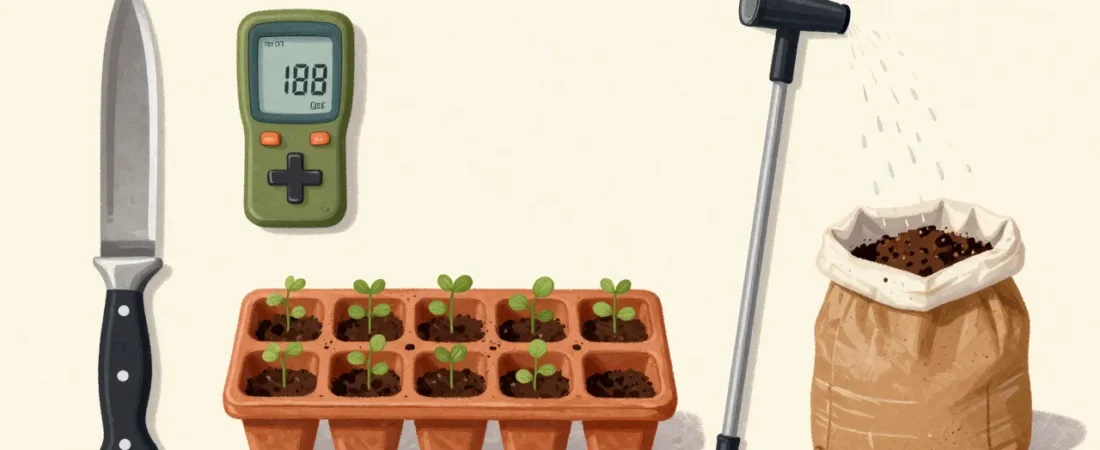
Most beginner vegetable gardeners don’t fail because they lack a green thumb. They fail because three specific, solvable problems hit them in the first eight weeks: the soil wasn’t right, the watering schedule was off, and they planted more varieties than any first-year gardener can track. The garden stalls, the new gardener concludes they’re not cut out for this, and the raised bed sits empty by August.
Gifts for this person succeed when they remove one of those three obstacles. A moisture meter doesn’t sound exciting until you understand it’s the thing that stops someone from drowning their tomatoes. A bag of pre-amended potting soil sounds utilitarian until you realize it’s the reason their first pepper plant actually produces fruit instead of sitting stunted for six weeks.
This guide is organized around those three bottlenecks — soil, watering, and right-sizing — so every pick has a job. The price range runs from $9.99 to $34.95, which means there’s a useful gift at every budget level, and none of them require the recipient to own any prior equipment to use them.
How we select these gifts
- Specialty retailers first: We start with what specialty nurseries actually stock. Independent nurseries whose business depends on return customers don’t carry products that fail in the field. When we surveyed the FoxFarm and Espoma lines, multiple Austin-area specialty nurseries stocked them — a meaningful signal beyond Amazon reviews.
- Community consensus: We cross-reference retailer inventory against what gardeners recommend in their own communities — r/vegetablegardening, r/beginnergardening, and the GardenWeb forums. Products that show up in both retailer stock and community recommendations consistently get priority placement.
- Stage fit: All picks here are calibrated specifically to the adult first-year gardener: someone who has outdoor space (patio, raised bed, or in-ground plot) but has never grown food before. We’ve excluded products that require prior knowledge to use correctly, and we flag where a pick makes sense only for a specific setup (balcony vs. backyard).
- Budget range: Picks span $9.99 to $34.95 so the guide works whether you’re spending $10 or $35.
- Skip-this guidance: Where a popular pick isn’t right for this specific stage or setup, we say so and explain why.
The Soil Problem: Why Most First Gardens Fail Before They Start
Poor soil is the silent killer of beginner vegetable gardens. A new gardener plants in hard, compacted ground or cheap fill dirt, the seedlings stall at four inches, and by week six the gardener concludes they did something wrong. They probably didn’t. The soil did something wrong — specifically, it failed to drain properly, locked up nutrients at the wrong pH, and compacted around roots before the plants could establish.
The cleanest fix for a container or raised-bed gardener is FoxFarm Ocean Forest Potting Soil. It arrives pre-amended with earthworm castings, bat guano, and aged forest products, and it’s pH-adjusted to 6.3–6.8 — the range where most vegetables and herbs can actually absorb the nutrients in the soil. A beginner can open the bag and plant directly. No soil test, no amendment math, no mistakes to make.
For a gardener who already has ground to work with — someone amending an in-ground bed rather than filling containers — the soil story is different. That’s where Espoma Organic Garden-Tone fits. The reason it’s the right fertilizer for beginners specifically is its slow-release granular form. Beginners routinely over-fertilize with liquid concentrates, burning root systems or pushing excessive leafy growth at the expense of fruiting. Garden-Tone’s Bio-tone microbe formula makes it genuinely hard to over-apply.

FoxFarm Ocean Forest Potting Soil
The foundational soil fix. Pre-amended with aged forest products, earthworm castings, and bat guano — a beginner can plant directly into it without any soil testing or amendment math. pH-adjusted to the ideal 6.3–6.8 range for vegetables and herbs. All four Austin specialty nurseries surveyed stock the FoxFarm line.
- Ready to use out of the bag — no amendments needed at planting
- pH pre-adjusted to ideal range for vegetables and herbs, preventing nutrient lockout
- Light, aerated texture prevents compaction and overwatering damage
- Runs hot with nitrogen for very young seedlings — best for transplanting, not seed-starting
- Higher price per cubic foot than big-box alternatives

Espoma Organic Garden-Tone 8 lb.
Beginners routinely over-fertilize with liquid synthetic fertilizers, burning plants or creating lush foliage at the expense of fruit. Garden-Tone’s slow-release granular formula is genuinely hard to over-apply. It covers both herbs and vegetables in one bag. Shoal Creek Nursery in Austin carries Espoma products, and the brand has been the choice of independent specialty nurseries for over 60 years.
- Slow-release organic granules are nearly impossible to over-apply — eliminates fertilizer burn
- One product covers all vegetables and herbs
- Enhanced with Bio-tone microbes that improve root health without extra effort
- Noticeable organic odor that some users find unpleasant when first applied
- Slower visible results than liquid fertilizers
The Watering Problem: Tools That Remove Daily Guesswork
The core watering mistake beginners make isn’t laziness — it’s method. They water on a fixed schedule or by feel. Both approaches cause real damage, because neither accounts for what actually determines water need: temperature, recent rainfall, the specific crop, and where in its growth cycle the plant is.
The XLUX Soil Moisture Meter converts watering from a guess into a data decision. Push the probe into the soil, read the dial — 1 through 4 means water now, 5 through 7 means wait, 8 through 10 means the soil is saturated. No batteries, no calibration, no app. With over 63,000 Amazon ratings, it’s become the community’s default recommendation for beginners.
The Dramm ColorMark 30″ Rain Wand solves the delivery side. A garden hose with a standard nozzle fired at seedlings can rip them out of the soil and displace seeds. The Dramm’s 400 Water Breaker nozzle breaks the flow into a soft shower. This is the watering tool professional greenhouse growers use; the 30-inch reach means a gardener can water the far edge of a raised bed without kneeling on the soil and compacting it.

XLUX Soil Moisture Meter
Overwatering is the number-one killer of first-year vegetable gardens. The XLUX’s analog probe requires no batteries and gives an instant color-coded reading on a 1–10 dial: red means water now, green means fine, blue means back off. No setup, no calibration. Over 63,000 Amazon ratings — the default community answer to “how do I know when to water?”
- No batteries required — zero setup barrier for beginners
- Color-coded 1–10 dial is interpretable at a glance
- Under $10 — can live permanently staked in a raised bed
- Not accurate in very gritty or perlite-heavy mixes where probe loses contact with moisture
- Analog mechanism can drift over time in heavy-use conditions

Dramm ColorMark 30″ Rain Wand
Dramm’s 400 Water Breaker nozzle distributes water as fine, soft rain, mimicking rainfall and directing moisture to soil rather than foliage. This is the tool professional greenhouse growers use. The 30-inch reach lets beginners water the back of a raised bed without stepping on soil and compacting it.
- Soft shower pattern prevents soil disturbance and doesn’t displace seeds
- Brass shut-off valve and lifetime guarantee — specialty-grade durability
- 30-inch length reaches across a 2-foot raised bed without kneeling
- Foam grip can degrade in UV-heavy climates if left outside seasonally
- Available in multiple color variants with separate ASINs — listing can be confusing
The Right-Sizing Problem: Seeds and Systems Matched to Year One
Overplanting is the most seductive beginner mistake. The seed rack at the garden center has 80 varieties, everything looks possible in February, and the beginner walks out with peppers, cucumbers, three kinds of tomatoes, basil, kale, and a pumpkin variety that needs 14 square feet per plant. By May they have a crowded, competing, unmanageable bed and no clear mental model of which plant needs what.
The Gardener’s Supply GrowEase Seed Starting Kit solves this by imposing a useful constraint. Twenty-four cells is a deliberate first round — enough to start a meaningful garden, not so many that the beginner loses track of what they planted. The system’s capillary mat and bottom reservoir solve the most common seed-start failure mode: seeds dry out between waterings during the 7–14 day germination window. The dome holds humidity without any misting schedule. Gardener’s Supply Company is the country’s premier specialty seed-starting catalog; this is their flagship product.
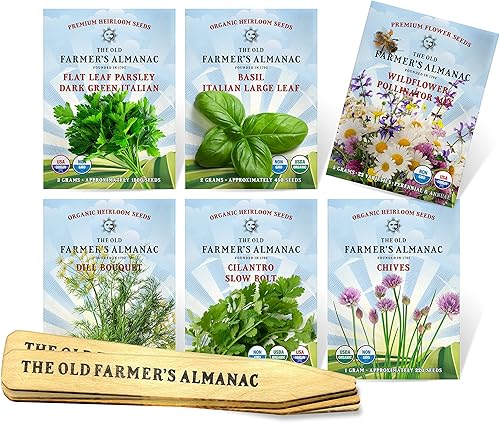
For a smaller entry point — apartment balcony, kitchen windowsill, or a gift for someone who isn’t sure they want a full vegetable garden — the Old Farmer’s Almanac Herb Garden Starter Kit is the right scale. Six culinary herbs, pre-curated by a 230-year-old brand with a genuine reputation to protect. Each packet includes planting depth, spacing, and timing — the three facts a beginner most needs and most often has to guess. Herbs are the ideal first crop because they’re fast-growing, directly useful in the kitchen within weeks, and forgiving enough to survive a watering mistake or two.

Gardener’s Supply GrowEase Seed Starting Kit
Most beginner seed starts fail because the seeds dry out between waterings. The GrowEase system uses a capillary mat and bottom reservoir to wick moisture upward continuously, removing the need to monitor soil moisture during the critical 7–14 day germination window. The dome creates the humid environment seeds need without any misting schedule. Gardener’s Supply Company is the country’s premier specialty seed-starting catalog, and this is their signature product.
- Bottom-watering reservoir with capillary mat eliminates the most common seed-start failure mode
- Clear dome creates humidity chamber that improves germination rates without a misting schedule
- 100% recycled plastic, fully reusable across multiple seasons
- 24-cell capacity is modest — serious seed starters quickly want two or three
- Sold primarily through Gardener’s Supply and Amazon — not widely stocked at local nurseries
Old Farmer’s Almanac Herb Garden Starter Kit
The OFA kit pre-curates six high-success herbs that work in containers and raised beds, with individual planting instructions on each packet. The 230+ year OFA brand carries credibility. Herbs are the ideal first crop: fast-growing, rewarding, and directly usable in cooking within weeks. Great for apartment balconies and kitchen windowsills.
- Pre-curated selection removes decision paralysis — all six are culinary herbs that grow reliably for beginners
- Each packet includes planting depth, spacing, and timing instructions
- Heirloom, non-GMO, open-pollinated seeds with clear sourcing
- Herbs only — a beginner wanting tomatoes and peppers needs a separate seed collection
- Wooden plant markers are not weather-durable outdoors
The Tool Problem: What Actually Holds Up vs. What Snaps in Clay Soil
The standard beginner garden tool kit almost always contains stamped-steel trowels with plastic-molded handles. In loamy, prepared soil these work fine. In the clay-heavy, rocky, compacted soil that most beginners are actually dealing with, they snap at the neck within one season.
The Nisaku NJP650 Hori Hori Knife is the one-tool solution. It replaces the trowel, the weeder, the transplanting knife, and the measuring dibber in a single Japanese-forged blade handcrafted by the Tomita workshop since 1960. The depth markings on the blade turn “plant this seed one inch deep” from an abstract instruction into something you can read off the knife as you dig.
The Fiskars Ergo Garden Trowel is the right pick for gifters who want a more traditional-looking tool at a lower price. Fiskars uses a cast-aluminum head molded around the handle insert rather than a stamped-steel blade crimped onto a separate handle. Garden Gate Magazine named it the best trowel for beginners in their 2025 tested roundup. Lifetime warranty at under $13.

Nisaku NJP650 Hori Hori Knife
Cheap trowels snap or bend the first time they hit clay soil, and most beginner garden tool kits contain exactly these cheap trowels. The hori hori solves what four separate tools try to do — digging, transplanting, slicing through weed roots, dividing perennial herbs — in one durable Japanese-forged blade. The NJP650’s depth markings on the blade directly solve the seed-planting-depth confusion. Handcrafted by the Tomita workshop in Japan since 1960.
- Depth markings on the blade solve the core beginner problem — guessing how deep to plant seeds
- Single tool replaces trowel, weeder, and transplanting knife
- Authentic Japanese stainless steel by Tomita (est. 1960); won’t bend or snap
- Blade is sharp on both edges — beginners should handle with care
- Leather sheath not contoured to fit all tool belts

Fiskars Ergo Garden Trowel
The single most commonly broken beginner garden tool is a cheap trowel — the stamped-steel blade snaps the first time it hits compacted soil or a hidden rock. Fiskars’ cast-aluminum head is structurally different: it cannot snap off the handle under normal use because the aluminum is molded around the handle insert rather than crimped. Garden Gate Magazine named Fiskars the best trowel for beginners in their 2025 tested roundup. Lifetime warranty at under $13.
- Cast-aluminum head is molded, not crimped — physically cannot snap at the neck
- Ergonomic handle reduces wrist fatigue during repeated planting
- Lifetime warranty and under $13 — the obvious first trowel
- Not the right tool for serious soil amendment work — need a larger fork or spade for that
- Wider blade can be awkward in tight container plantings
What to skip
Ten-piece beginner tool bundles, novelty gardening sets in decorative tins, and jumbo seed assortments are the three most common wrong turns in vegetable garden gifting. The tool bundles almost always contain three trowels of varying sizes and a cultivator — most of which the beginner doesn’t need and some of which will snap before the season ends. The 50-variety seed assortments sound generous, but they create real problems: a beginner who doesn’t know their climate zone, last frost date, or how to read a seed packet will plant the wrong varieties at the wrong time and wonder why nothing germinated. Start with six herbs or a curated seed-starting system. Add varieties once the gardener has a season under their belt.
When a gift directly removes a known obstacle — bad soil, the guessing-game of when to water, the trap of planting too much too fast — it doesn’t just give the recipient something to use. It gives them a reasonable chance at a successful first season, which is the only thing that determines whether they garden again next year.
Match the pick to what you actually know about their setup. If they have a backyard plot with real ground to dig, the hori hori and soil moisture meter are the two highest-leverage picks. If they’re on an apartment balcony, the herb starter kit and moisture meter are the right combination. You don’t need to gift everything in this guide to give a useful gift; you need to give the right one thing for where they are right now.