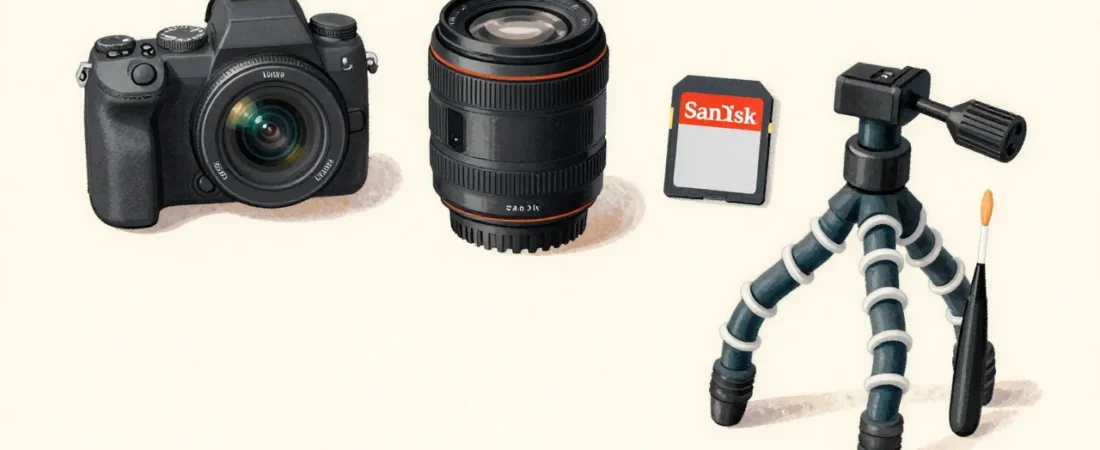
Most photography gift guides hand you a spec-sheet list. They tell you that 24 megapixels is better than 20, that this lens has “beautiful bokeh,” and that you should definitely buy a UV filter. What they don’t account for is where the beginner actually is.
Someone who picked up a camera in the last few months is not a gear-driven photographer yet. They are in a phase where friction kills the habit. Choosing the wrong gift — something powerful but premature — does not accelerate their learning. It creates overwhelm and shelf dust.
Every pick in this guide is justified by the specific friction point it removes, matched to the phase of learning where it delivers real value. That is the only criterion that matters for a beginner.
How we select these gifts
- Specialty retailers first: We start with what specialty camera retailers actually carry — B&H Photo, Adorama, and local camera shops whose business depends on repeat customers. Stores that outfit working photographers don’t stock gear that fails beginners in the first month.
- Community consensus: We cross-reference retailer inventory against what photographers recommend in beginner communities — r/photography, r/Beginning_Photography, and the DPReview beginner forums. Products that appear across both signals carry the most weight.
- Phase fit: Beginner photographers fall into two phases. Phase 1 (0–3 months): still in Auto mode, intimidated by manual controls, carry friction is high. Phase 2 (3–12 months): experimenting with Aperture Priority, frustrated that the kit lens can’t deliver the shots they see in their head. Most gift shoppers buy Phase 2 gear for Phase 1 shooters. Every pick here is labeled with the phase where it delivers maximum return.
- Budget range: Picks span $18–$198, so the guide works whether you’re spending $20 or $200.
- Skip-this guidance: Where a popular category of gear is wrong for this specific stage — filters, studio lights, multi-lens bundles — we say so and explain exactly why.
How We Pick: The Friction-Reduction Framework
The biggest mistake in photography gifting is treating a beginner like a photographer who just happens to own less gear. Beginners and experienced photographers have different problems. The experienced photographer is optimizing image quality; the beginner is trying to build the habit of picking up the camera at all.
Phase 1 (roughly the first three months) is defined by intimidation and carry friction. The camera feels complicated. Manual mode is overwhelming. If the bag is annoying to carry, the camera stays home. Gifts that solve Phase 1 problems are about reducing the distance between “I want to take a photo” and the shutter click.
Phase 2 begins when the photographer has shot enough to feel the ceiling of their kit lens. They understand that their shots at family dinners always look muddy and flat. They’ve tried to photograph a dog mid-run and watched the autofocus miss every time. They are now capable of using better gear — and a prime lens or a real tripod will genuinely change what they can produce.
The danger zone is gifting Phase 2 gear to a Phase 1 shooter. A 50mm prime on a camera that hasn’t left Auto mode yet is a lens that will confuse and frustrate its owner until they’re ready for it. This guide maps each pick to the phase where it pays off, so you can match the gift to where your person actually is.
Never Miss a Shot: SanDisk 128GB Extreme PRO SDXC Card
This is the highest-ROI gift on this entire list, and it is the one most people skip because it feels too practical. Entry-level cameras either ship with no memory card at all, or include a slow Class 10 freebie that causes the camera’s buffer to lock up mid-burst. The photographer presses the shutter and nothing happens. They don’t know why. They assume the camera is broken or they did something wrong.
The U3/V30 speed rating on the Extreme PRO prevents this entirely. Buffer lockup is a non-event. 4K video records without dropped frames. And 128GB holds roughly 1,200 RAW files — enough for a full day of shooting before a card swap becomes necessary.
One practical note: buy this from Amazon directly, not from a third-party seller through Amazon’s marketplace. Counterfeit SanDisk cards are a real and documented problem. The genuine card is under $25. This is a Phase 1 gift — it matters from day one.

SanDisk 128GB Extreme PRO SDXC Card
Every entry-level camera ships with no card or a slow freebie that causes buffer lockup during RAW burst shooting. U3/V30 rating prevents the freeze mid-sequence that makes beginners think they’re doing something wrong. 128GB holds roughly 1,200 RAW files — enough for a full day without swapping. With 52,000 verified ratings at 4.8 stars, this is the most-proven card in the entry-level category.
- U3/V30 prevents buffer lockup during burst RAW or 4K video
- Shockproof, waterproof, x-ray-proof — survives bag life without concern
- 128GB eliminates mid-shoot card swaps for a full day
- 200MB/s read speed requires a UHS-I USB 3.0 reader to fully achieve — standard card readers will bottleneck transfers
- Buy from Amazon directly — counterfeits circulate from third-party marketplace sellers
The Thing Nobody Buys Until It’s Too Late: Altura Photo APS-C Camera Cleaning Kit
Sensor dust is invisible until it isn’t. The typical pattern: a beginner shoots for three or four months, starts photographing bright skies or solid-color walls, and suddenly notices identical dark spots in the same position on every shot. They have been there for weeks. Every photo taken during that period is compromised.
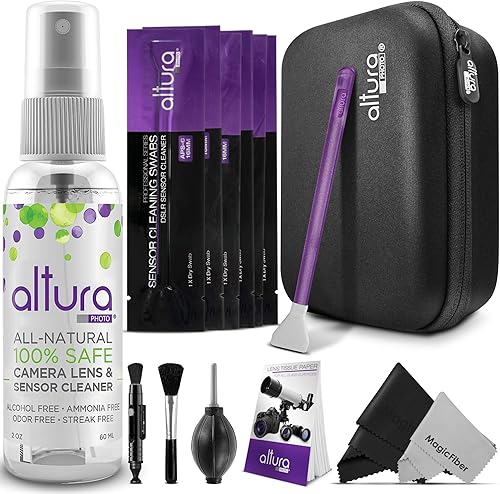
This kit is the stocking-stuffer nobody thinks to buy. The detail that matters is the “APS-C” designation — the 16mm swabs are correctly sized for crop-sensor bodies, which cover essentially every beginner camera (Canon Rebel series, Canon EOS M, Sony a6000 series, Nikon D3500/D5600, Fujifilm X-T series). Oversized full-frame swabs on an APS-C sensor cause streaking and require re-cleaning. The alcohol-free, ammonia-free solution is safe on coated optics. Photography Talk consistently recommends this kit as the first cleaning solution for beginner photographers.
At $18, it is a practical gift that protects months of shooting history and teaches a maintenance habit that every serious photographer eventually needs.
Altura Photo APS-C Camera Cleaning Kit
Most beginners discover sensor dust only after reviewing months of compromised shots. APS-C-specific 16mm swabs are correctly sized for crop-sensor bodies — using oversized full-frame tools on an APS-C sensor causes streaking damage that requires re-cleaning. Alcohol-free, ammonia-free solution is safe on coated optics. The hard carry case keeps swabs sterile inside any camera bag. Photography Talk rates this the go-to cleaning kit for beginner photographers.
- 16mm APS-C swabs correctly sized — prevents streaking damage from oversized full-frame tools
- Alcohol-free, ammonia-free solution safe on coated optics
- Hard carry case keeps swabs sterile, fits inside any camera bag
- Only 6 sensor swabs included — a refill pack is worth ordering at the same time for ongoing maintenance
- Compact blower is less powerful than a full-size Giotto Rocket alternative
Stability on Any Surface: Joby GorillaPod 3K Kit vs. Full Tripod
The question of “which tripod” for a beginner is really a question about how they currently shoot. Two products serve two different photographers at two different stages, and the right answer depends on which one you’re buying for.
The Joby GorillaPod 3K Kit is the Phase 1 pick. It weighs 8.7 ounces. It fits in a jacket pocket or slips into any bag without adding meaningful bulk. The flexible legs wrap around railings, tree branches, fence posts, and ledges — places where a traditional tripod simply cannot go. A Phase 1 shooter who carries it everywhere will actually use it. A Phase 1 shooter handed a 1.5kg full-size tripod will leave it in the car. The GorillaPod also handles the most common beginner use case: self-portraits, low-light indoor shots propped on a table, and creative angles where the ground isn’t flat.
The Manfrotto Element MII is the Phase 2 pick. At 160cm with a quick-release ball head, it covers eye-level landscape shooting, long exposures on flat ground, and the kind of stable platform that separates sharp shots from motion-blurred near-misses at slow shutter speeds. Manfrotto is the brand specialty camera retailers actually stock and recommend — not a white-label tripod with a Manfrotto-adjacent name. TechRadar called it “superb value” in the aluminum tripod category. This is the right gift if your person is past the intimidation phase and actively frustrated with handheld instability.
If you’re unsure which phase your person is in: ask whether they still mostly shoot in Auto mode. If yes, GorillaPod. If they’ve started experimenting with manual settings and complaining that handheld shots are blurry at lower light, Manfrotto.

Joby GorillaPod 3K Kit
Flexible legs wrap around railings, branches, and ledges — enables long exposures and creative angles without flat ground. At 8.7oz it fits in any bag, which means it actually gets carried. This is the only support a Phase 1 beginner will use consistently. Handles any entry DSLR or mirrorless with a prime lens attached. A recurring Phase 1 recommendation in r/Beginning_Photography threads about camera bag essentials.
- Flexible legs wrap around poles, branches, and railings — stable placement where tripods cannot go
- Ball head with 360-degree pan locks position after legs are set
- 8.7oz fits in a jacket pocket — gets carried, unlike most tripods
- 9-inch max height — not a full-tripod replacement for landscape or standing eye-level portraits
- Ball head can drift under a heavy DSLR with a zoom lens — tighten before long exposures
The Real Reason Beginners Leave Their Camera at Home: Lowepro Adventura BP 150 III Backpack
Carry friction is documented, not hypothetical. Cameras end up on shelves because carrying them is annoying. The neck strap that came in the box is uncomfortable for more than twenty minutes. The camera won’t fit in a normal bag without risk of damage. The solution is a bag sized for exactly the kit a beginner owns — not a professional bag with 14 padded dividers for gear they haven’t acquired yet.
The Lowepro Adventura BP 150 III is sized for year-one reality: one body with a lens attached, a memory card wallet, a cleaning kit, maybe a GorillaPod strapped to the outside. The back-side zipper is a genuine practical feature, not a marketing differentiator — it makes the camera inaccessible to a pickpocket when the bag is worn in a crowd, which is exactly when and where beginners most want their camera. Digital Camera World gave it a 5-star review specifically citing the beginner use case.
The 82% recycled materials construction is worth noting because it does not come at the expense of padding or weather resistance — this is not a greenwashed product compromise. The bag holds up.

Lowepro Adventura BP 150 III Backpack
Carry friction is the most common reason beginners leave cameras at home. This bag is sized for exactly year-one kit: one body with lens attached, plus 2–3 accessories. The back-side zipper keeps the camera inaccessible when worn — a practical theft deterrent at events and crowded locations. Digital Camera World awarded it 5 stars specifically for the beginner photographer use case, citing the Lowepro brand’s history of durable, correctly-sized bags at this price tier.
- Back-side zipper keeps camera inaccessible when worn — theft deterrent at crowded locations
- External tripod strap loops carry a GorillaPod without using internal space
- 82% recycled materials without sacrificing padding or weather resistance
- 11L fits one body and 2–3 small items max — will feel cramped as the kit grows
- No integrated rain cover included
The One Upgrade That Changes Everything: 50mm Prime Lens
The kit lens that shipped with the camera is a zoom. It covers a useful range — typically 18–55mm on a crop sensor body — but it achieves that range through optical compromises. The most consequential compromise is the maximum aperture: f/3.5 at the wide end, f/5.6 at the long end. At f/5.6, the background stays in focus, low-light performance is mediocre, and the autofocus hunts in dim rooms.
A 50mm prime at f/1.8 is a different kind of optic. The fixed focal length forces a different relationship with composition — to change framing, you move. This is one of the reasons photography teachers assign prime lenses to students who are developing their compositional eye. The f/1.8 aperture lets in nearly ten times more light than f/5.6, which means indoor shots at family dinners, concerts, and museum visits go from dark and blurry to clean and sharp. Background blur — the separation between subject and background that beginners associate with “professional-looking” photos — becomes available at any reasonable distance.
This is a Phase 2 gift. The photographer needs to have some familiarity with their camera before a prime lens pays off. But when they are ready, it is the single most significant upgrade they can make to image quality, and it costs less than most people expect.
System compatibility is non-negotiable. The wrong mount makes the lens incompatible. Three current picks, one per major system:
- Canon EF mount (Rebel T8i, 90D, older DSLR bodies): Canon EF 50mm f/1.8 STM
- Sony E-mount (a6000 series APS-C, a7 series full-frame mirrorless): Sony FE 50mm f/1.8
Canon RF mirrorless (EOS R50, R8, R10) owners should seek the Canon RF 50mm f/1.8 STM (ASIN B08MQBVFVW) — the EF version below requires an adapter on RF bodies and is not the ideal solution for that system.

Canon EF 50mm f/1.8 STM Lens
The nifty fifty for Canon DSLR owners. f/1.8 delivers background blur and low-light capability the kit zoom cannot approach — nearly ten times more light than the kit lens at its longest setting. Silent STM autofocus locks in dim indoor light where kit lenses hunt. At under $130 with 18,000 verified ratings at 4.8 stars, this is the highest-ROI lens purchase for any Canon Rebel or 90D owner who is ready to leave Auto mode behind.
- f/1.8 aperture delivers background blur and low-light performance the kit zoom cannot match
- Silent STM autofocus locks in dim indoor light where kit lenses hunt and miss
- Under $130 — highest ROI lens upgrade for Canon DSLR owners at this stage
- EF mount only — not directly compatible with Canon RF mirrorless bodies without an adapter (buy RF version instead)
- No image stabilization — handholding below 1/60s requires good technique

Manfrotto Element MII Aluminum Tripod
The Phase 2 stability pick for beginners who are ready to pursue landscapes, long exposures, and self-portraits seriously. 160cm height covers standing eye-level shooting without crouching, 8kg payload handles any entry DSLR or mirrorless with a prime lens, and the twist-lock legs are faster and more reliable than the flip-lock levers common on budget alternatives. Manfrotto is what specialty camera stores — B&H, Adorama, local camera shops — actually stock and recommend at this price point. TechRadar called it “superb value” in the aluminum tripod category.
- 160cm height covers standing eye-level shooting without crouching
- Twist-lock leg sections are faster and more reliable than flip-lock levers
- Ball head with quick-release plate ships included — ready to use out of the box
- 1.55kg adds noticeable weight on longer hikes
- No center column hook for counterweighting in wind

Sony FE 50mm f/1.8 Standard Lens
The nifty-fifty for Sony mirrorless owners. Full-frame E-mount means this lens works on both APS-C Sony bodies (a6000, a6100, a6400) and full-frame bodies (a7 series) — it survives any future camera upgrade the photographer makes within the Sony ecosystem. The 7-blade circular aperture produces smooth, rounded bokeh rather than the harsher geometric blur common on cheaper fast primes. Highest ROI lens upgrade in the Sony system at this stage.
- Full-frame E-mount works on crop-sensor and full-frame Sony bodies — lens survives any future upgrade within the ecosystem
- 7-blade circular aperture produces smooth, rounded bokeh
- 4.7 stars from over 1,500 verified owners
- AF speed and noise noticeably slower than Canon’s STM system — audible during video recording
- Plastic build feels less premium than the $198 price suggests
What to skip
Pass on UV and ND filter kits, multi-lens bundles, and studio flash systems. These are Phase 2 and Phase 3 purchases that require compositional and technical foundations a beginner has not yet built — gifting them early creates a shelf of gear that looks like progress but produces none. Also skip photography-themed mugs, tote bags, and decorative prints unless they accompany something functional from this list; a Phase 1 photographer does not need more reminders that they own a camera, they need fewer reasons to leave it at home.
The best gift for a beginner photographer is anything that shortens the distance between picking up the camera and taking a photo they are proud of. Smaller friction, more shots taken, faster learning. That is the whole model.
If you are still deciding between picks, use the phase framework as the tiebreaker. Ask yourself: does this person still shoot mostly in Auto mode? If yes, reduce carry friction and prevent technical failures first — the memory card, the cleaning kit, the bag, the GorillaPod. If they are already experimenting with settings and frustrated that their shots don’t look the way they see the scene, the 50mm prime for their specific mount is the move.
One practical note on the prime lens: if you don’t know which camera body your person owns, find out before buying. Canon EF, Canon RF, and Sony FE are not interchangeable. Check the camera body’s product page — the mount type is always listed in the specifications. When in doubt, the memory card and cleaning kit are universal picks that work regardless of system and will be used from day one.