Most yoga gift guides treat all yogis the same — beginner and advanced get identical lists. But a person in their first year of yoga has one acute problem: they do not yet know what they do not know. They are still building a consistent practice, often on a $15 foam mat from a big-box store or a borrowed studio mat that smells like sixty other people. The right gift removes a specific friction point in that window.
There is also a meaningful difference between a beginner who practices at a studio and one who practices at home. Studio beginners have blocks, straps, and blankets available at every class — the studio supplies them. Home beginners have none of that unless someone gifts it to them. The right gift depends entirely on which situation your person is in, and this guide separates the two.
What the right gift does not do: front-load expensive props they are not ready for, or accessorize a practice they have not fully committed to yet. We skipped the bolsters, the Dharma Wheels, the artisanal meditation cushions. What is here works in month two just as well as month twelve.
How we select these gifts
- Specialty retailers first: We start with what major yoga-focused specialty retailers actually stock — REI, Yoga Journal’s recommended retailers, and the pro shops inside Austin yoga studios. Stores whose business depends on regulars returning every week do not stock gear that fails students.
- Community consensus: We cross-reference retailer inventory against what practitioners recommend in their own communities — r/yoga, r/beginneryoga, and the Yoga with Adriene forum. Products that appear in both retailer stock and community recommendation threads carry the most weight.
- Stage fit: Every pick is evaluated specifically for year-one practitioners — people still building a weekly habit, not yet specialized in a style, often split between studio and home practice. Props that only serve intermediate or advanced practitioners were excluded regardless of their quality.
- Budget range: Picks span $14 to $128, with a bundle option at $35 that covers the entire starter setup in one box.
- Skip-this guidance: Where a popular pick is not right for this specific stage — or conflicts with another pick in this guide — we say so explicitly.
What a First-Year Yogi Actually Needs (And What They Already Have Access To)
Studios are not as minimalist as they look. Walk into any established yoga studio and you will find shelves of foam blocks, cotton straps, and folded blankets available for free use during class. Most studios replenish these regularly. For a beginner who exclusively practices in a studio setting, gifting a block set is low-value — they already have access to blocks every time they unroll their mat.
The real gap for studio-practice beginners is a personal mat. Borrowed studio mats accumulate wear, carry other people’s sweat, and offer inconsistent grip. A beginner who owns and trusts their own mat eliminates a significant physical distraction — they stop thinking about whether their hands will slide and start thinking about the pose. That is the leverage point.
Home-practice beginners are in a different situation entirely. Without a studio’s prop shelf, they need their own blocks and strap if they want to do the poses correctly. And increasingly, adult beginners are starting yoga at home rather than in a studio — which is why a streaming class subscription belongs on this list alongside the physical gear. If someone is learning on YouTube or a streaming platform, they are also learning without anyone watching their form, which is where consistent, progressive instruction becomes genuinely valuable.
The One Gift That Unlocks Everything: A Quality Mat
Mat quality is the highest-leverage gift you can give a first-year practitioner. The gap between a $15 PVC foam mat and a quality natural rubber mat is not cosmetic — it is functional in every foundational pose. Downward dog on a sliding mat turns a stretch into an exercise in gripping the floor. Warrior I on a mat that bunches at the back foot creates instability at exactly the moment a beginner needs to feel secure. A mat a practitioner trusts removes all of that.
The thickness sweet spot for beginners is 4–5mm. Thinner than 4mm and hard floors become uncomfortable during seated and kneeling poses; thicker than 6mm and the spongy surface actually destabilizes standing poses by reducing ground-feel. Most quality beginner mats land in this range intentionally.
There are two picks here at different price points. The JadeYoga Harmony Mat is the value recommendation — natural rubber, made in the USA, the most teacher-recommended mat in the $80–$100 range, and named Best Mat for Grip by Yoga Journal in 2024. The Liforme Original is the investment pick, and adds something the Jade does not: a printed alignment grid that shows exactly where hands and feet go in warrior, triangle, and downward dog. For a beginner learning without a teacher in the room, that grid is genuinely useful — it is like having alignment cues printed into the floor.
One practical distinction: the Jade ships as a mat only. The Liforme includes a carry bag. If studio commuting is part of the picture, that detail matters.

JadeYoga Harmony Mat (68″)
The Jade Harmony is the single most-recommended mat by working yoga teachers and the consensus pick across enthusiast communities for someone investing in their first serious mat. Natural open-cell rubber gives beginning practitioners the secure footing they need when learning unfamiliar poses — no sliding in downward dog, no bunching in lunge transitions. Named Best Mat for Grip by Yoga Journal 2024. Plants one tree per mat sold.
- Natural rubber provides exceptional grip even as a beginner builds heat — no slipping in foundational poses
- 3/16″ (approx 4.8mm) thickness hits the sweet spot between cushioning and ground-feel stability
- Made in the USA from sustainably sourced rubber with no PVC, phthalates, or heavy metals
- Weighs approximately 4.5 lbs — heavier than synthetic mats, less ideal for daily studio commuting; natural rubber also requires air-drying only and degrades in direct sunlight

Liforme Original Yoga Mat
For a first-year practitioner who wants to build correct form from day one, Liforme’s patented AlignForMe grid is uniquely valuable — printed alignment markers show exactly where hands and feet go in warrior, triangle, and downward dog. OutdoorGearLab calls out these markers as the mat’s top beginner benefit. Comes with a free carry bag, making it a complete gift at a single price point. Excellent out-of-the-box grip with no break-in period, unlike some mats that require conditioning before they stop sliding.
- Patented alignment grid teaches correct hand/foot placement — uniquely valuable for self-taught beginners without a teacher watching form
- Includes a free carry bag — a $20+ accessory bundled in at no extra cost
- At $128, the most expensive mat in this guide — best for a serious gift, not a casual one; 4.2mm is also slightly thinner than some beginners prefer for joint cushioning on hard floors
Props That Matter Most When They Move Practice Home
Studio beginners take props for granted because the studio provides them. The moment they try to replicate a class at home — which most regular practitioners eventually do — they realize blocks and a strap are not optional. Triangle pose without a block is inaccessible to most beginners. Seated forward fold without a strap is just frustration. The props are what allow a beginner to actually do the pose correctly rather than collapse toward it.
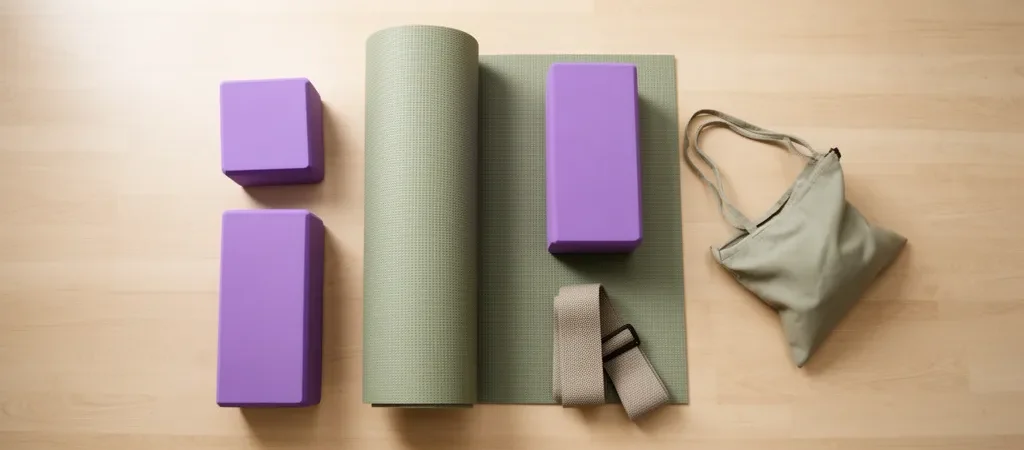
For a home-practice beginner who needs everything, the Gaiam Beginner’s Yoga Starter Kit is the simplest gift — one box covers a mat, two foam blocks, and a 6ft strap. It appears in virtually every “what to buy a beginner” thread on r/yoga and r/beginneryoga, and it is stocked at REI and Target nationwide, which matters when returns are a possibility. The mat is PVC-based and 4mm thin, so it is not the long-term solution a serious practitioner will keep for years — but for a beginner still figuring out whether yoga is going to stick, it is exactly the right starting point.
For a beginner who already has a mat — someone who received the Jade or Liforme, or who already bought their own — the component gifts make more sense. The Gaiam Essentials Foam Block Set is the block pick. Foam over cork for beginners is not a preference — it is the right call. Cork blocks are denser and heavier, which can strain wrists during supported poses when grip strength is still developing. These EVA foam blocks have over 52,000 Amazon ratings at 4.8 stars. The Manduka Unfold Cotton Yoga Strap is the standalone strap pick — unbleached cotton, double D-ring buckle that holds without slipping, and the Manduka name carries the same trust signal among yoga teachers that the brand’s mats do.

Gaiam Essentials Foam Yoga Block Set (2-Pack)
Foam blocks — not cork — are the right call for year-one practitioners. Cork is denser and heavier, which can strain wrists during supported poses when a beginner is still building grip strength. These Gaiam EVA foam blocks are the default beginner recommendation at every yoga studio pro shop and dominate beginner threads on r/yoga and r/beginneryoga. 52,000+ Amazon ratings at 4.8 stars. At $16.98 for two, they are the most cost-effective high-impact gift in this guide.
- Soft EVA foam is forgiving on wrists and hands — critical for beginners still building grip and wrist strength
- 52,000+ reviews at 4.8 stars — near-unassailable social proof from actual practitioners
- Foam is less durable than cork over years of daily intensive use; some buyers note a factory smell that needs a day or two of airing before first use

Gaiam Beginner’s Yoga Starter Kit (Mat + Blocks + Strap)
For a beginner who has nothing, this bundle eliminates all the guesswork — one box covers a mat, two foam blocks, and a 6ft strap. Stocked at REI and Target nationwide. This bundle appears in virtually every “what to buy a complete beginner” thread on r/yoga and r/beginneryoga, and it is the canonical answer when someone asks what to get a person just starting out. Straightforward returns at major retailers if sizing or color is off.
- Everything a first-year practitioner needs in one box — mat, two blocks, and strap eliminate the multi-item shopping problem
- Stocked at REI and Target nationwide — returns are easy if needed
- 4mm PVC mat is on the thinner side (beginners with sensitive knees may want a 6mm standalone) and is not the eco-conscious choice compared to natural rubber mats

Manduka Unfold Cotton Yoga Strap (6ft)
A 6-foot cotton strap is the most underrated beginner prop, and $14 is the most giftable price point in this guide. It allows practitioners with tight hamstrings, hips, or shoulders — which describes nearly every adult beginner — to reach proper position in seated forward folds, bound poses, and shoulder openers that would otherwise be inaccessible. The Manduka Unfold uses unbleached cotton with a double D-ring buckle that adjusts without slipping mid-pose. Manduka is the brand yoga teachers recommend for mats, so it carries strong trust credibility here.
- Unbleached cotton is softer on skin than nylon — no synthetic bite during active stretches
- Double D-ring metal buckle holds any position securely without slipping, which matters when you are trying to hold a stretch for 5 full breaths
- Cotton absorbs sweat and requires periodic washing to avoid odor; 1.25″ width is narrower than some studio straps

Gaiam Cargo Yoga Mat Bag
Once a beginner commits to studio classes — which typically happens somewhere in months two through four — carrying a bare mat on public transit or through a parking lot becomes awkward fast. The Gaiam Cargo bag solves this with a full-length zipper (far easier to load than drawstring bags with a rolled mat), an exterior phone pocket with an earbud slit, and an adjustable shoulder strap that fits mats up to 68″. The most frequently recommended bag alongside Gaiam mats on beginner forums.
- Full-length zipper makes loading and unloading easy — no wrestling with drawstring closures on a thick mat
- Exterior phone pocket with earbud slit is a practical detail that generic bags omit
- May not fit thicker 6mm+ mats or extra-wide mats — verify fit if pairing with a premium mat; mat-only carrier, not designed for blocks or props
The Underrated Gift: Access to Guided Practice
Gear solves one class of problem. Instruction solves another. A beginner with a quality mat and two foam blocks but no teacher is still largely figuring it out by feel — which means developing habits, some of them compensatory, that can take years to unlearn. The way most adult beginners actually get instruction today is not from a weekly in-person class. It is from streaming video at home, where they can pause, rewind, and repeat without a room full of people watching them.
An Alo Moves Annual Membership gives access to 2,500+ on-demand yoga, meditation, and fitness classes by world-class instructors. At $99 for 12 months, the value proposition is straightforward: a single drop-in class at most Austin studios runs $20–$25. The membership pays for itself in five sessions. The physical gift box format matters here — it is wrappable and presentable, which a digital code emailed to someone is not.
There is a genuine question about when a streaming platform beats a local studio gift card. The answer is practice context. A beginner who needs hands-on form correction in their first few months is better served by in-person instruction — a teacher who can physically adjust a pose is irreplaceable early on. A beginner who has already been to studio classes and is ready to build a home practice is exactly who Alo Moves is for. If you know which situation your person is in, that is the call.

Alo Moves Annual Membership Gift Box
For a beginner who already has gear, an Alo Moves membership unlocks 2,500+ on-demand yoga, meditation, and fitness classes by world-class instructors. This is how most adult beginners are actually learning yoga today — streaming video at home they can pause and repeat, not a DVD. The physical gift box format makes it wrappable and giftable in a way a digital code is not. At $99 for 12 months, it is strong value against $20–25/class drop-in rates.
- 2,500+ on-demand classes across all levels — beginners can follow a structured 30-day program rather than picking classes at random
- Physical gift box is wrappable and presentable — more memorable and giftable than a digital code
- Some Amazon reviewers report receiving boxes with already-used redemption codes — inspect the packaging seal carefully before gifting; requires reliable internet access and a streaming device
What to skip
Yoga-themed candles, inspirational quote journals, novelty grip socks, and matching athleisure sets are lifestyle accessories, not practice tools — they signal the aesthetic of yoga without contributing anything to the actual practice. Bolsters look useful but belong to restorative yoga, a specialized style most beginners have not yet encountered and will not need until year two or later. Dharma Wheels, inversion benches, and resistance bands marketed as yoga props are intermediate-to-advanced equipment that will sit unused. The test is simple: does this gift reduce a specific friction point in their current practice? If you cannot name the friction it removes, it belongs on a generic wellness wishlist, not here.
The best yoga gift for a beginner is not the most yoga-looking item in the store. It is the thing that makes it easier for them to show up tomorrow — to unroll the mat, do the class, and not have the gear get in the way of the practice. A mat they trust, props they can use at home without a studio’s supply shelf, or access to a teacher who builds real technique over weeks and months: these are the gifts that compound. Everything else is decor.
If you are deciding between the Jade and the Liforme, the deciding factor is not price — it is practice context. Home practitioner learning without a teacher? The Liforme’s alignment grid earns its premium. Studio practitioner who needs a mat they can trust in class? The Jade is the better fit and easier on the wallet. If you are not sure which they are, ask. It is a five-second question that makes a meaningful difference.
And if you are genuinely unsure whether they already have a mat, buy the strap. At $14, the Manduka Unfold is the one gift in this guide that almost no beginner already owns and almost every beginner will use in every session, permanently, without outgrowing it.