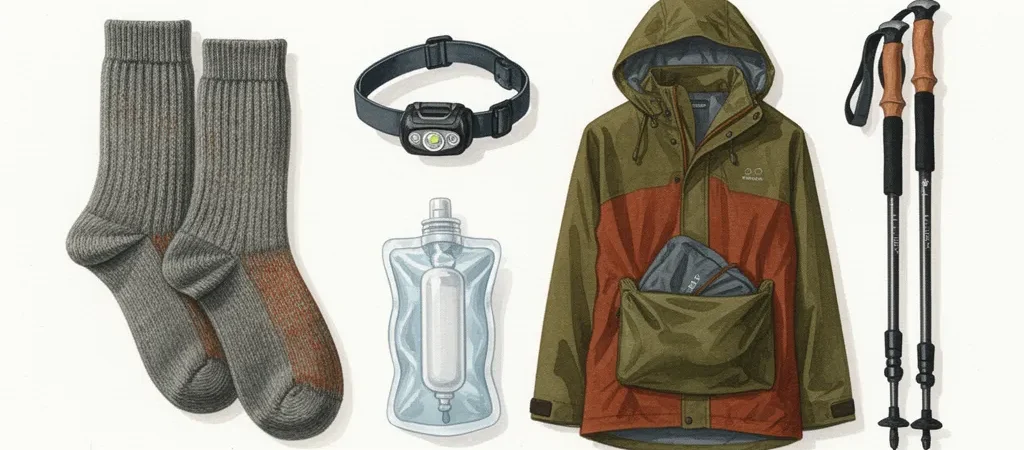
New hikers almost always make the same first two purchases: a pack and footwear. Those are the right calls — but they leave a predictable cluster of gear gaps that make early trails harder than they should be. Cotton socks that blister. No rain layer on a day that turned wet. A headlamp still in the box at home when sunset came 40 minutes early. These aren’t obscure edge cases; they’re the quiet friction that makes someone skip the next hike.
The problem for gift-givers is that hiking gear looks confusing from the outside. There are dozens of headlamps, a wall of rain jackets, and a thousand sock options at every price point. Most of the advice online treats beginners as a monolith, but there’s a meaningful difference between someone on their first three trails and someone who’s been out 10 times and is starting to think about multi-day trips.
This guide is organized around that distinction — two sub-stages, five gear categories, seven picks — so the gift you choose actually lands in the right gap.
How we select these gifts
- Gear gap first: Every pick addresses a specific category beginners demonstrably skip — footwear socks, rain protection, lighting, hydration from natural sources, and stability on descents. We don’t include products just because they’re popular; we include them because they solve a real, documented beginner problem.
- Community consensus: Picks were cross-referenced against what experienced hikers recommend in r/hiking, r/ultralight, and the REI Co-op beginner gear threads. Products that appear repeatedly across independent community discussions carry more weight than any single review.
- Sub-stage fit: We distinguish between sub-stage 1 (0–3 hikes, still uncommitted) and sub-stage 2 (5–15 hikes, clearly hooked). Some picks are right for both; others belong firmly in one stage. We say which and why.
- Budget range: Picks span $20 to $120 so the guide works whether you’re spending $20 or $120. Three picks are under $40.
- Skip-this guidance: Where a popular category seems like an obvious gift but isn’t right for a beginner, we name it and explain the reasoning.
The Beginner Hiker’s Most Common Gear Gaps (and Why They Happen)
Most adults who start hiking do so with gear borrowed from camping trips or a hasty weekend purchase — a daypack from Target, a pair of trail runners they already owned, and whatever clothes they’d wear to the gym. That’s a fine starting point. The problem is the next layer of gear doesn’t announce itself until something goes wrong on trail.
You don’t know you needed merino wool socks until mile four when a hotspot becomes a blister. You don’t know you needed a headlamp until the trailhead is still 45 minutes away and the sun is gone. You don’t know you needed a rain layer until you’re three miles in and the temperature dropped 15 degrees. These are the gear gaps this guide fills — and they’re predictable enough that a well-chosen gift lands almost every time.
It helps to think about your recipient in two sub-stages. Sub-stage 1 is 0–3 hikes: they’re trying hiking, haven’t committed, and need gear that’s low-cost, low-risk, and immediately useful. Sub-stage 2 is roughly 5–15 hikes: they’ve decided they like this, they’re starting to plan more ambitious trails, and they’re ready for gear that will last. A Frogg Toggs rain suit is exactly right for sub-stage 1; a Marmot PreCip is exactly right for sub-stage 2. That framing does most of the gift-selection work for you.
The clothing gaps tend to be the most consequential for safety and comfort, and they’re also the easiest to get right. The navigation and hydration gaps matter more as the hiker moves into sub-stage 2 and starts exploring trails with variable cell coverage and natural water sources.
Layer Up: Clothing Gifts That Outperform Gadgets for New Hikers
Hiking gear marketing pushes gadgets hard — GPS devices, multi-tool kits, hydration bladders — because gadgets photograph well and command high price points. For a beginner, though, the gear that changes the quality of every single hike is the clothing they wear against their skin. A pair of Darn Tough Hiker Micro Crew Midweight Socks costs $24 and eliminates the single most common cause of beginner discomfort on trail: cotton socks that hold moisture against the foot and cause blisters within three miles.
Cotton fabric absorbs sweat and stays wet. On trail, that means sustained friction between a damp sock and a hiking boot, which translates directly to hotspots and blisters on anything longer than a gentle loop. Merino wool manages moisture differently — it wicks away from the skin, regulates temperature across a wider range, and resists odor well enough that a single pair can handle multi-day trips. The Darn Tough warranty — lifetime, no-questions-asked, send back any worn or holed pair for a free replacement — makes the $24 price credible even for someone on their first trail.
For rain protection, the right answer depends almost entirely on which sub-stage your recipient is in. A Frogg Toggs Ultra-Lite2 Rain Suit is under $20 for a full jacket-and-pants set and compresses to sandwich size — this is the “buy it without worrying if they’ll use it” option for a sub-stage 1 hiker. The Marmot PreCip Eco Rain Jacket is the $120 answer for a sub-stage 2 hiker who is clearly committed: it breathes on uphill climbs in a way the Frogg Toggs cannot, packs into its own chest pocket, and is built to last several seasons rather than one. The choice between them is not a quality judgment — it’s a commitment diagnosis.

Darn Tough Hiker Micro Crew Midweight Sock
Cotton socks cause blisters on trail — merino wool eliminates that variable. The 61% merino blend wicks moisture away from the foot and resists odor enough for multi-day wear. The midweight cushion at the heel and ball of the foot makes this pair versatile across trail runners and light boots. A consistent recommendation in r/hiking beginner threads, and the lifetime unconditional warranty makes the $24 price a credible spend for someone on their first trail.
- 61% merino wool wicks moisture and resists odor
- Midweight cushion at heel and ball for trail runners and light boots alike
- Lifetime unconditional warranty replaces worn or holed pairs permanently
- ~$24 per pair noticeably pricier than synthetic alternatives
- Micro crew height can expose ankle on brushy trails

Frogg Toggs Ultra-Lite2 Rain Suit
For a sub-stage 1 hiker who isn’t yet committed to hiking regularly, this is the rain protection answer: under $20 for a full jacket-and-pants set, 5.5 oz total, compresses to sandwich size. Most packable rain jackets at this price point are jacket-only — the pants inclusion matters on a full-day trail where your legs are as exposed as your torso. The trade-off is breathability: the Frogg Toggs does not breathe on a long uphill climb the way a proper waterproof-breathable membrane does, and the seams begin to degrade after a season of regular use. For a sub-stage 1 hiker, neither of those downsides matters yet.
- Under $20 for full suit including pants — lowest-cost entry into dedicated rain protection
- 5.5 oz jacket compresses smaller than packable rain jackets costing 5× more
- Rain pants included — most rain jackets at this price are jacket-only
- Does not breathe like Gore-Tex — clammy interior on long climbs in heavy rain
- Durability limited: seams degrade after a season of regular use

Marmot PreCip Eco Rain Jacket
For a sub-stage 2 hiker who is clearly hooked on hiking, the PreCip Eco is the rain jacket that shows up on practically every “first real rain jacket” recommendation list — including the REI Co-op beginner gear guide — and earns that position on substance. The 2.5-layer NanoPro Eco membrane breathes on uphill climbs in a way no non-breathable rain suit can, which matters when you’re generating real heat on a 1,500-foot climb and a Frogg Toggs would leave you soaked from the inside. It packs into its own chest pocket with a clip loop sized for hipbelt attachment, so it’s accessible mid-hike without opening the pack.
- 2.5-layer NanoPro Eco waterproof-breathable membrane with pit zips
- Packs into its own chest pocket with clip loop for hipbelt access
- PFC-free DWR, 100% recycled construction, manufacturer warranty
- At $120, real commitment — sub-stage 1 hikers should start with Frogg Toggs
- 2.5-layer can feel slightly clammy in extended heavy rain vs pricier 3-layer alternatives
Safety and Navigation Gifts That Match Their Trail Level
Every beginner hiking checklist puts a headlamp on the non-negotiable list, and it belongs there. The scenario isn’t dramatic — it’s mundane. A trail takes longer than expected. The afternoon cloud cover makes it dark earlier than sunset. A wrong turn adds 45 minutes. Suddenly a hiker who left the car at 2pm is navigating a rocky descent at dusk without a light source. The Black Diamond Spot 400 Headlamp is the right answer here — not because it’s the cheapest option, but because it runs on standard AAA batteries (available at any gas station in an emergency), delivers 400 lumens, and carries an IPX8 waterproof rating that survives rain and stream crossings.
The navigation gift for a beginner is less obvious: AllTrails+ is worth discussing separately from the headlamp because it solves a different kind of problem. The free AllTrails tier is genuinely useful, but it requires cell signal to load maps in real time. In many popular hiking areas — canyon country, dense forest, rural state parks — LTE coverage is unreliable at best. AllTrails+ offline map downloads eliminate that failure mode entirely. The wrong-turn push alerts are the other feature that pays off for beginners specifically: an experienced hiker reads trail junctions intuitively; a beginner does not, and a 400-meter wrong-turn branch can spiral into a significant navigation problem.
Both the headlamp and the AllTrails+ subscription are appropriate for sub-stage 1 and sub-stage 2 hikers alike. Neither requires commitment or experience to justify — they’re gap-closers that matter on the first trail as much as the fifteenth.
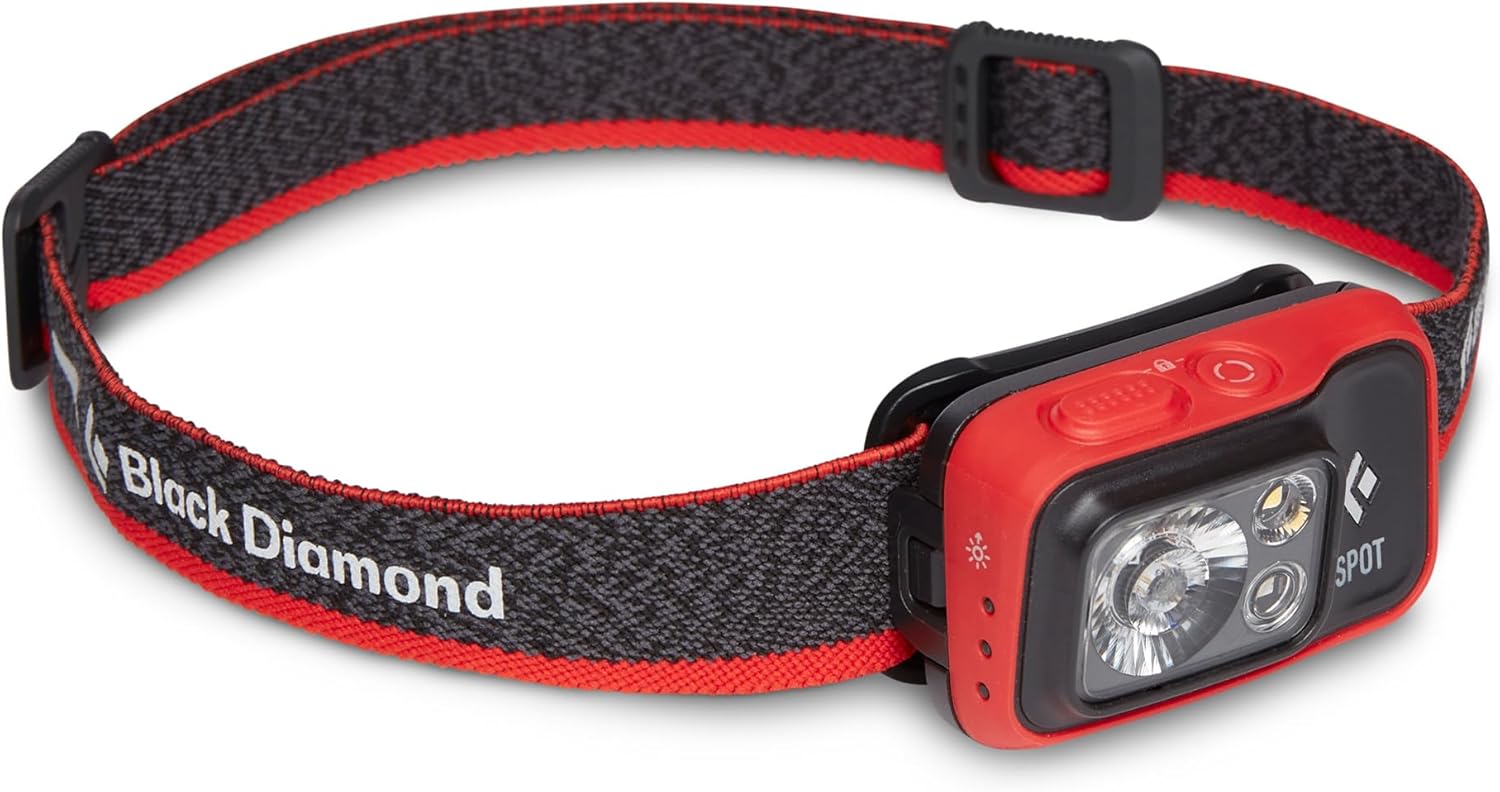
Black Diamond Spot 400 Headlamp
Every beginning hiking guide lists a headlamp as a non-negotiable safety item, and the Spot 400 is the model that shows up consistently in those guides because it gets the fundamentals right. AAA battery operation means no USB cables and no dead-battery anxiety — any gas station near the trailhead sells a replacement set. The IPX8 waterproof rating survives full submersion, the red night-vision mode protects dark adaptation on early-morning starts, and PowerTap technology lets you jump from low to full brightness with a single side-switch tap without cycling through modes.
- Runs on AAA batteries — no USB cables, works with any gas station batteries in emergency
- IPX8 waterproof rating survives rain and stream crossings
- PowerTap technology jumps from low to full brightness with a side-switch tap
- At $55 costs more than budget headlamps like Petzl Tikkina (~$20)
- Slightly heavier than the rechargeable Spot 400-R variant

AllTrails+ Annual Subscription
Unlocks offline maps, wrong-turn alerts, and weather overlays — exactly the features that matter when a beginner hikes somewhere without reliable LTE coverage. The free AllTrails tier requires a cell signal to render maps in real time; the paid tier downloads full topographic maps to the phone before the hike, so the navigation layer works in airplane mode. Wrong-turn push alerts fire when the user strays off the trail line, which is the failure mode that sends beginners on unplanned detours. Purchase at alltrails.com/gift — not on Amazon.
- Offline map download eliminates the “phone lost signal” navigation failure
- Wrong-turn push alerts fire when user strays off the trail line
- 400,000+ trails with community conditions reviews
- Not on Amazon — must purchase at alltrails.com/gift
- Community data thinner on remote trailheads vs dedicated topo apps like Gaia GPS
High-Value Picks Under $50 a Beginner Will Use on Every Hike
If your budget is under $50, the two strongest picks on this list are the Darn Tough socks ($24) and the AllTrails+ subscription ($35.99). Both are immediate, tangible, and get used on every outing regardless of trail difficulty or trip length. The socks ship on Amazon; the AllTrails+ subscription ships as an email gift link from alltrails.com/gift. Either one makes a stronger beginner gift than most items marketed specifically as “hiking gifts.”
The Sawyer Squeeze Water Filter also clears $40 and belongs in this section with an asterisk. At 3 oz and under $40, it’s the canonical water filtration pick in backpacking communities — lightweight, requires no batteries or pumping, removes 99.99999% of bacteria, and carries a lifetime guarantee rated to 100,000 gallons. The asterisk is the sub-stage caveat: a sub-stage 1 hiker carrying all their water from a car faucet on short day hikes doesn’t need this yet. The Sawyer becomes the right gift when the recipient is clearly in sub-stage 2 and has started exploring trails long enough or remote enough that natural water sources come into play.

Sawyer Squeeze Water Filter
The canonical upgrade pick for a sub-stage 2 hiker who has started exploring trails long enough or remote enough that natural water sources come into play. At 3 oz and under $40, the Sawyer Squeeze removes 99.99999% of bacteria with no batteries, no pumping, and no wait time — fill the included pouch, squeeze through the filter, drink. The 100,000-gallon lifetime guarantee makes it the lowest long-run cost per gallon of any filtration method at this price.
- No batteries, pumping, or wait time — fill pouch, squeeze, drink
- 100,000-gallon lifetime guarantee — lowest long-run cost per gallon at this price
- Backflushes with included syringe in 30 seconds
- Included squeeze pouches develop leaks with heavy use — most users replace with Cnoc or Platypus bottle
- Does not remove viruses — fine for US backcountry, not international travel
Splurge-Worthy Picks That Grow With Them
Two picks on this list sit at the $100–$120 range and require a confident read on your recipient’s commitment level before you spend there. Both are worth it for the right person — and premature for the wrong one.
The Black Diamond Trail Back Trekking Poles are the sub-stage 2 upgrade that committed hikers consistently report wishing they’d bought sooner. The common beginner objection is “I don’t need poles on flat trails,” which is largely correct — poles reveal their value on sustained descents, steep switchbacks, and any terrain where knee fatigue accumulates over miles. That’s exactly the kind of terrain a sub-stage 2 hiker is starting to encounter. The FlickLock adjusters clamp instantly from 63.5 to 140cm and hold under full body weight. The 7075 aluminum construction absorbs lateral stress; carbon poles at the same price point do not.
The Marmot PreCip Eco (covered in the clothing section) belongs here too as the $120 rain layer for a committed hiker. Both of these picks are not one-season purchases — a pair of Black Diamond Trail Back poles and a Marmot PreCip can follow a hiker from beginner day hikes into multi-day backpacking trips without being outgrown.

Black Diamond Trail Back Trekking Poles
The upgrade sub-stage 2 hikers consistently wish they had bought sooner — once you’ve had poles on a 2,000-foot descent, going back to hiking without them feels like a deliberate handicap. The FlickLock adjusters clamp instantly across a 63.5–140cm range and hold under full body weight, which matters while a new pole user is learning technique. The 7075 aluminum construction handles lateral stress without the pole folding. Interchangeable trekking and powder baskets are included.
- FlickLock adjustment clamps instantly from 63.5–140cm and holds under body weight
- Interchangeable trekking and powder baskets included
- 7075 aluminum withstands lateral stress — ideal while learning pole technique
- Foam grips absorb sweat but don’t wick — hands get damp in summer humidity
- 19 oz per pair heavier than carbon alternatives
What to skip: hiking boots as a gift
Don’t surprise a new hiker with boots or trail shoes. Hiking footwear has to be fitted in person with the exact socks the recipient will wear on trail, sized a half-size up to account for toe splay on long descents, and broken in for 10–15 miles before a real hike. Different manufacturers use different lasts — the shape that works for one foot doesn’t work for another — and a boot in the wrong last causes blisters on the first trail and quietly discourages a beginner from going out again. A pair of Darn Tough socks or a headlamp serves them better. Let them choose their own footwear.
The best hiking gift closes the gap between a hiker’s current kit and their next trail. That gap is almost never a pack or a pair of boots — those get bought first. It’s usually something quieter: socks that don’t blister, a light source for the trailhead parking lot at 6am, or an app that keeps them on the right trail when the signal drops. Any one of those removes a real friction point that was quietly making early hikes harder than they needed to be.
If you’re still deciding between two picks at similar price points, default to the one that works on every single hike rather than the specialized one. The Darn Tough socks go on every time; the Sawyer Squeeze only gets used when there’s a water source on the trail. Both are good gifts — one is ready on day one, the other waits until the hiker’s trails get long enough to need it.
If you genuinely don’t know which sub-stage your recipient is in, ask them one question: “When was the last time you went hiking?” If they say last month, they’re probably sub-stage 2 and you can spend up. If they say “I’m planning to start,” spend smart on the essentials — socks, headlamp, rain protection — and let the rest of the gear come naturally.