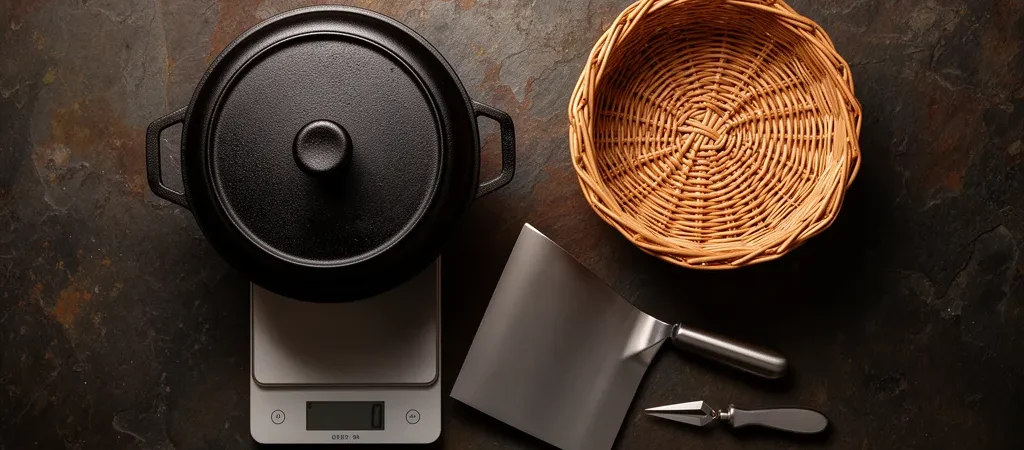
Someone in their first year of sourdough has already burned one loaf, questioned their starter at 2 a.m., and watched three YouTube videos about oven spring. What they have not done is buy themselves a proper Dutch oven, a kitchen scale, or a bench scraper — because those feel like splurges when you are not sure you will stick with it. That is exactly where a gift lands right: not as a novelty, but as the tool that finally makes the process click.
Sourdough is more unforgiving than yeast bread, and most beginner failures trace back to missing equipment rather than missing skill. The wrong vessel kills the crust. Volume measurements produce inconsistent dough. A serrated knife deflates a shaped loaf. These are not technique problems — they are tool problems, and the right gift solves them directly.
Most sourdough gift guides cover everything from beginner boules to advanced spiral mixers. This one does not. It is built around the five tools a first-year baker is almost certainly missing, plus two level-up picks for the baker who already has those covered.
How we select these gifts
- Specialty retailers first: We start with what reputable specialty kitchen retailers actually carry — stores like Williams-Sonoma and King Arthur Baking Company whose customers come back for their next loaf. Retailers whose business depends on return customers don’t stock equipment that fails in the first six months.
- Community consensus: We cross-reference retailer inventory against what sourdough bakers recommend in their own communities — r/Sourdough and r/Breadit, where bakers post troubleshooting photos and name what actually helped. Products that show up in both signals get the heaviest weight.
- Stage fit: Every pick is evaluated against the specific needs of a first-year baker who is baking 1-2 loaves per week, working from beginner recipes in the 750-900g dough range, and most likely learning from YouTube. This is not a guide for someone building a home bakery setup.
- Budget range: Picks span $11 to $49 for the core five, with two optional level-up picks at $45 and $35 — so the guide works whether you’re spending $12 or $50.
- Skip-this guidance: Where a popular pick isn’t right for this specific stage, we say so and explain why.
Why Sourdough Beginners Have Different Needs Than General Bread Bakers
Sourdough and yeast bread share an oven, but they require almost entirely different equipment. Yeast bread is forgiving: the dough is lower hydration, a loaf pan holds the shape, and commercial yeast is so reliable that a cup measure is close enough. Sourdough is the opposite. Hydration levels are higher, the dough is too slack to hold shape without support, and the leavening is a living culture that responds to temperature swings in ways that commercial yeast simply does not.
The practical result is that a beginner yeast baker and a beginner sourdough baker need almost nothing in common. A loaf pan, a measuring cup set, and a packet of instant yeast — the classic yeast-bread starter kit — are either useless or actively wrong for sourdough. What sourdough specifically requires is a sealed vessel to trap the steam a home oven cannot produce on its own, a kitchen scale to weigh ingredients to the gram, a bench scraper to handle sticky high-hydration dough without adding flour that would tighten the crumb, a banneton to hold the loaf during its cold proof, and a lame to score the top so the loaf opens in a controlled direction during baking.
Remove any one of these five tools and something breaks. No Dutch oven: flat, pale crust with no oven spring. No scale: inconsistent dough from bake to bake because a cup of flour varies by 20-30% depending on how it was scooped. No bench scraper: sticky dough becomes a mess and the baker adds too much flour to compensate. No banneton: the shaped loaf flattens during the cold proof. No lame: the loaf blows out randomly along a weak seam. This is why sourdough gift guides that mix beginner and advanced picks are not useful — the beginner’s real gap is in these five specific tools, not in a fancier mixer or a grain mill.
The Five Tools a First-Year Sourdough Baker Will Use Every Single Bake
The Lodge Cast Iron Combo Cooker is the single highest-impact gift on this list, and it is not close. The fundamental challenge in home sourdough is that residential ovens vent steam continuously — but sourdough needs steam in the first 15-20 minutes of baking to keep the crust supple long enough for full oven spring. Professional deck ovens inject steam. Home bakers have to simulate that environment, and the Lodge Combo Cooker is the most elegant solution available at any price point.
The design is specifically well-suited to beginner bakers. The shallow skillet becomes the baking surface: you preheat it face-up, drop the shaped loaf directly onto the hot surface, then invert the deep pot over it as a lid. The joint seals the steam released from the dough. After 20 minutes, you remove the pot and finish uncovered for crust color. This is meaningfully easier than the standard Dutch oven method, which requires dropping a shaped loaf down into a deep preheated vessel — a maneuver that has burned many wrists. Widely cited as the go-to baking vessel on both r/Sourdough and r/Breadit, where it appears regularly in beginner gear threads alongside Le Creuset and Staub as comparable in baking results at a fraction of the cost.
After the Dutch oven, the Escali Primo Digital Kitchen Scale has the second-highest impact on beginner results. Sourdough recipes are written in baker’s percentages — flour is always 100%, and every other ingredient is expressed as a percentage of total flour weight. A cup of bread flour can weigh anywhere from 120g to 155g depending on how compactly it was scooped; that 35g swing is enough to move a dough from ideal to too stiff. The Escali reads to 1g precision, handles up to 5kg, and has a tare function for adding ingredients incrementally without switching bowls. Two-button operation means there is genuinely no learning curve.
The OXO Good Grips Stainless Steel Bench Scraper is the most underrated tool in sourdough and the one beginners are least likely to buy for themselves. High-hydration dough — anything above 70% hydration, which covers nearly every beginner sourdough recipe — sticks aggressively to wooden boards, hands, and everything else. The reflex is to add more flour, which tightens the crumb and moves the dough away from what the recipe intended. A bench scraper lets you fold, divide, pre-shape, and transfer sticky dough without adding anything. The rigid stainless blade peels preshaped rounds off the bench cleanly, and the integrated ruler markings help divide dough evenly for two loaves. At $13 and 4.8 stars across 17,000 Amazon reviews, it has the best dollar-per-impact ratio of any tool on this list.
The SUGUS HOUSE 9-Inch Round Banneton solves the cold proof problem. After shaping, sourdough goes into the refrigerator for an overnight ferment — but the shaped dough needs a container that holds its round form, allows airflow so the surface skins slightly, and releases cleanly when it is time to bake. A banneton does all three. The natural rattan breathes, imprinting the characteristic spiral pattern on the finished crust that signals handmade artisan loaves. The included linen liner is specifically important for beginners, who haven’t yet learned the rice flour technique that prevents dough from sticking to bare rattan.
The Saint Germain Premium Bread Lame closes out the core five. Scoring — making one or more deliberate cuts in the top of a shaped loaf before it goes in the oven — is what controls oven spring. Without a score, the loaf’s expanding gases find the weakest point in the crust and blow out there, producing a misshapen loaf with an uncontrolled tear. A lame uses a razor blade mounted on a curved wand, which allows an angled, gliding cut rather than the dragging motion of a knife. That drag is enough to deflate the surface tension a baker spent 20 minutes building. Worth noting: the community consensus pick for bakers past the beginner stage is the Wire Monkey UFO lame from wiremonkey.com (~$65, US-made, not on Amazon). The Saint Germain is the right gift-tier entry point — 10 replacement blades included, leather cover, and 4.6 stars across 7,700 reviews.
For the Baker Who Already Has the Basics
If the baker on your list already owns a Dutch oven, a scale, a bench scraper, a banneton, and a lame, there are two gifts that genuinely extend what they can do rather than filling gaps they have already filled.
The Lavatools Javelin PRO Duo Instant-Read Thermometer targets the variable most sourdough bakers don’t monitor until they hit a wall of inconsistent results: temperature. Starter activity peaks at 75-78°F. Every recipe’s bulk fermentation timeline assumes a specific dough temperature — typically 75-77°F — and extends significantly in a cooler kitchen or with cold water. A finished loaf is done when the internal crumb reaches 205-210°F, not when the crust looks right. Bakers who are troubleshooting inconsistent bulk times or gummy crumbs are exactly the right audience for this tool. America’s Test Kitchen rates it as their top mid-priced thermometer pick. The Thermapen ONE ($105) is more accurate, but the Javelin is the gift-tier sweet spot at $45.
The Perfect Loaf by Maurizio Leo is the recommended cookbook for sourdough beginners and serves the baker who has been learning from YouTube and Reddit and now wants to understand why the process works rather than just following steps. Most video content teaches technique — fold like this, shape like that — but skips the mental model that explains what to look for when something goes wrong. Leo won the 2022 James Beard Award for this book and explains baker’s percentages, fermentation signs, and dough temperature math in plain language with step-by-step process photos. The active community and free recipe archive at perfectloaf.com means the book’s support continues past the last page. It is deliberately recommended over Tartine Bread for beginners: Chad Robertson’s writing assumes more prior knowledge, and beginners frequently report losing the thread.

Lodge Cast Iron Combo Cooker (3.2 qt)
The single most impactful sourdough gift for a beginner. Home ovens can’t trap steam — the Lodge Combo Cooker solves this by letting you preheat the shallow skillet lid face-up, drop the shaped loaf directly onto the hot surface, then seal the deep pot over it. That trapped steam in the first 20 minutes gives sourdough its open crumb and blistered crust. Universally cited as the go-to baking vessel on r/Sourdough and r/Breadit. The skillet lid design eliminates the awkward overhead-drop required with a standard Dutch oven. Made in the USA.
- Shallow skillet lid becomes the baking surface — loaf slides in without the overhead-drop risk of a standard Dutch oven
- Pre-seasoned cast iron retains heat evenly and doubles as a stovetop skillet; at $50, delivers the same steam environment as Staub or Le Creuset at a fraction of the price
- Heavy at ~12 lbs combined — maneuvering a preheated unit at 500°F requires long oven mitts; 3.2 qt pot limits you to round boules up to ~900g of dough

Escali Primo Digital Kitchen Scale
Sourdough baking is ratio-based: flour, water, starter, and salt are all measured by weight in grams. A cup of flour can vary by 20-30% depending on how it is scooped — that variation alone produces inconsistent dough from bake to bake. The Escali Primo reads to 1g precision, handles up to 11 lbs (5kg), and has a tare button for incremental additions directly in the bowl. Confirmed accurate to 1g in independent testing. At $26, it is the lowest-friction entry point for the skill that matters most in sourdough.
- 1g precision confirmed in independent testing — sufficient for weighing salt additions as small as 9g
- Two-button operation (on/off and tare) with zero learning curve; displays grams, oz, and lb:oz
- Platform is 8.5 x 6″ — wide mixing bowls can overhang the edges, making the display harder to read; no backlit display

SUGUS HOUSE 9-Inch Round Banneton Proofing Basket
High-hydration sourdough dough is too slack to hold shape during the final cold proof. A banneton holds the loaf in a tight round while the gluten structure sets, and the natural rattan creates the signature spiral pattern on the finished crust. The 9-inch round fits the most common beginner recipe (750-900g total dough weight). The included linen liner lets beginners avoid the stick-and-tear problem while they learn proper flouring technique.
- 9-inch round fits the most common beginner boule recipe without wasted headroom
- Linen liner included — critical for beginners who haven’t mastered the rice flour + rattan stick-prevention technique
- Round only — bakers who want oval batards need a separate oval banneton; rattan requires air-drying after each use to prevent mold

OXO Good Grips Stainless Steel Bench Scraper
Beginners consistently underestimate how difficult high-hydration sourdough is to handle — the dough sticks to everything. A bench scraper changes this immediately. The stainless blade lets you fold, divide, pre-shape, and transfer sticky dough without adding extra flour (which dries out the crumb). The integrated measurement markings help portion dough evenly for two loaves. At $13, this is the best dollar-per-impact ratio in sourdough. 4.8 stars across 17,000 Amazon reviews.
- Rigid stainless blade with non-slip grip — scrapes the bench clean in one pass and lifts preshaped dough without tearing
- Measurement markings etched on blade double as a ruler for portioning dough accurately; dishwasher safe
- Steel only — a plastic bowl scraper (for scraping inside mixing bowls) is a separate $2-3 purchase; many home cooks already own one, so confirm before gifting

Saint Germain Premium Bread Lame
Scoring the top of a shaped loaf before baking controls where it opens during oven spring — without a score, sourdough blows out randomly and looks misshapen rather than cleanly arched. A serrated knife or dull blade drags across the dough and deflates it. The Saint Germain uses a replaceable razor blade on a curved wand for a clean, gliding cut. 7,700+ reviews at 4.6 stars. Note: the community consensus pick for serious bakers is the Wire Monkey UFO lame (~$65, wiremonkey.com, US-made) — but it is not sold on Amazon. This is the correct gift-tier entry point.
- 10 replacement blades included with a lifetime blade warranty — beginners can change blades freely without worrying about running out
- Leather protective cover prevents accidental cuts in a drawer; curved wand enables the angled cut that produces an “ear” on the loaf
- Plastic handle is noticeably less ergonomic than artisan wood-handled lames; blade holder can feel slightly wobbly after extended use — not the community consensus pick for bakers past the beginner stage

Lavatools Javelin PRO Duo Instant-Read Thermometer
Temperature is the most overlooked variable in sourdough — and the most common reason bakers get inconsistent results once they have the basics down. Starter activity peaks at 75-78°F; every recipe’s bulk fermentation timeline assumes a specific dough temperature; finished bread is done when the internal crumb hits 205-210°F, not when the crust looks right. The Javelin PRO reads in 2 seconds to ±0.9°F with an auto-rotating backlit display. America’s Test Kitchen rates it as their top mid-priced thermometer pick. The Thermapen ONE ($105) is more precise, but the Javelin is the gift-tier sweet spot at $45.
- 2-second readout at ±0.9°F — sufficient for all sourdough temperature checks: dough temp, starter temp, internal bread temp
- Auto-rotating display works right- or left-handed; IP65 water resistant; 4,000-hour battery life with motion-activated sleep
- At $45, the baker who doesn’t yet understand why dough temperature matters may not use it enough to justify early in year one; some long-term owners report durability issues after 2+ years of heavy use

The Perfect Loaf by Maurizio Leo
Most sourdough beginners learn from YouTube and Reddit, which teach technique but rarely explain why things work — and that missing mental model is why results stay inconsistent. Maurizio Leo’s The Perfect Loaf (2022 James Beard Award winner, New York Times bestseller) explains bulk fermentation signs, baker’s percentages, and dough temperature math in plain language with step-by-step photos. Preferred over Tartine Bread for beginners because Chad Robertson’s recipes assume more prior knowledge. The active perfectloaf.com community means the book’s support continues after the last page.
- Step-by-step photos of the visual cues that signal each fermentation stage — replaces the “how do I know when bulk is done?” guesswork that derails most beginners
- James Beard Award winner with an active companion blog and community at perfectloaf.com; baker’s percentage explanations clear enough for year-one bakers to start scaling recipes
- Hardcover at ~$35 is not an impulse gift; some beginners prefer free video content and may not work through a technical cookbook
What to skip
Three common mistakes: a bread machine eliminates the tactile feedback that makes sourdough learnable and cannot replicate the manual timing and shaping the process requires; a loaf pan is for yeast bread — sourdough bakes free-form inside a Dutch oven, not in a tin; and any kit marketed as a “sourdough starter kit” that includes commercial yeast, bread mix, or flavored leavening agents is not sourdough and directly contradicts the live-starter process. The same logic rules out novelty bread-themed aprons, tea towels, and decorative cutting boards — lifestyle accessories that go on the shelf, not into the bake. The test is simple: will this gift be used on bake day? If not, it stays on the shelf.
A sourdough beginner does not need more inspiration — they are already checking their starter jar at odd hours and rewatching the same shaping video for the fourth time. What they need is the tool that removes the specific friction standing between them and a good loaf. The Dutch oven delivers the crust they have been chasing. The scale makes their recipes reproducible instead of situational. The bench scraper makes high-hydration dough feel manageable rather than chaotic. Gift one of those and you are not handing over equipment — you are giving them the bake that makes sourdough finally make sense.
If you are choosing between two picks and are unsure which to prioritize, go by what the baker does not own yet. The Dutch oven and the scale are the two highest-impact gaps; either one alone is a complete and useful gift. The bench scraper, banneton, and lame make a strong three-piece set for under $45 total if you want to fill the remaining gaps in one go.
If the baker is several months in and already working from a consistent routine, the Lavatools thermometer or The Perfect Loaf will stretch what they can do rather than patch something broken. Both are better received once a baker has hit the wall of inconsistent results and is actively asking why — that curiosity is what makes the more analytical tools land.