Every gift guide for guitar players leads with a clip-on tuner, a Kyser capo, a strap, and a multipack of light strings. Those are fine gifts — for someone who just picked up a guitar last month. An intermediate player already has all of them, probably in duplicate. Buying another set signals, however unintentionally, that you don’t know where they actually are.
The intermediate stage is a specific and recognizable place: barre chords are clean and reliable, three or four strumming patterns feel natural, songs get played start to finish rather than abandoned at a difficult transition, and fingerpicking is either just starting or just stalling. The friction at this stage isn’t about fundamentals anymore. It’s about tone quality, practice methods that break plateaus, physical comfort during longer sessions, and the ability to hear yourself objectively.
The seven gifts here address those friction points directly. None of them duplicate what a player at this stage owns. The price range runs from $20 to $100.
How we select these gifts
- Community consensus: We cross-reference what established gear communities actually recommend — specifically the Acoustic Guitar Forum and r/acousticguitar. Products that appear repeatedly in intermediate player threads carry the most weight.
- Targets the intermediate ceiling, not the beginner floor: Every pick was evaluated against one question: does this address a friction point that emerges at the intermediate stage, or does it duplicate something the player almost certainly already owns?
- Stage fit: Intermediate acoustic players are developing ear training, transitioning to fingerpicking, and putting in enough daily practice time that durability and physical comfort actually matter.
- Budget range: Picks span $19.95 to $99.99.
- Skip-this guidance: Where a popular gift category isn’t right for this stage, we name it and explain why.
What “Intermediate” Actually Means (and Why It Changes Everything You Buy)
An intermediate player makes clean chord transitions, has two or three strumming patterns that feel automatic, can play a complete song without stopping, and has some awareness of basic theory — knowing why a chord is a G major, not just where to put their fingers. Fingerpicking may be present at a basic level: a simple Travis pattern, an alternating thumb. It isn’t clean yet, but it exists.
That profile creates four specific friction points that don’t exist for beginners: tone quality (good enough to hear that their instrument sounds dull, but may not know dead strings or a dry guitar are the culprit), practice plateau (self-teaching players hit a ceiling where they play their songs but aren’t getting better), performance capability (can play for an audience but has no way to record or loop), and technique accessories (the physical setup that worked at beginner level starts creating audible and physical problems as standards rise).
Every pick in this guide addresses one of those four friction points specifically.
The Gifts: Tone, Practice, Performance, and Feel
The most immediate upgrade for any intermediate acoustic player isn’t a new technique — it’s strings and instrument care. A guitar strung with six-month-old budget strings stored in a dry room sounds worse than it should, and the player often doesn’t realize the instrument itself is holding them back tonally. That’s where this list starts.
From there, the picks move into technique tools: the Hal Leonard Fingerpicking Guitar Method addresses the most common plateau mechanism (learned shapes without learned technique), and the G7th Performance 3 ART Capo upgrades a piece of kit the player already has but whose tuning limitations they’ve probably started noticing. The Peterson StroboClip HD takes the tuner category seriously for the first time, giving a player developing ear training a tool that actually matches that level of attention.
The Boss RC-1 Loop Station is the single highest-leverage practice tool on the list, but it requires a pickup — confirm the guitar has a 1/4-inch output jack before purchasing. If it does, the RC-1 transforms practice from passive repetition into active musical problem-solving.

Oasis OH-1 Guitar Humidifier
Intermediate players have invested real money in a quality acoustic. A $20 humidifier in the soundhole is the cheapest insurance available. Gel crystals hold water without liquid — zero drip risk from basic sponge units. Most-cited humidifier recommendation across Acoustic Guitar Forum threads; endorsed by Taylor Guitars’ own care documentation. Included syringe and stabilizer bar make refilling clean; crystals hold moisture 5–7 days per fill.
- Gel crystal fill — zero drip risk that sponge humidifiers carry
- Cheapest protection available for a several-hundred-dollar instrument
- If allowed to dry completely, hardened crystals can puncture membrane — refill before fully dry

Elixir Nanoweb Phosphor Bronze Light Strings
Intermediate players are on the guitar enough that cheap strings die mid-session. Phosphor bronze wrap delivers warm low-mids ideal for fingerpicking and open-chord work. Nanoweb coating — Elixir’s thinnest — reduces string noise between notes without the artificial feel of heavier coatings, and extends life 2–3x over uncoated strings. 4.8 stars across 85,000+ ratings: the closest thing to undisputed community consensus in any string category.
- Phosphor bronze delivers rich low-mids ideal for fingerpicking and open-chord work
- 2–3x lifespan of uncoated strings; 4.8 stars / 85,000+ ratings
- At $21.99 roughly double an uncoated D’Addario; tone never has the bright pop of fresh uncoated strings on day one

Hal Leonard Fingerpicking Guitar Method (Boduch)
The most common intermediate plateau is fingerpicking that stalls because the player learned patterns by imitation without learning underlying technique decisions: thumb independence, alternating bass movement, hand anchoring. This method covers exactly that gap using real repertoire the player already wants to play correctly — Blackbird, Dust in the Wind, Landslide, Africa. Streaming audio and video for every example is included, making the tab usable for ear-first self-teachers.
- Real repertoire (Blackbird, Dust in the Wind, Landslide, Africa) — no motivation gap of abstract exercises
- Online streaming audio and video for every example
- Pure tab-based method book — players preferring video instruction may find it less engaging
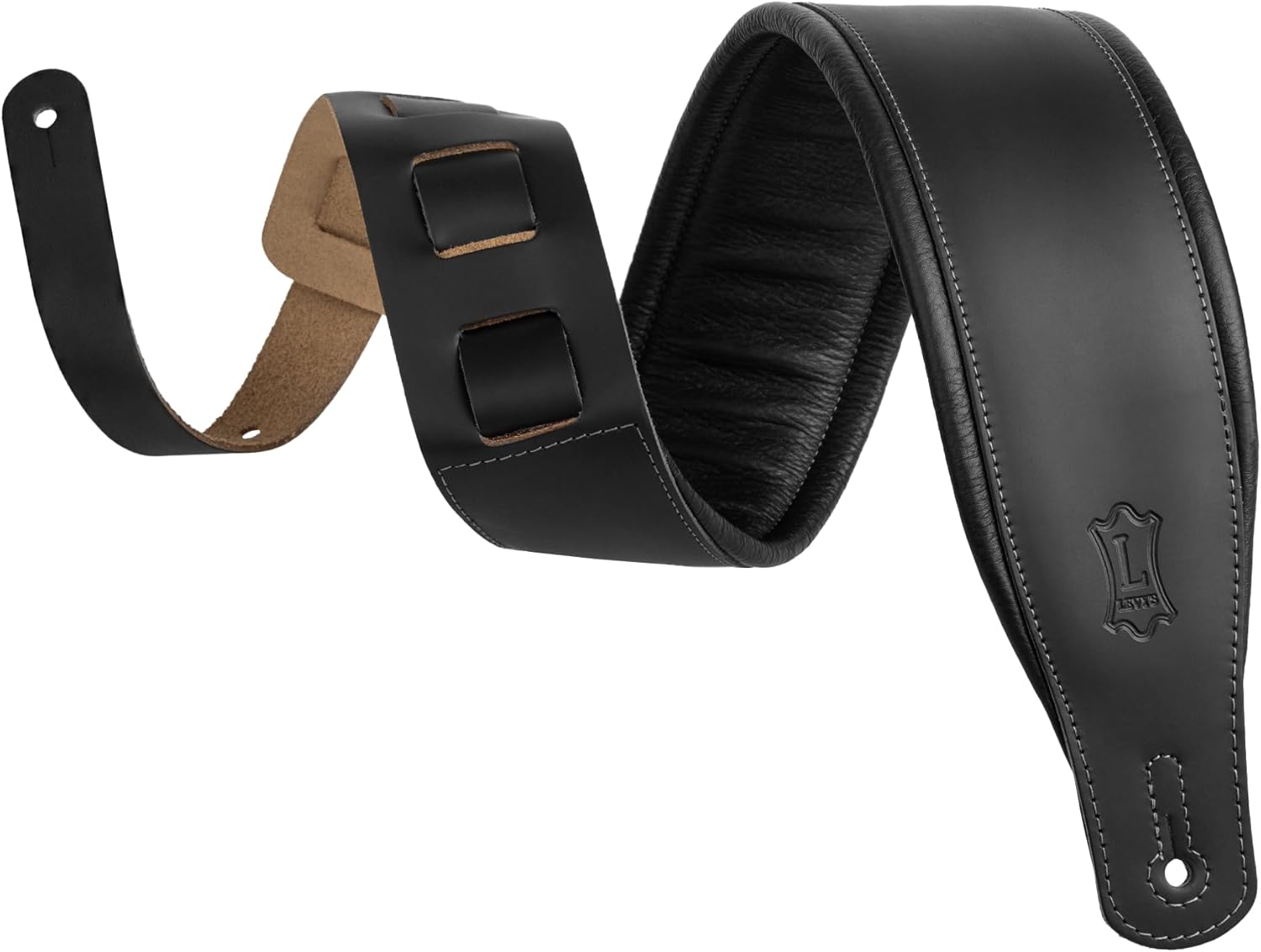
Levy’s M26PD 3-Inch Padded Leather Guitar Strap
The 2-inch nylon strap from a starter bundle digs into the shoulder within 15–20 minutes of standing play. The M26PD uses a 3-inch top-grain leather face with foam padding, distributing the guitar’s weight across a significantly broader surface. Handmade in Nova Scotia; reviewers across guitar forums regularly report 15-plus years of use on a single strap. Adjusts from 37 to 51 inches. A gift that improves every single standing session.
- 3-inch width with foam padding substantially reduces shoulder fatigue during standing practice
- Top-grain leather; 15+ year lifespan reported by long-term users
- Max 51 inches can run short for very tall players who wear the guitar low; leather takes a few weeks to break in fully

Peterson StroboClip HD Strobe Tuner
Ear training develops actively at the intermediate stage — and that’s when a basic chromatic tuner starts feeling inadequate. The StroboClip HD reads to 0.1-cent accuracy, fine enough to reveal whether a capo is pulling a string slightly sharp or whether a nut slot needs filing. The 50+ Sweetened Tunings compensate for natural string inharmonicity, so open chords ring cleaner than equal temperament allows. The tuner recommended by professional guitar technicians and players who care about intonation at this price point.
- 0.1-cent strobe accuracy — identifies nut, saddle, and capo intonation problems
- 50+ Sweetened Tunings make open chords ring audibly cleaner than standard equal temperament
- Strobe display takes a few sessions to learn to read quickly; plastic clamp arm is the weakest point mechanically

G7th Performance 3 ART Capo
The standard trigger capo applies a fixed spring force regardless of fretboard radius, consistently bending strings slightly sharp — imperceptible to a beginner and increasingly audible as the ear develops. The Performance 3’s Adaptive Radius Technology string pad conforms mechanically to the exact curvature of the fretboard, applying only the minimum required pressure. Acoustic Guitar Forum comparison threads name it the tuning-stability winner at this price bracket by a clear margin.
- ART string pad adapts to fretboard radius — no string pull-sharp, no retune ritual after placement
- Squeeze-on tension control; lifetime warranty when registered; robust aluminum build
- Slower to relocate mid-song than a spring-loaded trigger capo; string pad reported to separate if dropped on a hard surface

Boss RC-1 Loop Station
A looper changes what practice sounds like for a self-teaching intermediate player in a way nothing else on this list does. Record a I-IV-V rhythm loop, then improvise melody over the top. Lay down a Travis-picked bass line and practice chord melody against it. Hear timing discrepancies in your own playing that vanish when you’re only listening to yourself in real time. The RC-1 has a single footswitch and a circular LED display — the most intuitive interface in its price category. Five-year Boss warranty. Hard requirement: the guitar needs a 1/4-inch output jack.
- Single footswitch with circular LED loop display — most intuitive looper interface at this price
- 12 minutes of recording time; Boss durability and 5-year warranty; battery or AC power
- No built-in drum/rhythm tracks (RC-5 adds those for $50 more); requires 1/4-inch output jack on the guitar
What to skip
Clip-on chromatic tuners, spring-loaded trigger capos, beginner string multipacks, wall hangers, guitar polish kits, and pick variety samplers are all reasonable beginner gifts — and an intermediate player already owns every one of them. The other category to avoid without serious prior research: a new guitar. At the intermediate upgrade price point ($400–$1,200), body style, tonewood, neck profile, and scale length all affect playability and sound in deeply personal ways. Getting it wrong isn’t just a financial problem — it creates an awkward gift dynamic that’s difficult to resolve.
The intermediate stage is when playing starts to feel like a real skill rather than a project in progress — and when the gap between “I can play songs” and “I sound like I want to sound” becomes the dominant frustration. If the guitar has a pickup, the RC-1 is the highest-leverage single purchase on the list. If you’re less certain about the setup, the Elixir strings and Oasis humidifier together come in under $42 and address two problems that affect every acoustic player at this stage regardless of configuration. When in doubt between two picks at similar prices, think about where the player spends their practice time: standing (strap), stalling on fingerstyle (Boduch method), or frustrated by a capo that keeps putting them slightly out of tune (G7th).