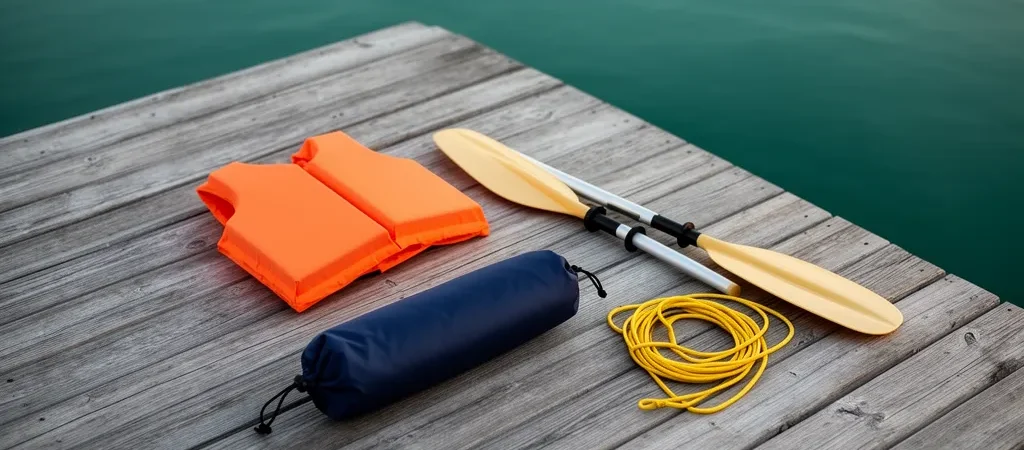
Most kayak gift guides are written for people who already know what they are doing. They recommend carbon fiber paddles, rolling accessories, and spray skirts that mean nothing to someone who just bought their first sit-on-top and has been on the water twice. The gear that shows up on the first page of Google — from REI, Paddling Magazine, Adventure Junkies — mixes beginner and advanced picks without ever filtering by skill stage. Carbon fiber touring paddles require consistent technique to feel the benefit. Spray skirts require a sit-inside hull and the ability to wet-exit. A first-year paddler needs neither.
Every pick in this guide solves a specific problem that flatwater recreational beginners actually hit in their first season: sore back after 90 minutes on a stock plastic seat, soaked phone at the launch ramp, arm fatigue that compounds from a paddle that is too heavy, a PFD that gets removed because it is unbearable to wear, no protection from open-water UV. These are the five failure modes that make beginners quit. None of them require expensive solutions — most can be fixed with a thoughtful gift under $100.
The gear that fixes first-year problems is not glamorous. But getting even one of these picks right does more for a new paddler’s long-term enjoyment than any high-end upgrade they are not yet positioned to appreciate.
How we select these gifts
- Specialty community signal first: We cross-reference against what active paddling communities actually recommend — r/kayaking, the paddling.com forums, PaddleRoundThePier’s tested reviews, and OutdoorGearLab’s paddle roundups. Products that show up repeatedly across independent sources carry the heaviest weight.
- Community consensus: We also check what major paddling publications tested with real water time — OutdoorGearLab Best Buy designations, Paddling Magazine tested picks, and GearJunkie’s category roundups. A product that shows up in editorial testing and paddling forums simultaneously is a strong signal.
- Stage fit — first-year recreational flatwater: This guide draws the line at sit-on-top and recreational sit-inside hulls, flatwater lake and bay paddling, and paddlers who have been on the water fewer than a dozen times. Every pick is evaluated against the specific failure modes that make first-year paddlers quit, not the gear needs of someone with solid technique or a touring destination in mind.
- Budget range: Picks span $9.99 to $89.95, so the guide works whether you’re spending $10 or $90. The most impactful gifts in this guide are not the most expensive ones.
- Skip-this guidance: Where a popular pick is wrong for a first-year paddler — spray skirts, carbon fiber paddles, GPS chart plotters — we say so and explain why the stage mismatch matters.
What a First-Year Kayaker Has (and What They’re Still Missing)
Most adult beginners enter the season with three things: a rental or budget recreational sit-on-top kayak (typically 27–30 inches wide, stable and forgiving), the heavy aluminum paddle that came bundled with it, and whatever PFD the retailer pushed at checkout — usually an uncomfortable foam block Type II they will wear once and then stash in the cockpit.
What they do not yet own is telling. No aftermarket seat with lumbar support. No paddling-specific low-profile PFD that actually stays on. No dry storage for the phone and keys they bring on every trip anyway. No paddle leash, which means the first capsize is an education. And no real sun protection for a sport that reflects UV from the water surface, the hull, and the sky simultaneously — a triple exposure that surprises paddlers who would never sit outside for three hours without sunscreen.
The kayak itself is rarely the problem. Budget recreational hulls do the job for first-year flatwater paddling. The bundled accessories are where the friction lives. A stock seat that feels fine for 30 minutes becomes punishing after 90. An aluminum paddle that weighs 44 ounces creates forearm fatigue that compounds over two hours. A PFD that pushes the paddler forward whenever they sit against their seat back gets taken off. All of these are fixable without replacing the boat — which is exactly what a gift is for.
The #1 First-Year Problem: Back Pain from a Stock Kayak Seat
The seat upgrade is the most impactful single improvement a first-year paddler can make, and also the least obvious one from the outside. Stock seats on budget recreational kayaks fall into two categories: molded plastic with a thin foam insert, or a low-profile webbing seat with no meaningful lumbar support. Both feel acceptable during a 20-minute test paddle at a demo event. Both become genuinely uncomfortable somewhere between 60 and 90 minutes on the water — right around the duration of a real first outing.
The pain is not dramatic. It is the kind of low-grade back and hip discomfort that makes a paddler decide to head back to shore earlier than planned, then the following weekend decide not to go at all. An aftermarket seat with genuine lumbar support extends that two-hour limit into a four-hour paddle. That extra time on the water is where beginners actually get comfortable with the boat — where the paddling becomes automatic rather than effortful.
The Surf to Summit Outfitter Tall Back Kayak Seat is the pick here precisely because it was not designed for retail consumers — it was designed for outfitter and instructional fleets that need seats to survive daily beginner abuse across a rental season. Commercial durability requirements produce a different product than consumer-grade price-optimization. The compression-molded foam back reaches 16.5 inches and does not fold or sag, which distinguishes it from the sewn-foam aftermarket seats that look identical in photos but fail within a season.

Surf to Summit Outfitter Tall Back Kayak Seat
Originally engineered for rental and instructional outfitter fleets — places that need seats to survive daily beginner abuse — the Outfitter Tall Back is the closest thing to a commercial-grade upgrade seat available on Amazon. The paddle community on paddling.com consistently points new sit-on-top owners here when they want to fix the plastic-seat-back problem that makes two-hour paddles feel like four. The compression-molded foam back reaches 16.5 inches, meaningfully higher than most no-name aftermarket seats, providing real lumbar support without requiring a proprietary mounting system.
- Compression-molded foam back does not fold, sag, or blow out — lace-through webbing anchors it permanently, surviving the launch and landing scrambles that destroy sewn-seam budget seats
- Universal strap attachment system fits nearly every production sit-on-top recreational kayak without drilling or modifying the hull
- The molded foam seat pan is firm by design (built for outfitter durability, not plushness); paddlers with lower-back sensitivity may want to add a thin gel pad underneath
Safety First: The PFD Problem Nobody Talks About
The uncomfortable truth about beginner PFD compliance is not that paddlers don’t know they should wear one — it is that the PFD they own makes wearing it unpleasant enough that they find reasons not to. Type II PFDs, the bulky horseshoe-collar orange vests from boat rentals and big-box checkout counters, are designed for unconscious victim rescue in open-water emergencies. They are not designed for active paddling. Worn over a kayak seat, they push the paddler forward off the backrest, creating exactly the lower-back strain the seat is trying to prevent.
A Type III paddling-specific PFD changes this equation. The critical design feature is a mesh or cut-away lower back panel that sits cleanly against a kayak seat backrest without creating interference. Ventilation mesh on the front eliminates the second most common complaint — heat, on any paddling day above 75 degrees. Multiple adjustment points at the shoulders and sides achieve a fit that stays put through paddle strokes rather than riding up.
The Onyx MoveVent Dynamic Paddle Vest is the default Type III recommendation across every major paddling community for those specific reasons. It is USCG-approved with SOLAS-grade reflective accents and an included safety whistle — which matters because a whistle is legally required on all US waters for human-powered vessels, and most beginners do not know this. At $49.95 it costs roughly half what specialty outfitters charge for paddling-specific PFDs with equivalent functionality.

Onyx MoveVent Dynamic Paddle Vest
The Onyx MoveVent Dynamic is the default Type III recommendation across every major paddling community for a single concrete reason: it solved the high-seat-back problem. The mesh lower back panel and sculpted foam sit cleanly against kayak seat backrests without pushing the paddler forward — a chronic issue with traditional foam-block PFDs that causes beginners to remove them. USCG-approved with SOLAS-grade reflective accents and an included safety whistle, it clears every flat-water safety requirement at roughly half the price of specialty-store alternatives. 4.8 stars across 1,300+ reviews.
- Mesh ventilation front and back makes it genuinely wearable in warm-weather flat-water conditions — heat is the most common reason beginners don’t wear a PFD, and this vest directly addresses it
- Six adjustment points including neoprene shoulder pads achieve a precise fit across a wide range of adult body types
- Foam is less sculpted than premium models like the NRS Ninja, so paddlers logging extended high-mileage days may notice slight restriction at full paddle extension
The Gear Beginners Don’t Think About Until It’s Too Late
Three categories of gear reliably show up after the first bad experience rather than before it: dry storage, a paddle leash, and real sun protection. The pattern is consistent — a soaked phone, a drifted paddle after a capsize, or a sunburn that takes two days to fade teaches these lessons faster than any gift guide. The value of giving them before the first bad experience is that the bad experience never happens.
Dry storage is the most financially consequential. A phone that goes overboard in a soft-side pocket does not survive. A roll-top dry bag from a reputable outdoor brand costs $40 and prevents a $1,000 equipment loss. The Sea to Summit Big River Dry Bag 13L was named the best kayaking-specific dry bag in GearJunkie’s 2026 tested roundup. The 13L size covers the real first-year load: phone, keys, a dry shirt, sunscreen, and a snack — everything that belongs in the cockpit and not at the bottom of the lake.
A paddle leash addresses a scenario beginners do not visualize until they are in it: you capsize, you grab for the hull, and your paddle drifts. In open water with any wind or current, a paddle moves faster than a swimmer. Experienced paddlers prevent this automatically; beginners need the leash. The OCEANBROAD Kayak Paddle Leash costs $9.99 and clips in five seconds — which matters when you are managing a boat, a PFD, and a dry bag simultaneously at a busy launch ramp.
Sun protection on open water is a different exposure environment than sitting in a backyard. Water reflects UV from below. The hull reflects it from the sides. And most kayakers do not reapply sunscreen mid-paddle — they forget, their hands are wet, or they simply run out of it in the first 90 minutes. The Roadbox UPF 50+ Long Sleeve Sun Shirt blocks 98% of UV regardless of whether it is wet or dry, and the integrated sun hood covers the back of the neck — the spot paddlers most reliably miss when applying sunscreen before a session. The Pelican Marine IP68 Waterproof Phone Pouch XL rounds out this category: IP68-rated, built with air-cushion buoyancy so it floats face-up after a capsize, from a brand that has supplied watertight protection to military and public safety users since 1976.

Sea to Summit Big River Dry Bag 13L
GearJunkie named the Sea to Summit Big River the best kayaking-specific dry bag in their 2026 tested roundup. The 420D TPU-coated nylon holds up to repeated pack-unpack cycles and 13L covers the most common first-year use case: phone, keys, a dry shirt, sunscreen, and a snack. Integrated D-ring lash points allow clip-in attachment to kayak deck rigging without improvising with bungee cords.
- White interior laminate lets you find dark items instantly — a detail that matters when rummaging at a crowded boat ramp
- Field-replaceable buckles (Phillips screwdriver only) give the bag a multi-year service life rather than the single-season failure point common in cheaper roll-top closures
- At $39.95 it costs nearly twice as much as budget roll-top options; beginners who paddle fewer than five times per year may not use it enough to justify the premium

OCEANBROAD Kayak Paddle Leash 4-7ft
A paddle leash is a $10 item that prevents a $300 problem: beginners capsize, grab for their kayak, and watch their paddle drift out of reach in open water. PaddleRoundThePier awarded the OCEANBROAD their Editor’s Choice in the paddle leash category, noting it outperformed leashes at twice the price in stretch retention and clip security. The coiled bungee stays out of the way while paddling but extends to 7 feet on a reach, long enough to recover a drifting paddle without dragging slack through the water.
- Stainless-steel gate carabiner resists saltwater and UV degradation — important for coastal bay paddling where stainless hardware outlasts aluminum-gate alternatives by multiple seasons
- D-ring wrist loop attaches in under five seconds, which matters when launching from a busy ramp while managing the boat and gear simultaneously
- Newer product with a smaller review base than established brands like Seattle Sports or NRS

Roadbox UPF 50+ Long Sleeve Sun Shirt
Open water reflects UV from the surface, the hull, and the sky simultaneously — beginners who would never sit outside for three hours without sunscreen do exactly that on a kayak. The Roadbox UPF 50+ blocks 98% of UV, wears across tens of thousands of verified purchases spanning fishing, kayaking, and hiking, and at $20 costs nothing emotionally if it goes overboard. The integrated sun hood eliminates the most commonly missed spot: the back of the neck, where kayakers rarely think to reapply sunscreen mid-paddle.
- UPF 50+ protection works when wet and does not wash off — unlike sunscreen that requires reapplication every 80 minutes, which most beginners forget mid-paddle
- Flatlock seam construction eliminates chafing that appears under PFD straps during sessions over two hours — a friction source new paddlers do not anticipate
- Roadbox is a volume-apparel brand, not paddling-specific — the performance polyester works well but lacks the 4-way stretch panels in purpose-built paddling shirts from Kokatat or NRS

Pelican Marine IP68 Waterproof Phone Pouch XL
Pelican has supplied watertight protection to military and public safety users since 1976 — brand credibility matters here because the waterproof phone case space is saturated with unbranded Amazon listings that fail on first water contact. The Marine XL is IP68-rated for 1-meter submersion and is built with high-density foam air cushions that make it float, so a wet exit does not mean a drowned phone. The Hi-Vis Yellow colorway is recoverable in murky coastal water. Paddling Magazine called it a top pick in their tested phone pouch roundup.
- Floats face-up after a capsize — the built-in air-cushion buoyancy is engineered for water recovery, not just splash resistance like most soft pouches
- Detachable lanyard clips to a PFD D-ring so the phone stays attached through a wet exit, the most common scenario where an unsecured phone disappears permanently into open water
- Touchscreen responsiveness through the TPU window is slightly reduced — detailed navigation apps and typing require more deliberate taps than bare-screen operation
The Hidden Upgrade: Why Your Paddle Matters More Than Your Kayak
Most beginners do not know that the paddle that came bundled with their kayak is a weight problem. An aluminum paddle shaft weighs 38–44 ounces. You lift it out of the water, swing it forward, and drop it in — hundreds of times per hour. That swing weight compounds. By the two-hour mark, arm fatigue from an aluminum paddle is measurable and the paddler just thinks they are getting tired.
The first time someone switches from an aluminum shaft to a wound fiberglass shaft, they feel the difference within five minutes — not because the technique changed, but because the weight in the swing dropped. Fiberglass also transmits less vibration and less cold than aluminum, which matters on early-morning lake paddles when the water is still cool. This is the classic stealth gift: the recipient does not know they need it, they feel the benefit immediately, and they cannot go back.
The Carlisle Magic Plus Fiberglass Shaft Kayak Paddle is the right entry point for this upgrade. OutdoorGearLab awarded it a Best Buy designation in their paddle roundup and described it as “well suited to novice and intermediate touring kayakers.” The 220cm ASIN is appropriate for recreational kayaks 27–30 inches wide — the standard beam for a first sit-on-top. One sizing note that matters: wider fishing-style hulls need 230cm, not 220cm. If the paddler’s boat is on the wider end or has a raised seat, confirm before ordering.

Carlisle Magic Plus Fiberglass Shaft Kayak Paddle (220cm)
Every aluminum paddle bundled with an entry-level kayak weighs 38–44 ounces. The Carlisle Magic Plus uses a wound fiberglass shaft that transmits significantly less vibration and cold than aluminum — the first improvement new paddlers actually feel without crossing into the $150+ range. OutdoorGearLab awarded it a Best Buy designation in their paddle roundup and called it “well suited to novice and intermediate touring kayakers.” The 220cm ASIN is appropriate for recreational kayaks 27–30″ wide (the most common sit-on-top dimensions for a beginner’s first boat).
- Wound fiberglass shaft is warmer to grip than aluminum on cool morning paddles — a real comfort difference that aluminum shaft owners feel immediately on first use
- Asymmetrical dihedral blade design reduces flutter and torque on the forward stroke, directly addressing the wrist fatigue beginners develop from fighting an unstable aluminum blade
- Polypropylene blades are heavier than glass-reinforced alternatives; after two to three hours the extra swing weight becomes perceptible
What to skip
Spray skirts require a sit-inside kayak and the ability to wet-exit reliably — a first-year recreational paddler has neither, and a spray skirt that traps someone in a capsized hull is a safety problem. Carbon fiber paddles are genuinely lighter, but the $200+ premium pays for a weight savings that only becomes perceptible after technique is consistent enough to stop fighting the water — a stage most first-year paddlers have not reached. Skip GPS chart plotters, VHF radios, and kayak fishing rod holders for the same reason: these are the right gear for the right stage, and that stage is not a paddler who has been on the water twice. The test for any kayak gift is simple: will it get used in the first five sessions? If the honest answer is “probably not,” it will spend the season in a gear closet.
The best kayaking gift for a first-year paddler is not the most technically sophisticated option in the guide. It is the one that removes the friction making them consider not going out again. Back pain that builds over 90 minutes, a phone that does not survive the launch ramp, an arm that gives out at the two-hour mark, a PFD that gets taken off because it is too hot and pushes them forward — fix any one of those and you give them the experience of actually enjoying the hobby rather than tolerating it.
A paddler who stays on the water long enough to get comfortable will figure out carbon fiber paddles, rolling technique, and dry suits on their own timeline. A paddler who quits after three uncomfortable sessions will not get there. The right gift for a first-year paddler is the one that makes session four more likely.
If you are choosing between two picks and unsure which fits their setup: the seat upgrade and the PFD have the widest impact for the most paddlers. Every sit-on-top recreational kayak benefits from an aftermarket seat, and every paddler on any US water is required to have a PFD. Start there, and the rest of the list fills in naturally as they spend more time on the water.