Most adult beginners either overbuy — a $400 fiberglass wave board that’s wrong for their beach and gets dinged on day one — or underbuy from a toy store and ride something that cracks on the first hard drop. The actual starter setup is narrow: one board in the right material and size, one grip solution, and nothing else. But “right material” is doing a lot of work there.
Before any other decision, you have to answer one question: are you skimming flat wet sand, or are you trying to reach and ride small shore waves? That single fork determines whether wood or foam is correct — and most gear guides skip it entirely, defaulting to foam recommendations for everyone. This post doesn’t do that.
Everything below is scoped to adult beginners specifically. Adult riders are heavier, have slower initial reaction times for the drop technique, and need boards sized to body weight rather than the child-optimized sizes that dominate most product pages. The picks here account for all of that.
How we select these picks
- Specialty retailers first: We start with what dedicated skimboard retailers actually stock — East Coast Skimboards, Surf Station Store, and ZapSkimboards.com. Retailers whose entire business is one sport don’t carry junk. When a product appears across multiple specialty stockists, that’s a meaningful signal.
- Community consensus: We cross-reference retailer inventory against what skimboarders recommend in their own communities — r/skimboarding beginner threads and the East Coast Skimboards buyer guide. Products that show up in both channels get the heaviest weight.
- Age and stage fit: Adult beginners need boards wider than 19 inches for foot-placement forgiveness and sized explicitly to body weight — the range where most adults fall sits between a board’s Large and XL designations. Toy-store boards fail here on both counts.
- Budget range: Picks span $12.99 to $289.00 so the guide works whether you’re equipping a casual first try ($119 wood board + wax) or starting serious with the intent to ride waves ($289 Zap Wedge + traction pad).
- Skip-this guidance: Where a popular pick isn’t right for a specific riding style or weight, we say so and explain why.
Flatland or Wave Riding? The Answer Changes Everything You Buy
Flatland skimboarding means you throw the board on wet sand — the thin film of retreating water left by a broken wave — run after it, and jump on while it’s sliding. The board never needs to float. It stays on the surface of the water film through momentum and speed alone. The technique is the point: the throw, the run, the drop. Most beginners who learn on a beach without consistent shorebreak are flatland riders whether they know it or not.
Wave riding means you time your throw and run to intercept an incoming wave before it breaks, plant onto the board while it’s still moving, and use the wave’s energy to push you back toward shore — ideally with some kind of turn or maneuver. This requires real float. The board has to sit on top of the water surface long enough for you to ride back in. A wood board sinks at the waterline; a foam core board does not. These are physically different requirements, not just preference differences.
The problem with most beginner buying guides is that they recommend foam to everyone because foam is technically capable of both styles. That’s true, but it costs $90–$170 more than a wood board, and a beginner working on flat wet sand gets nothing from that extra float. Wood boards slide longer distances on wet sand, feel more stable underfoot for the stomp-and-ride technique, and cost significantly less while you’re still figuring out whether this sport is for you. The only situation where foam is clearly correct on day one is when your beach has consistent shorebreak and you know you want to ride waves from the start.
What They Actually Need: Board Selection by Style, Size, and Weight
Flatland (Wood Board): Victoria Woody
For flatland riding, the Victoria Woody Wood Skimboard is the standard entry point — hand-built in California, carried by every legitimate skimboard specialty retailer, and built from Russian birch rather than the cheap plywood used in toy-store boards. It won’t flex apart mid-session and it won’t shatter on a hard drop.
Size matching matters more for adults than for kids because the weight range on beginner boards is often set for younger riders. For the Victoria Woody: the L covers 150–180 lbs and the XL covers 180–210 lbs. If you are near the top of a weight range, size up — a board that’s slightly too large is far more forgiving than one that’s too small. Wider boards (the Woody runs about 19.5 inches) compensate for the slower reaction times adult beginners have on the initial drop, giving more surface area to land on.
The practical limitation of wood is also its honest selling point: when you eventually want to ride actual waves and your board keeps sinking at the waterline, that’s the concrete signal that you’ve learned everything a wood board can teach you. The upgrade decision makes itself.
Wave Riding (Foam Board): Zap Core V2 vs Zap Wedge
Zap Skimboards has been making foam boards in Venice, Florida since 1983 and earns the most consistent endorsements across specialty retailers. For wave-riding beginners, the choice narrows to two boards depending on commitment level.
The Zap Core V2 is the entry point: EPS foam core with E-Glass wrap, 49 inches, sized correctly for adults up to 170 lbs. It’s the board for lighter adults or for anyone who wants genuine wave-riding capability before committing to a $289 board. The construction handles beginner abuse well and provides real float without requiring a full Composilite build.
The Zap Wedge 49-inch is the step up for buyers who are certain about wave riding and want a board with a longer useful life. At 49×19.75 inches with 5/8-inch Composilite construction, East Coast Skimboards explicitly calls the 49-inch Wedge their recommended starting point for adults. The thicker Composilite build handles harder sessions and takes longer to degrade than EPS foam. The $80 price gap between the Core V2 and the Wedge is justified if wave riding is the explicit goal and budget allows.
For adults over 170 lbs targeting wave riding, the Wedge in a larger size is the only right answer in this lineup — the 49-inch board’s weight limit is firm, not a suggestion.
Grip: Wax First, Traction Pad When Your Stance Is Set
The wax vs traction pad debate is actually a sequencing question, not a preference question. Start with wax on any board — wood or foam — until your foot placement is consistent enough that you hit the same spots on the board every single time. Sticky Bumps Skimboard Wax is stocked by Zap’s own retail store and recommended uniformly across specialty retailers as the baseline grip solution. The warm/tropical formulation covers most US beach conditions above 68°F water temperature.
Traction pads become the right call once your natural stance — where your front and back feet land automatically on a clean drop — is dialed in. The reason the sequence matters: traction pads are applied with 3M adhesive and are permanent. Installing one before your stance is consistent means you’re likely to position it wrong, and repositioning after the fact usually means pulling the pad and damaging the board’s top coat. It’s a common and avoidable mistake.
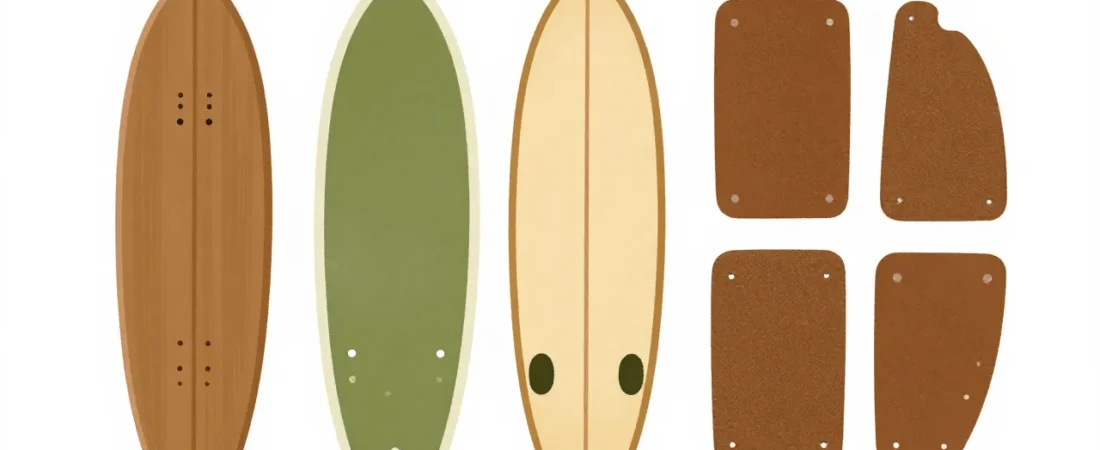
When you’re ready for a pad, the two options here are the Hammer Traction Regular Skim Kit at $60 (made in the USA, stocked by Surf Station Store and East Coast Skimboards as a standard upgrade) and the Creatures of Leisure Skim Traction/Arch Combo at $90 (five-piece construction that lets you dial in placement before permanently adhering). If budget is the deciding factor, Hammer delivers the same function. If you want more placement flexibility while still developing your stance, Creatures is the better fit.
What to Skip Until You Can Ride 20 Feet Clean
Board bags, nose guards, performance fins, and leashes all have their place — but that place is not your first season. A board bag protects a board during travel, which isn’t a problem until you’re traveling specifically for skimboarding. Nose guards add weight and are typically applied after you’ve already put dings in the nose, which takes time. Leashes are a surf accessory that most competitive skimboarders don’t use at all.
Full fiberglass performance boards deserve a specific note because they appear frequently in product searches and look like the “real” version of the sport. They are — for riders who can already drop and ride consistently and are actively progressing tricks or riding bigger waves. For a beginner, a $400+ fiberglass board doesn’t accelerate learning. It just costs more when you inevitably ride it into hard sand or let it skip off the beach on a bad throw. The $119 Victoria Woody or $209 Zap Core V2 covers months of productive learning at a fraction of the replacement cost.
The progression checkpoint that unlocks the upgrade conversation is specific: when your drops happen automatically — when you’re no longer thinking about your feet during the run-and-plant — and you’re actively seeking small shore waves rather than flat wet sand, the entry board has done its job. That’s the moment for a step-up, not before.

Victoria Woody Wood Skimboard
The Victoria Woody is the canonical American-made entry-level wood skimboard, hand-built in California for over 38 years and stocked by every major skimboard specialty retailer. For an adult beginner targeting flat-land shoreline skimming, wood is the correct starting material — forgiving on drops, slides long on wet sand, and won’t shatter when a beginner wipes out hard on the first day. Size L covers 150–180 lbs; size XL covers 180–210 lbs. Size up if you’re at the top of a range.
- Russian birch core with polyester resin — genuinely durable for a beginner learning to throw and chase a board
- Carried by every legitimate skimboard specialty retailer — not a toy-store product
- Wood boards lose float at the waterline — once you want to ride actual waves, you’ll need to upgrade to foam

Sticky Bumps Skimboard Wax 3-Pack
Wax is non-negotiable for any wood or foam board without a factory traction pad — it’s the difference between riding and sliding off on your first drop. Sticky Bumps is stocked by Zap Skimboards’ own store and recommended uniformly across all specialty skimboard retailers. The warm/tropical formulation is correct for most US beach conditions above 68°F water temperature, and the 3-pack provides enough wax for a full first season plus reapplication after hard sessions.
- Stocked by Zap’s own retail store as the preferred wax recommendation
- 3-pack gives a full season’s supply plus base coat for a new board
- Requires periodic reapplication after hard sessions or if the board is stored in sun or heat; choose cool-water formula for Pacific Northwest waters below 60°F

Zap Core V2 Skimboard
Hand-made in Venice, Florida since 1983, Zap is the most consistently recommended brand across every specialty skimboard retailer. The Core V2 is Zap’s entry-level 49-inch foam board — EPS core with E-Glass wrap — sized correctly for adults up to 170 lbs who want real wave-riding float without the $289 Wedge commitment. The best pick for lighter adults testing wave riding before deciding to spend more.
- EPS foam core provides actual float — this board can reach and ride waves, unlike a wood board
- Made in the USA by a brand with 40+ years of skimboard-specific manufacturing
- No traction pad included — you will need wax or a separate pad purchase; EPS core is slightly less durable than Composilite over multiple hard seasons

Zap Wedge 49″ (170 lb limit)
The Wedge is Zap’s longest-running beginner-to-intermediate line and earns the most consistent endorsements across specialty retailers — East Coast Skimboards explicitly calls the 49-inch their recommended starting point for adult wave riders. At 49×19.75 inches with 5/8-inch Composilite construction, the Large Wedge provides genuine float for adults up to 170 lbs, carries enough speed to reach shorebreak, and handles the rough treatment a new rider delivers. This is the board you buy when you want to start serious and not outgrow your first board within a single season.
- 5/8-inch Composilite construction handles learning-phase abuse better than EPS entry boards
- Stocked and recommended by multiple skimboard-specific specialty retailers as the adult entry point
- At $289 it’s a meaningful commitment before you know if the sport sticks; heavier Composilite construction is slightly less nimble than epoxy foam boards once you progress to tricks

Hammer Traction Regular Skim Kit
Hammer Traction is the only surf traction pad brand manufactured in the United States, handcrafted in Florida and stocked directly by Surf Station Store and East Coast Skimboards as the standard traction upgrade. The 3-piece tail pad plus 26-inch arch bar combo provides full-deck grip for the nose-plant, stomp, and ride sequence. Experienced skimboarders on East Coast Skimboards’ site explicitly recommend traction pads over wax for better grip on foam boards — this is the value-end way to get there.
- Tail pad plus arch bar combo addresses both foot-plant zones — the stomp zone at the tail and arch guidance for the ride
- Made in the USA with 3M adhesive backing that sticks properly to EPS foam boards without peeling in salt water
- Once applied, placement is permanent — incorrect placement before your stance is consistent is a costly mistake

Creatures of Leisure Skim Traction Arch Combo
Creatures of Leisure is one of two brands the skimboarding community consistently recommends for traction pads alongside Hammer, and the Skim Traction/Arch Combo is engineered specifically for skimboard use with a 10mm ridged arch — higher than standard surf pads — to provide the leverage needed when running onto a moving board at speed. The five-piece construction lets an adult beginner position each piece independently before permanently adhering, which is the single practical advantage over the Hammer kit for someone still dialing in their stance.
- 10mm ridged arch specifically engineered for skimboarding’s running-mount technique
- Five-piece construction allows stance customization before permanent adhesion — more forgiving for beginners still developing consistent foot placement
- At ~$90, the most expensive traction option in this guide — the Hammer kit delivers the same core function for $30 less
What to skip
Skip full fiberglass performance boards, board bags, nose guards, fins, and leashes until you can execute a clean drop-and-ride 20 feet on flat wet sand without thinking about your feet. A quality wood board at $119 or the entry-level Zap Core V2 at $209 covers months of productive learning. Buying a $400 fiberglass wave board as your first board doesn’t accelerate learning — it just costs more when you ding it on a rough drop, which you will. Toy-store skimboards are the other end of the same mistake: boards under $50 are typically thin plywood that cracks under adult body weight on the first hard stomp. There is a narrow band of correct gear for this stage, and all of it is listed above.
The progression signal that matters here is behavioral, not time-based. When your drops stop being something you think about — when the run, the throw, and the plant happen as one automatic motion — the entry board has done its job. That shift usually happens within a summer of regular beach visits, sometimes faster.
The second signal is where you’re looking when you get to the water. Flatland beginners scan for wet sand. Wave riders scan for the shorebreak. When you find yourself instinctively watching the wave timing before you throw, the wood board has nothing left to teach you and a foam or fiberglass step-up makes mechanical sense.
If you’re buying this as a gift and aren’t certain which riding style fits — flatland or wave — default to the Victoria Woody plus a pack of Sticky Bumps wax. At $132 combined, it’s a complete first kit that works at any beach, builds the core technique, and leaves the wave-riding upgrade decision to the rider once they know what they want.