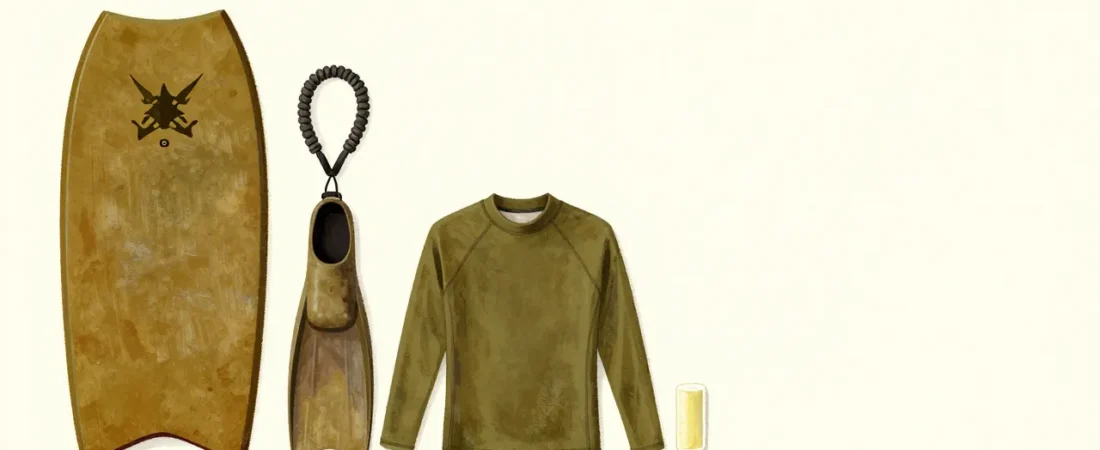
The gap between a $15 beach-shop foam slab and a real entry-level bodyboard is about $60 — and it changes the entire experience. A cheap board creases under adult body weight within a few sessions, waterlogging the EPS core and destroying the flex memory that helps you catch and ride waves. You are not a bad swimmer. The equipment is just wrong for your body.
This guide covers the five items that make up a complete adult starter setup: board, fins, leash, rash guard, and wax. It explains the one decision that trips up almost every adult beginner — EPS versus PE core — and gives you two clear tiers so the choice is about commitment level, not confusion.
All-in cost runs $80 to $180 depending on which tier you choose. That spread will outlast three seasons of weekend sessions and puts you on equipment that lets you actually progress past whitewater riding.
How we select these picks
- Specialty retailers first: We start with what dedicated surf retailers actually stock — Island Water Sports, Cleanline Surf, and Ron Jon Surf Shop. Shops whose inventory turns on local wave knowledge do not carry boards that fall apart in a season.
- Community consensus: We cross-reference retailer inventory against what adult bodyboarders recommend in their own spaces — r/bodyboarding and the boogie board discussion threads on Swaylocks. Products that surface in both signals get the heaviest weight.
- Age and stage fit: Adult beginners are capable swimmers whose limiting factor is equipment mismatch, not athletic ability. Every pick here is sized and flex-rated for an adult body — nothing in this guide is a scaled-up children’s product.
- Budget range: Picks span $14 to $135 so the guide works whether you are assembling a budget-first kit around $80 or a buy-once setup closer to $180.
- Skip-this guidance: Where a popular pick is wrong for a first-timer’s stage or use case, we say so directly and explain why.
What They Actually Need
A complete adult bodyboard setup has four functional items: a board that fits your body weight and the wave type you will ride, fins that generate enough propulsion to catch unbroken green waves, a leash that keeps the board tethered if you wipe out, and a rash guard plus wax that keep you comfortable enough to stay in the water for a full session.
That is it. Every other item sold at a beach shop — mesh board bags, waterproof speakers, inflatable vests, extra-stiff competition fins — is either irrelevant to a beginner or actively works against you at this stage. The decision set is narrow on purpose: adult beginners are not held back by missing accessories. They are held back by boards that sink under their weight and fins that create blisters before the first wave is ridden.
The sections below work through each item in the order of importance. Start with the board decision — EPS vs PE core — because it sets the price point for the rest of the kit.
The Board: Size It for Your Body, Then Pick the Right Core
Adult bodyboard sizing follows one reliable heuristic: the board should reach from your navel to your chin when stood on end in front of you. In practical terms, most adults between 140 and 200 pounds land on a 41″ or 42″ board. Riders over 200 pounds should look for a 43″ or 44″. Length matters because a board that is too short will not provide enough buoyancy to carry your torso; too long and it becomes unwieldy to control in the lineup.
Once you have the size, the core choice determines everything else about how the board performs and how long it lasts. EPS (expanded polystyrene) cores are lighter and more buoyant — good properties for catching whitewater and small surf. The problem is that EPS under sustained adult body weight will crease and crack at the deck surface, then waterlog through those cracks. After one or two summers of regular use, an EPS board loses its stiffness and becomes a liability. PE (polyethylene) cores flex and rebound rather than crease, hold their shape across seasons, and perform especially well in cool water — the Pacific coast, the Pacific Northwest, early-season Atlantic. A PE board with an HDPE slick bottom and a single stringer will outlast two or three EPS boards at the same riding frequency.
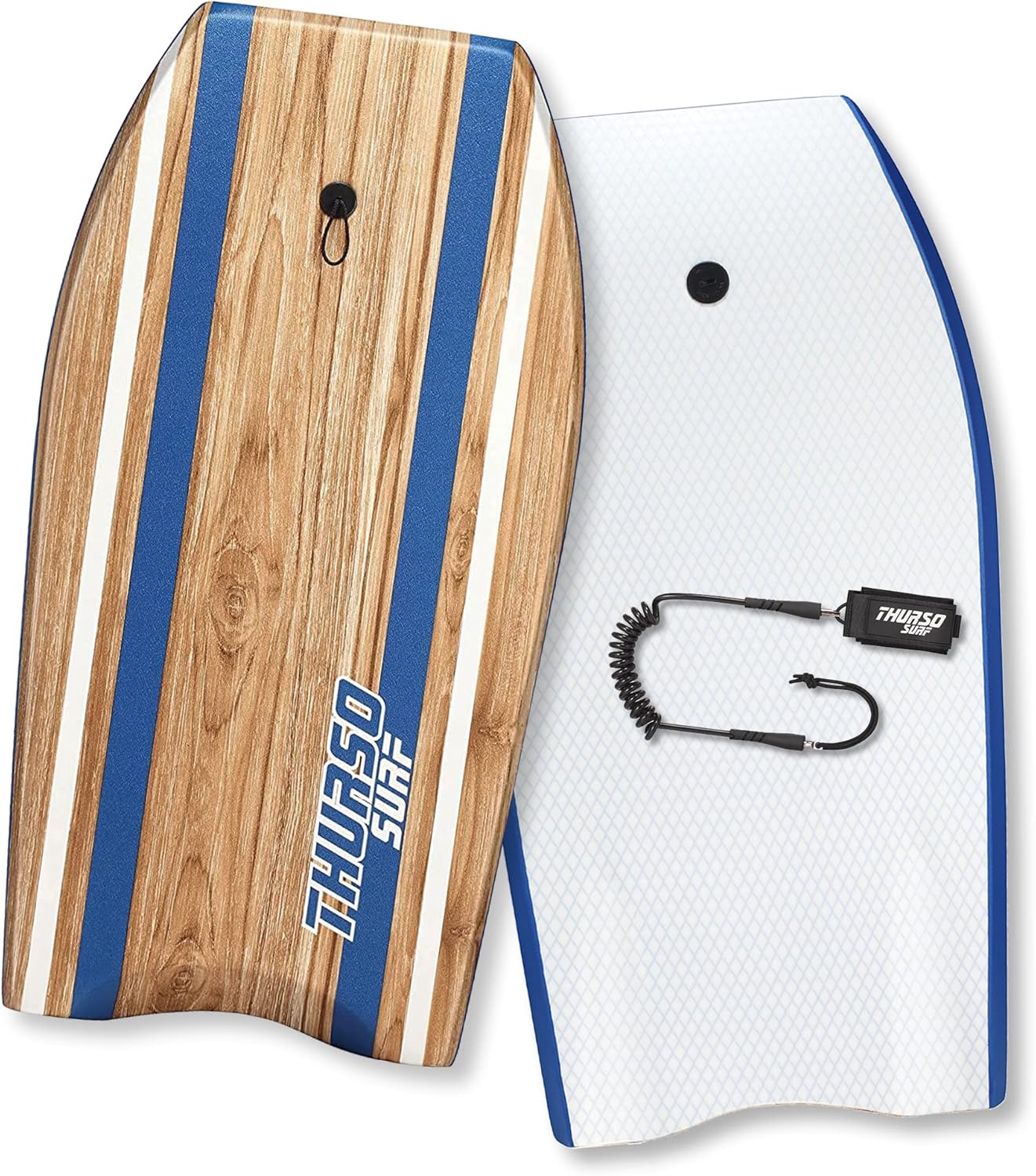
The Thurso Surf Quill and the Morey Mach 7 represent the two tiers of this decision. The Quill is the right call if you are genuinely unsure whether you will bodyboard beyond one or two trips. The Mach 7 is the right call if you already know you will be back — it is the reference-standard PE board that has been sold at every serious surf shop since 1981, and the extra $80 buys years of reliable performance.
Thurso Surf Quill 42″ Bodyboard
Top-rated dedicated beginner bodyboard at 4.7 stars from over 200 verified buyers. The EPS core floats effortlessly and catches whitewater with minimal paddling effort — exactly what an adult beginner needs in the first few sessions before wave-reading instincts develop. Includes a coiled wrist leash in the box, which removes one line item from your first-trip checklist. The 42″ / 200 lb capacity fits most adult body sizes without requiring a special order.
- EPS core is lighter and more buoyant — easier to catch waves when you are still learning timing
- Coiled wrist leash included — one less purchase for a first trip
- 42″ / 200 lb capacity covers most adult sizes
- EPS core creases under sustained adult body weight — expect to replace or upgrade within one to two seasons of regular use

Morey Mach 7 Bodyboard 41″
The reference-standard bodyboard since 1981, stocked by every serious specialty surf retailer — Island Water Sports, Cleanline Surf, and Ron Jon all carry it because it is the board that holds up. The PE core delivers real rebound and wave feedback an EPS board simply cannot replicate, and it performs especially well in cool Pacific water and early-season Atlantic surf where EPS becomes sluggish. A single REX stringer gives the board responsive flex without the floppy, unsteerable feel of entry-level boards. The crescent tail and bottom channels do something an adult beginner cannot replicate with technique alone: they help you steer instead of just pointing downhill and hoping.
- PE core with HDPE slick bottom holds shape across multiple seasons of regular use
- Crescent tail and bottom channels give beginners actual steering leverage without advanced technique
- Decades of refinement — sizing, stringer placement, and rail shape are dialed in for real-world performance
- At $135 it is a real commitment if you are not sure bodyboarding will stick
Fins: Why Beginners Need Them and How to Pick a Pair That Won’t Shred Your Feet
The most common beginner mistake is skipping fins. Without fins, catching an unbroken green wave requires paddling hard enough to match the wave’s speed before it passes under you — a physical challenge that trips up most first-timers and makes the sport feel unrewarding. Fins roughly double your propulsion with the same leg effort, which is the difference between reliably catching waves and getting left behind on every set.
The practical question is not whether to buy fins — it is which fins will not cause the blisters that make beginners abandon them after one session. Most entry-level fins sold at beach shops use hard rubber that stiffens the foot pocket and creates pressure points across the top of the foot and at the heel. Two sessions in, new bodyboarders decide fins are uncomfortable and stop wearing them entirely. The answer is natural gum rubber (floats, medium flex, breaks in faster) or a purpose-built flexible foot pocket like the DaFin Pro.
Regardless of which fin you choose, add fin saver tethers. A lost fin in surf is expensive and genuinely hazardous to other swimmers. The TAGVO leash with fin savers bundles both tethers with your board leash for $14, which is the simplest way to cover this at the beginner tier.

Churchill Makapuu Swim Fins
The default beginner-to-intermediate bodyboarding fin since 1936, and a recurring recommendation in r/bodyboarding beginner threads. Made from 100% natural gum rubber, which means they float — a genuinely useful property when you take a wipeout and the fin comes off your foot. Medium blade stiffness provides enough thrust to catch unbroken green waves without the leg fatigue that comes from a competition-stiff blade. Sizing runs S through XL with a published foot-length chart, which eliminates the guesswork that produces ill-fitting beach-shop fins.
- Natural gum rubber floats — a lost fin in surf is a hazard this eliminates
- Medium flex provides real propulsion without the leg burn of stiff competition fins
- Published foot-length sizing chart — no guessing
- Sizing runs snug — go up half a size if between sizes, and pair with neoprene fin socks for extended cold-water sessions

DaFin Swim Fin Pro
Endorsed by the Hawaiian Lifeguard Association and the preferred fin of lifeguards who spend entire shifts in the water — which is a meaningful signal about long-session comfort. The flexible rubber foot pocket breaks in almost immediately, which directly addresses the blisters-by-session-two problem that causes beginners to stop wearing fins. The blade is stiffer than the Churchill Makapuu, which means more thrust per kick once your legs have adapted — a genuine upgrade path rather than a lateral move. Also works for bodysurfing and casual open-ocean swimming, making it the better choice if you want one fin for multiple water activities.
- Flexible foot pocket breaks in almost immediately — eliminates the blisters that cause beginners to abandon fins
- Stiffer blade than Churchill provides more thrust per kick as you develop leg conditioning
- Works for bodysurfing and open-ocean swimming — genuine multi-use value
- At $75, costs $25 more than the Churchill — a meaningful difference in a budget-constrained first-trip kit
The Leash: Wrist vs Bicep, Length, and Why It Is Non-Negotiable Safety Gear
A bodyboard leash is not a convenience item. In any surf above ankle height, a loose board becomes a projectile — it can hit you, it can hit other swimmers, and in a strong current it will be gone entirely within seconds of a wipeout. Every beach with a lifeguard presence expects you to have one. A leash is the only item in this guide with a safety argument that overrides the budget question.
The two practical choices for a beginner are coiled vs straight cord and wrist vs bicep attachment. Coiled leashes retract away from the kick zone during paddling, which matters the moment you start using fins — a straight leash will tangle in your fins on every fourth or fifth kick and interrupt your rhythm. Wrist attachment is more intuitive for first-timers and easier to put on without help; bicep attachment is preferred by experienced riders in bigger surf because it gives the arm more range of motion. Start wrist, adjust later if you want to.
The budget pick bundles fin savers with the leash for $14 total — one transaction covers three pieces of safety gear. The step-up option from Dakine is stocked at Island Water Sports and brings marine-grade construction that is worth the extra $16 if you are pairing it with a Mach 7 that will last years.

TAGVO Bodyboard Leash with Fin Savers
Budget-complete safety pick: one $14 purchase covers the board leash and both fin tethers. At 1,840 reviews and a 4.3 rating it has broad real-world validation from casual beachgoers who needed exactly this setup. The adjustable wrist or bicep attachment lets a first-timer find what is comfortable before committing to a preference. The fin saver tethers prevent the single most avoidable first-trip loss.
- Includes two fin saver tethers — prevents the most common and most expensive beginner gear loss
- Attaches to wrist or bicep — lets you find your preference before committing
- $14 removes any cost objection to proper safety gear
- Fin tether material runs thin — treat as season-one gear and replace if you are riding frequently into year two

Dakine Bodyboard Coiled Wrist Leash
Stocked at Island Water Sports and Cleanline Surf — two of the most respected dedicated surf retailers on the East and West coasts respectively — which is a reliable signal about build quality. The marine-grade stainless steel swivel prevents the cord twist that causes cheap leashes to kink and tangle mid-session. The molded neoprene wrist cuff sits flat against your skin without pressure points, which matters when you are in the water for two or three hours. The coiled design retracts fully away from the kick zone so your fin stroke is never interrupted.
- Marine-grade stainless steel swivel prevents cord twist that degrades cheap leashes within one season
- Molded neoprene cuff sits flat — no pressure point fatigue during long sessions
- Coiled design stays fully clear of fin kick zone
- At $30 it costs twice the TAGVO option and does not include fin savers — budget separately for fin tethers
Rash Guard and Wax: The Two Items That Keep You in the Water Longer
Bodyboarding is a prone sport. Your chest and forearms are in continuous contact with the deck surface — abrasive foam, salt crystals, and sun exposure — for every minute you are in the water. Most beginners discover this the hard way after their first session: raw skin across the sternum and inside the forearms that shortens every subsequent trip. A rash guard eliminates this entirely. The O’Neill Basic Skins is the straightforward pick — UPF 50+ sun protection, minimal seam placement at the shoulder and underarm where paddling creates repeated contact, and a long sleeve that covers the forearm that presses against the nose rails during riding.
Bodyboard wax is the most-overlooked item in every beginner kit. Without it, your hands slide off the nose rails of the board on every wave — you cannot control where the board goes, and you cannot pull the nose down to steer through the face. This is not a technique problem. The deck foam on most boards is too smooth for bare hands to grip reliably in saltwater. Bodyboard wax is a different formula from surfboard wax: bodyboard deck wax is softer and applied in thinner coats because the foam surface grips differently than a fiberglass deck. Use a temperature-matched formula — warm-water wax for summer Atlantic, cool-water formula for Pacific or early-season sessions — and apply it to the nose and rail edges where your hands actually contact the board.

O’Neill Basic Skins Long Sleeve Rash Guard
Bodyboarding puts your chest and arms in sustained contact with board foam and saltwater on every wave. Without a rash guard, the abrasion accumulates fast enough to end a session early and make the next morning uncomfortable. O’Neill Basic Skins addresses this with minimal seam placement at the exact paddle zones — shoulder and underarm — where a poorly designed shirt creates repeated friction. UPF 50+ coverage handles full beach days. The long sleeve covers the forearm that contacts the deck nose during prone riding, which short-sleeve options leave exposed.
- Minimal seam placement at shoulder and underarm — no pressure points from repeated paddling strokes
- UPF 50+ blocks sun for full-day beach sessions without sunscreen reapplication on covered areas
- Long sleeve covers the forearm contact zone that short sleeves leave raw
- Runs one full size small — order up from your standard shirt size; this is consistent across the product line
What to Skip When You Are Just Starting Out
PP-core competition boards are the most common wrong purchase for an adult who has done a little research. Polypropylene cores are stiffer than PE and designed for barrel riding — a skill that requires strong wave-reading instincts, precise body positioning, and surf that most beginners will not encounter in their first season. A PP board in beginner hands rides worse than a PE board because the stiffness that helps an advanced rider hold a rail in a barrel just makes the board hard to control on an open-face wave.
Surfboard wax is the other common mistake. Bodyboard deck wax and surfboard wax are different products with different formulas — surfboard wax is applied to a fiberglass deck for traction underfoot, and its stickiness and texture are wrong for bodyboard foam. Using surfboard wax on a bodyboard deck creates an uneven, overly tacky surface that collects sand and degrades the foam. Buy bodyboard-specific wax from any surf shop.
What to skip
Skip PP-core competition boards, extra-stiff fins designed for stand-up wave rescue, and inflatable flotation vests. PP cores are tuned for barrel riding and feel unresponsive on the open-face waves beginners actually ride. Extra-stiff fins will fatigue your legs before you catch your third wave. Inflatable vests restrict paddling mechanics enough to make catching waves harder, not easier — they belong in a different water-safety context entirely.
The right gift here is not the most expensive item in a category — it is the item calibrated to the specific problem a first-time adult bodyboarder actually faces. That means a board that floats and flexes correctly for your body weight, fins with a foot pocket that will not create blisters on the first session, a leash that keeps the board tethered in real surf, and a rash guard that lets you stay in the water for the full session without paying for it the next day.
If you are choosing between the two board tiers and genuinely cannot decide, apply this test: if the recipient is making a specific trip to the coast and this is a standalone vacation item, the Thurso Quill is the correct pick. If they live within an hour of the water, or if you already know they are the kind of person who gets into hobbies properly, the Morey Mach 7 is worth every dollar of the price difference — they will not outgrow it and they will not need to replace it.
A complete budget-tier setup — Thurso Quill, Churchill fins, TAGVO leash with fin savers, O’Neill rash guard — runs just under $160 all-in before wax. The step-up tier with the Mach 7, DaFins, and Dakine leash comes to roughly $295 and will last through multiple seasons without replacement. Either kit is a fundamentally different experience from anything bought at a beach shop, and that difference shows up on the first wave.