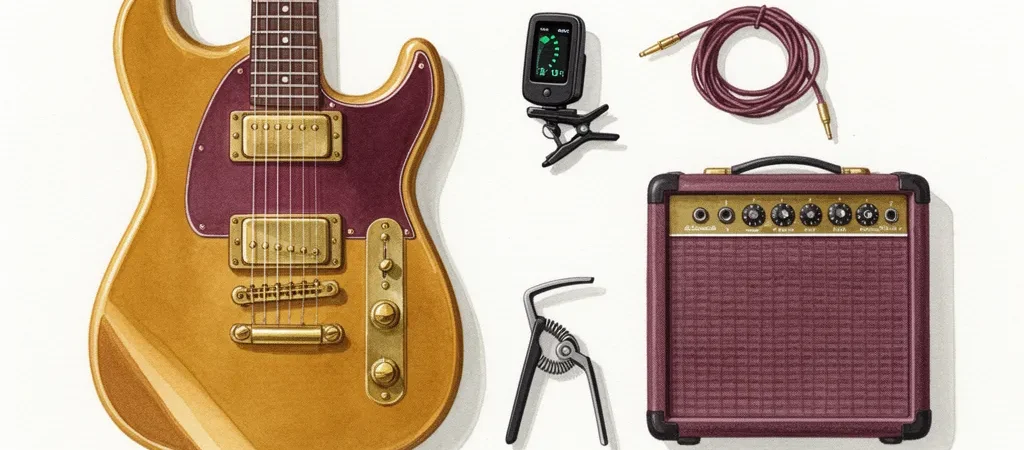
Most electric guitar gift lists for beginners are built backward: they start with products and work outward, rather than starting with the actual reason adult beginners quit. That reason, documented in nearly every guitar teacher forum and r/guitarlessons thread you’ll find, is finger pain and discouragement in weeks two through six. A factory-fresh guitar from a starter bundle has action — the gap between the strings and fretboard — set high enough to guarantee both.
The gifts on this list are organized around a different question: what removes the friction that stops an adult from picking up the guitar after a long day? That means a quiet amp that sounds good at 9pm in an apartment, a tuner that gives a real-time answer in five seconds instead of sixty, and a stand that keeps the guitar visible in the living room instead of hidden in a case in the closet.
One item on this list has no product card at all — because the most impactful gift for an adult beginner is not a physical object you can order from Amazon. It belongs here anyway, because leaving it out would make this guide dishonest.
How we select these gifts
- Specialty retailers first: We start with what guitar-focused retailers actually stock and reorder — Guitar Center, Sweetwater, and local independent guitar shops. When a product sits on Sweetwater’s floor-demo wall for years, that’s a signal no amount of Amazon star ratings can replicate.
- Community consensus: We cross-reference retailer inventory against what working musicians and guitar teachers recommend in r/guitarlessons and r/guitar — specifically filtering for “what should I buy for a beginner” threads where experienced players are advising, not being advised.
- Adult-beginner-specific friction test: Adult beginners have different constraints than teenagers: apartment living, irregular practice windows (30 minutes at 10pm, not 3 hours after school), and less tolerance for gear that punishes early mistakes. Every pick here was evaluated against those constraints specifically.
- Budget range: Picks span $24.95 to $299.99 so the guide works whether you’re spending under $30 or making a serious commitment.
- Skip-this guidance: Where a popular pick isn’t right for this specific stage — or where a whole category of products wastes money — we say so and explain why.
How We Pick: Friction Removal Over Feature Lists
Every product on this list earned its spot by solving one of a small number of real obstacles that end adult beginner guitar journeys in the first six months. The obstacles, in rough chronological order: a guitar that hurts to play (solvable with a professional setup), an amp that sounds thin and harsh at low volume (solvable with power-attenuating amps), a tuning process so slow and confusing that the guitar always sounds slightly wrong (solvable with a polyphonic tuner), and a guitar that lives in a case because there’s nowhere visible and safe to put it (solvable with a proper stand).
This guide deliberately excludes all-in-one beginner bundles under $150. They are not bargains. The amp that ships with a $129 guitar-plus-amp bundle is a 5-watt practice amp with a 6-inch speaker that sounds harsh at any volume, cannot be made quiet enough for apartment use, and teaches a beginner that electric guitar sounds bad. The guitar itself is often salvageable — the amp almost never is.
The One Gift Nobody Puts on These Lists: A Professional Guitar Setup
If the adult beginner in your life already owns an electric guitar — any electric guitar, even an entry-level Squier or Epiphone bought new from Guitar Center three months ago — the single highest-impact gift you can give them is not on Amazon. It is a professional setup from a qualified guitar technician at a local shop.
A setup takes about an hour and costs $40 to $75 at most independent guitar shops. The tech lowers the action (string height) to a playable level, adjusts the truss rod to counteract neck bow, sets intonation so the guitar plays in tune up and down the neck, and typically installs lighter-gauge strings — 9s or 10s instead of the heavier gauges some guitars ship with. The before-and-after difference on a factory-stock guitar is not subtle. Chords that required painful finger pressure suddenly require normal pressure. Buzz disappears. The guitar sounds like itself for the first time.
This is giftable. Call your local guitar shop, explain what you want to do, and either buy a gift card for the amount or offer to pay for the setup directly on the recipient’s behalf. No product card, no affiliate link. This is the first thing any honest guide about electric guitar gifts for adult beginners should say.
Practice Amps That Work for an Adult’s Real Life
The problem with starter pack amps is not just that they sound bad — it is that they sound worst at the volume an apartment-dwelling adult actually needs to practice at. A 5-watt amp with a 6-inch speaker has no way to get quieter without a headphone jack. A beginner playing at 10pm in a shared apartment either plays too loud or puts the guitar away. The guitar goes away.
The Boss Katana-50 Gen 3 solves the apartment problem directly. Its 0.5W/25W/50W power settings mean you can run a full 1×12 combo at a volume that works at 9pm without disturbing anyone, with actual tone. Twelve onboard amp characters cover clean, crunch, lead, and acoustic simulation, which means a beginner can spend their first year exploring sounds without buying a single pedal. This amp is a recurring recommendation on Sweetwater and in r/guitarlessons threads specifically for adult beginners with space and volume constraints.
The $299.99 price tag is real and worth naming. This is not a stocking-stuffer. It is the gift that replaces every subsequent amp upgrade for five or more years. A beginner who receives this amp in month one will still be using it — and appreciating it — when they have enough skill to want a nicer guitar.

Boss Katana-50 Gen 3 50W Combo Amp
The single most common complaint after a few weeks is that the bundled starter pack amp sounds thin and harsh at bedroom volumes. The Katana-50 Gen 3 solves this with 0.5W/25W/50W power settings, 12 amp characters with onboard Boss effects, and a custom 12-inch speaker. Adult beginners will stay on this amp for years — it does not get outgrown.
- 0.5W/25W/50W settings let it work at bedroom volumes without killing tone — critical for apartment practice
- 12 amp characters with onboard Boss effects remove the need to buy any pedals for the first year
- Custom 12-inch speaker reveals what a Squier or Epiphone actually sounds like when properly amplified
- At $299.99, the most expensive item on this list — a real commitment, not a stocking stuffer
- Bluetooth connectivity requires a separately purchased $49 adapter not included out of the box
Tuners and Capos: The Accessories That Actually Prevent Quitting
A beginner who cannot hear that their guitar is in tune will spend every session thinking their chords sound wrong because they are doing something wrong. The TC Electronic PolyTune Clip addresses this better than any other clip-on tuner by letting you strum all six strings simultaneously and displaying every out-of-tune string at once on its 108-segment LED matrix. The process that took 60 seconds of one-string-at-a-time frustration becomes a five-second check before every session.
A capo changes the math on what a beginner can play in their first month. Without one, songs that require barre chords — which take months of practice to execute cleanly — are out of reach. With the Kyser Quick-Change Electric Guitar Capo at the second fret, “Good Riddance” by Green Day and “Wonderwall” become playable using open chord shapes on week one. The electric-specific narrow profile is the detail that matters: the acoustic version of this same capo will buzz the outer strings on the tighter radius fretboard of a Squier or Epiphone.

TC Electronic PolyTune Clip Polyphonic Tuner
Adult beginners who tune badly or not at all hear a guitar that always sounds off — and blame themselves. Polyphonic mode lets you strum all six strings at once and see every out-of-tune string at a glance, cutting tuning time from 60 seconds of frustration to a 5-second check. Strobe mode at ±0.02 cent accuracy is a feature they will grow into, not out of.
- Polyphonic tuning — strum all strings at once and see every out-of-tune string simultaneously
- Three modes: polyphonic for quick checks, chromatic for precision, strobe for ear-training accuracy
- 108-segment LED matrix readable in bright stage or window light
- At $49.99, roughly 5× the cost of a basic Snark — a beginner who loses accessories may want to start cheaper
- Polyphonic mode is less useful if the guitar has very bad intonation from a factory setup

Kyser Quick-Change Electric Guitar Capo
A capo transforms a beginner’s capability overnight: songs that require barre chords become immediately playable using open chord shapes. The electric-specific narrow profile fits the tighter fretboard of a Squier or Epiphone without buzzing the outer strings — a critical detail the acoustic version gets wrong. Spring-arm deployment in under a second, made in USA with a lifetime guarantee.
- Electric-specific narrow profile prevents string buzz on tighter neck radius of starter electrics
- Spring-arm one-handed deployment — on and off in under a second
- Made in USA with lifetime guarantee
- Fixed spring tension can pull certain gauges slightly sharp above the 5th fret on poorly-set-up guitars
- Black is the only common color in the electric-specific version
A Stand That Keeps the Guitar in the Room (Not the Case)
Guitar teachers will tell you this without hesitation: the most reliable predictor of whether a beginner keeps playing is whether the guitar is visible. A guitar in its case requires a conscious decision to retrieve and set up before a single note is played. A guitar on a stand in the living room gets picked up during commercial breaks, in the ten minutes before dinner, during a phone call. Visibility is practice time.
The reason not to use a $15 A-frame stand is not elitism — it is physics. A-frame stands leave the neck completely unsupported. When someone brushes the headstock, the guitar pivots over the base contact point and the headstock hits the floor first. A Squier Stratocaster or Epiphone Les Paul costs $200 to $400. Headstock repairs on those guitars cost $80 to $150 if the break is clean, and can be a total loss if it splinters. The Hercules GS414B PLUS has an Auto-Grip System yoke that clamps the neck automatically the moment you set the guitar in the stand — it locks in, rather than just resting.

Hercules GS414B PLUS Auto-Grip Guitar Stand
A guitar in its case is a guitar that doesn’t get played. A stand visible in the living room turns it into a daily invitation. The Auto-Grip System yoke automatically clamps the neck when the guitar is placed in the stand — preventing the most common beginner accident: guitar topples when someone walks past and destroys the headstock. Fits all standard beginner electric guitar neck profiles.
- Auto-Grip yoke clamps neck automatically — prevents tipping accidents that destroy headstocks on cheap A-frame stands
- Fits neck widths 1.57–2.05 inches, covering Squier Strat, Epiphone LP, Yamaha Pacifica
- Instant height-adjustment clutch; folds flat for storage
- At $59.99, more expensive than $15 A-frame stands — until the first time a cheaper stand tips over
- Some older units reported rubber contact points becoming sticky over years; PLUS version uses improved foam
The First Pedal (For the One Already Thinking About a Pedalboard)
At some point between month two and month four, a lot of adult beginners start watching videos about pedals. The Boss TU-3 is the correct answer to “what should my first pedal be,” for a reason that has nothing to do with tuning: it teaches the practice habit that separates players who develop musicality from players who develop slop. On a clip-on tuner, tuning between songs is optional. On a floor pedal with a mute switch, engaging the tuner silences the signal and forces a clean pause between every song. The muscle memory starts the first day it’s plugged in.
The chromatic 21-segment LED meter is readable under any lighting condition, the metal housing survives being stepped on for decades, and it will sit at the front of every pedalboard they ever build. The Boss TU series has been the industry standard for chromatic floor tuners since 1998. The honest caveat: this is a gift timed to a specific stage. If the recipient is still running guitar straight into amp, give them the PolyTune Clip instead.

Boss TU-3 Chromatic Tuner Pedal
For a beginner already 2–4 months in and asking about pedals: the TU-3 is the industry-standard first pedal — tuner, mute switch, and signal buffer in one tank-tough housing. Develops the habit of tuning between every song and anchors any future pedalboard. The Boss TU series has been the standard since 1998.
- Mutes signal while tuning — professional tuning discipline from day one
- 21-segment LED meter readable under stage lighting or bright sunlight
- Tank-tough Boss metal housing survives being stepped on and gigged for decades
- At $99, requires a 9V power supply (not included) — premature if not yet thinking about a pedalboard
- Overkill as a standalone tuner if they’re still in the guitar-straight-to-amp phase
What to skip
Skip any all-in-one beginner bundle under $150 that includes both a guitar and an amp in the same box. The amp in these kits is a 5-watt unit with a 6-inch speaker that produces its worst sound at low volume — exactly the volume an apartment-dwelling adult has to practice at. The guitar inside may be salvageable with a professional setup; the amp almost never produces acceptable tone. If budget is the real constraint, buy the guitar separately and spend whatever is left on the Katana-50 Gen 3 later — a decent guitar played through a good amp is worth every dollar of that swap.
Every item on this list addresses a specific, documented failure point in the adult beginner guitar journey. A professional setup removes the physical barrier. The Katana-50 removes the volume-and-tone barrier. The PolyTune Clip removes the “does my guitar always sound wrong” confusion. The Kyser capo removes the “I can’t play any real songs yet” wall. The Hercules stand removes the “I have to consciously decide to practice” inertia.
If you’re deciding between two items and genuinely unsure, default to solving the earliest friction point first. For a beginner in month one: the tuner and the stand before anything else. For a beginner in month three who already has those: the amp, or the professional setup if they haven’t had one yet. The TU-3 waits until the pedalboard conversation has actually started.