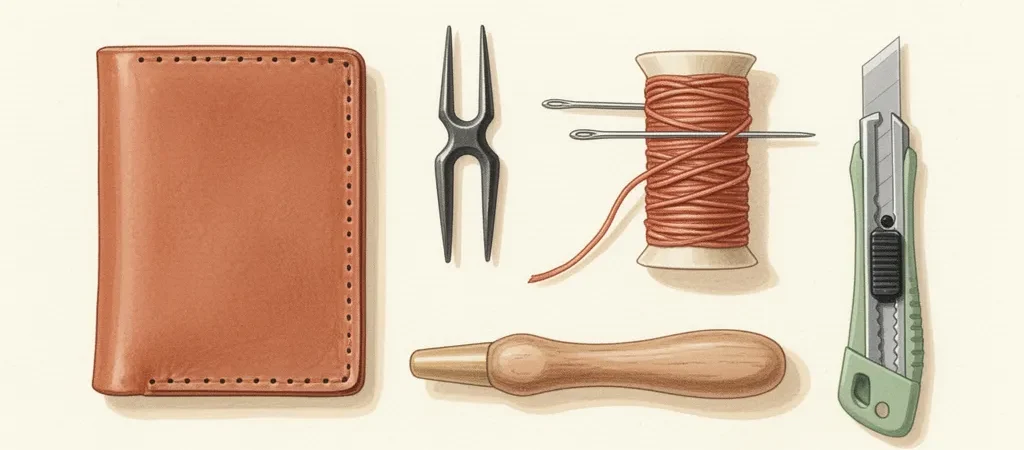
The most-gifted leathercraft item on Amazon is a 100-to-424-piece mega-kit: a suitcase of unlabeled tools, dull blades, and mystery chrome-tan scraps with no actual project inside. It photographs well under a tree. Then it sits in a closet, because the person who received it opened the case and had no idea what any of it was for.
Leathercraft has a specific failure mode that makes gift-buying tricky. The first skill every leatherworker learns is the saddle stitch, and everything a beginner needs — the right leather, sharp hole-punching irons, the correct thread-and-needle pairing — is invisible on a product listing. Piece count is what’s visible, so piece count is what gets bought.
This guide replaces the mega-kit with a smaller, better gift stack: one pre-cut project kit from a real leather supplier, plus a handful of sharp, single-purpose tools that hobbyists actually recommend to each other. Every pick maps to a first or second project, and every pick tells you when to skip it.
How we select these gifts
- Specialty retailers first: We start with what specialty leather suppliers actually stock and teach with — Tandy Leather (which runs an Austin storefront and in-store classes) and importers like Rocky Mountain Leather Supply. Suppliers whose business depends on students finishing a second project don’t push tools that fail on the first one.
- Community consensus: We cross-reference retailer inventory against what leatherworkers recommend in their own communities — r/Leathercraft beginner threads and the Leatherworker.net forums. Products that show up in both signals get the heaviest weight.
- Stage fit: These picks assume an adult beginner at zero to two projects — someone who can’t yet identify tannage or leather weight and has no knife-sharpening habits. That’s why everything here ships sharp and ready to use, and why the anchor gift is pre-cut and pre-punched: cutting and hole placement are the two highest-failure steps, so we remove them.
- Budget range: Picks span $7.99 to $56.99, with assembled gift stacks at under $50, under $100, and under $200.
- Skip-this guidance: Where a popular pick isn’t right for this stage — and in leathercraft, the most popular pick is exactly wrong — we say so and explain why.
Why the 200-Piece Mega-Kit Is the Wrong Gift
In beginner leathercraft kits, piece count is inversely correlated with success. A 273-piece kit at $45 works out to about sixteen cents per tool, and it shows: stamped mystery steel that can’t hold an edge or be sharpened, tools with no names and no instructions, and a rainbow of “genuine leather” offcuts of unknown origin.
Those offcuts are the quiet killer. They’re almost always chrome-tanned scrap — upholstery and garment leftovers — and chrome-tan won’t tool, won’t wet-mold, won’t burnish, and won’t take dye the way every beginner tutorial assumes. A new leatherworker follows a YouTube video step by step, gets a fuzzy edge and blotchy dye, and concludes they have no talent for this.
That’s the real cost of the mega-kit. Beginners blame themselves for outcomes caused by dull included blades and the wrong leather, and self-blame is the number-one quit trigger in this hobby. The gift that looks the most generous is the one most likely to end the hobby before it starts.
How We Pick: Saddle Stitch First, Sharp Tools Only
Our framework for this guide has three rules. First, anchor the gift on one reputable pre-cut, pre-punched vegetable-tanned project kit, because it removes the two steps beginners fail most: cutting straight lines and placing stitch holes. Second, every tool must ship sharp and do one job well — no bundles, no “kit-grade” steel. Third, every brand has to survive the r/Leathercraft beginner threads, where recommendations come from people who stitch daily and have no affiliate stake.
One piece of vocabulary makes you a smarter shopper than most kit buyers: veg-tan versus chrome-tan. Vegetable-tanned leather is tanned slowly with tree bark and plant matter; it’s firm, carvable, and predictable — it tools, wet-molds, burnishes, and dyes exactly the way tutorials promise. Chrome-tanned leather is tanned fast with chromium salts; it’s soft and great for factory jackets and sofas, but it resists nearly every technique a beginner will try to learn.
Every product below assumes veg-tan, because every beginner curriculum does. If a listing doesn’t say “vegetable tanned” with a stated weight in ounces, it’s not beginner leather — it’s scrap with marketing.
If You Buy One Thing: A Pre-Cut Veg-Tan Wallet Kit
The single best beginner leathercraft gift isn’t a tool at all. It’s the Tandy Leather Dillon Bifold Wallet Kit ($39.99) — pre-cut veg-tan pieces, pre-punched stitch holes, and needles and thread in the box. The recipient sits down, learns the saddle stitch from a ten-minute video, and stands up with a wallet they made. Finished project, day one.
That matters more than it sounds. Cutting and hole placement are where first projects die; a pre-punched kit converts “learn five skills before you see a result” into “learn one skill and carry the result in your pocket.” And because the natural version is undyed veg-tan, the same wallet becomes a canvas later — they can dye it, stamp it, or burnish the edges as their tool collection grows.
We deliberately link this one straight to Tandy rather than Amazon, because project kits from an actual leather supplier come with leather you can trust. If a bifold feels ambitious for your recipient, Tandy’s money-clip and eyeglass-case kits are the same idea with fewer stitches.
The Core Four: Cutting, Stitching, Needles & Thread, Edge Tools
If you want to give more than the kit — or build a gift for someone who already finished one — these are the four jobs a beginner’s bench actually needs covered, in the order a project uses them: cut the leather, punch the stitch holes, sew, finish the edges. One good tool per job beats fifty mediocre ones.
For cutting, the forum answer is almost anticlimactic: the OLFA SVR-2 utility knife. The secret to clean leather cuts is a fresh edge, not a $60 head knife a beginner can’t sharpen — and snap-off segments mean the edge is always fresh.

OLFA SVR-2 9mm Stainless Utility Knife
Forum veterans consistently tell beginners the real cutting secret is a fresh blade, not an expensive head knife — and the Japanese-made OLFA SVR-2 with snap-off segments means the blade is always fresh. Clean, controlled cuts through veg-tan without a $60 round knife they don’t yet know how to sharpen.
- 13 snap-off segments per blade — always cutting with a sharp edge, the #1 factor in clean leather cuts
- Auto-lock slider holds blade depth securely for safe pulls along a straightedge
- At $8 it fills the budget tier and doubles as an everyday tool
- 9mm blade flexes on very thick (10oz+) leather — an 18mm OLFA or head knife comes later
- Snap-off blades require a disposal jar for spent segments
Stitching irons — the pronged chisels that punch rows of stitch holes — are the opposite case. This is the one tool where experienced leatherworkers say to spend real money, because hole geometry is what makes hand stitching look hand-stitched. The WUTA French pricking iron set is the community’s standing answer for the gap between $15 kit chisels and $200 boutique irons.

WUTA French Pricking Iron Set (3.38mm, 2+8 Teeth)
Stitching irons are the one tool where forum experts say spend real money, and WUTA’s polished DC53 die-steel French irons are r/Leathercraft’s recurring ‘skip the Craftool, can’t afford KS Blade’ answer. The 2+8 tooth pairing covers straight runs and curves — everything a beginner wallet or belt needs.
- DC53 die steel punches clean through 11oz leather and pulls out easily thanks to full polishing
- 3.38mm spacing produces the fine slanted European stitch look that makes beginner work photograph like pro work
- 2-tooth + 8-tooth is the exact combo forums recommend as a minimum viable set
- Around $57, the priciest tool here — cheap diamond-chisel sets exist for $15 if budget is the only criterion
- Reverse-slant irons confuse some first-timers
Thread and needles are a matched pair, and the leathercraft world has already agreed on the match: Ritza 25 Tiger thread pulled through John James size 002 harness needles. The needles are blunt on purpose — saddle stitching goes through holes the irons already punched, so a sharp point only finds fingers.

Ritza 25 Tiger Thread, 0.6mm
German-made Tiger thread is the single most agreed-upon product in leathercraft — cited as ‘the best, just expensive’ in every expert roundup. The light wax coating holds stitches in place without gumming needles, which flatters a beginner’s inconsistent tension. 0.6mm is the right width for the 3.38mm irons above.
- Braided polyester is far stronger than the craft-store nylon that comes in cheap kits
- Pre-waxed at the factory — no separate beeswax step for a beginner to botch
- Pairs correctly with 3.38mm French irons and size 002 harness needles
- A mini spool goes fast once they graduate to belts and bags — the 500m spool is better value later

John James Harness Needles, Size 002 (25-Pack)
English-made John James harness needles are the forum-standard companion to Tiger thread — blunt rounded points glide through pre-punched holes instead of snagging or stabbing fingers, exactly what an adult learning saddle stitch needs. Size 002 matches 0.6mm thread, and 25 needles means losing a few to the couch cushions is fine.
- Blunt tips are the correct (and safer) geometry for saddle stitching through chisel holes
- Smooth polished eyes don’t shred waxed thread mid-project
- 25-pack lasts years for under $10 — ideal stocking-stuffer tier
- Only one size; heavier 0.8mm+ thread on future bag projects will want size 2/0
The last job is edge finishing, and it’s the difference between a wallet that looks homemade and one that looks handmade. The sequence is two steps: round the raw edge with the Owden #3 edge beveler, then slick it glassy with Seiwa Tokonole burnishing gum. Mega-kits skip both tools entirely, which is why kit projects always have fuzzy square edges.

Owden Professional Edge Beveler #3
Rounding the edge before burnishing is the step beginners don’t know they’re missing, and Owden’s high-carbon steel bevelers with ebony handles are the forum-vetted budget stand-in for $90 Barry King tools. The #3 covers 1.5-2.5mm leather — the range nearly all first wallet and belt projects use.
- Ships genuinely sharp, unlike the Craftool bevelers in starter kits that need immediate stropping
- Ebony handle with brass ferrule — a tool that feels like a gift, not a consumable
- Pairs directly with Tokonole for the full pro edge-finishing sequence
- One size only; very thin card-slot leather (under 1.5mm) wants a #1 or #2 eventually

Seiwa Tokonole Burnishing Gum, 120g Clear
Slicked edges are the fastest visible jump from ‘homemade’ to ‘handmade,’ and this Japanese water-based burnishing gum is what specialty suppliers and r/Leathercraft both point to over old-school gum tragacanth. Rub it on a veg-tan edge, burnish with a slicker or even a canvas scrap, and a beginner gets a glassy professional edge on their first wallet.
- Water-based, non-toxic, and low-odor — apartment-friendly for a new hobbyist
- Works on flesh side too, taming the fuzzy back of budget veg-tan
- 120g lasts through dozens of projects
- Clear only — dyed-edge work eventually wants the black or brown versions
- Needs a wood slicker or canvas cloth (a few dollars) to actually burnish
Pair It with the Skill: The Book That Turns Tools into a Curriculum
Tools without a sequence are how hobbies stall at project two. Leathercraft by Nigel Armitage solves that: it’s a project ladder, not a reference manual, walking from a simple card holder through a belt to a round-bottom bag, each project adding exactly one or two new skills.
Armitage matters because of who he is in the community. His independent pricking-iron reviews are the standard hobbyists cite when arguing about tools, which makes his book the rare instructional text that matches what forums actually recommend buying — including nearly everything in this guide.
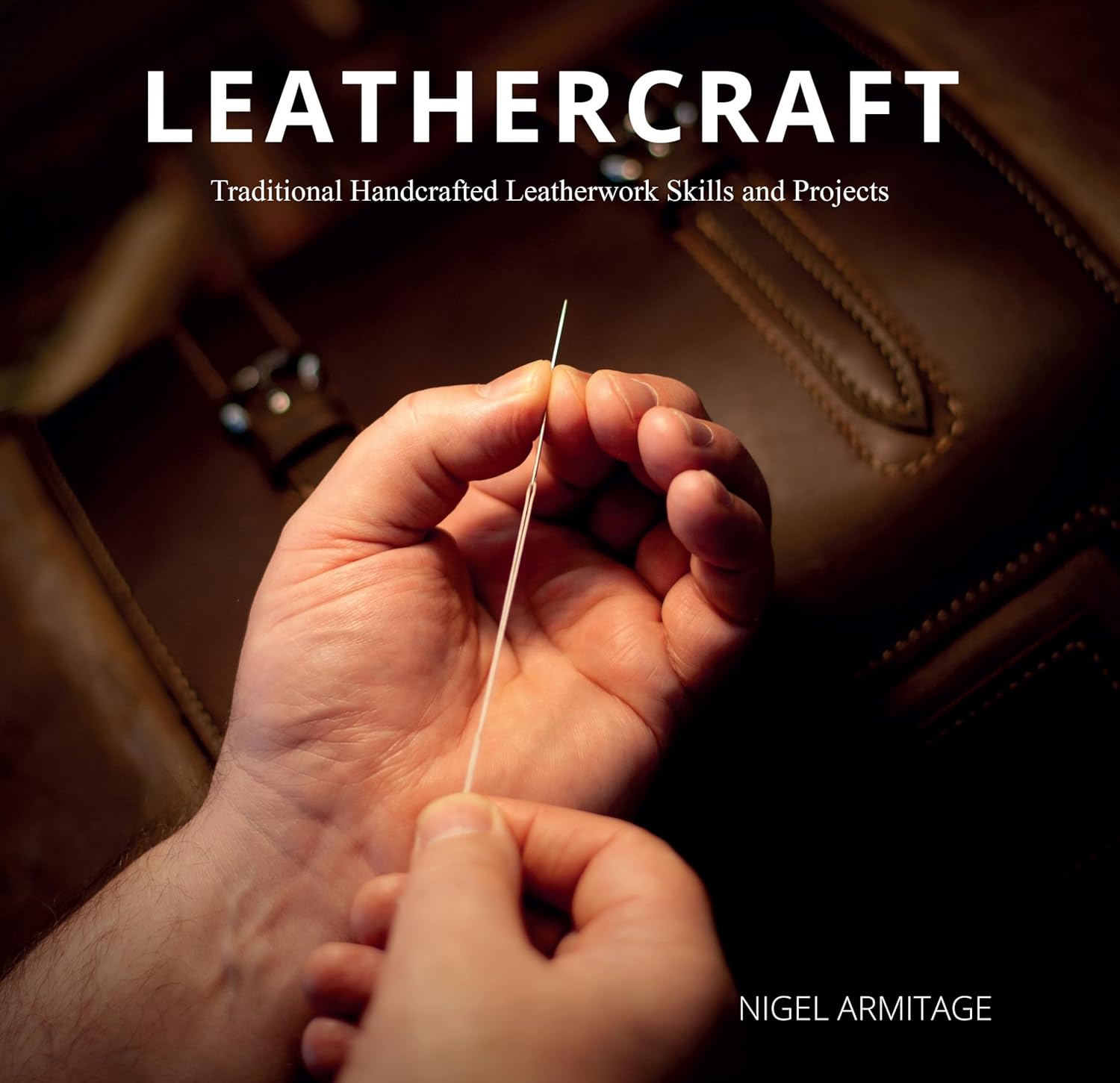
Leathercraft by Nigel Armitage
Nigel Armitage is the closest thing r/Leathercraft has to a referee — his pricking-iron reviews set community standards — and this book is the modern replacement for handing beginners a 1970s Stohlman pamphlet. It sequences skills from a simple card holder up through a belt and round-bottom bag, effectively turning the tools above into a twelve-month curriculum.
- Project difficulty ladder matches exactly the tools in this guide
- Teaches proper saddle stitch technique with photography clear enough to learn from the page alone
- Gift-quality hardback production — it reads as a considered gift, not a manual
- Focused on hand-stitched fine leatherwork; no tooling/carving or machine content
Gift Stacks by Budget: Under $50, Under $100, Under $200
Under $50: Two clean options. The Tandy Dillon wallet kit alone ($39.99) is the complete day-one experience — leather, holes, needles, and thread in one box. Or, for someone who already has leather to practice on, the OLFA knife, John James needles, Tiger thread, and Tokonole together run about $48 and cover cutting, stitching, and edges.
Under $100: The Tandy kit plus Tiger thread, John James needles, Tokonole, and the Owden beveler — roughly $97. This is the sweet spot: a finished first project plus the consumables and edge tools that make projects two and three possible without another shopping trip.
Under $200: Everything above plus the WUTA irons and the Armitage book, about $196 total. That’s a complete zero-to-second-project setup — the irons unlock stitching on their own leather instead of pre-punched kits, and the book supplies the next year of projects. It’s what most self-taught leatherworkers assemble piecemeal over six months of returns and regrets.
What to skip
Skip the 200+ piece Amazon mega-kit — unsharpenable steel, unlabeled tools, and chrome-tan offcuts that won’t tool, burnish, or dye, no matter how giftable the case looks. Skip swivel knives and stamping sets too: carving is a later-stage detour, not a starting point, and gifting one signals a curriculum the recipient isn’t on yet. Same for leather sewing machines and bulk “craft leather” remnant bags with no stated tannage or weight — if the listing can’t tell you what the leather is, neither can the beginner holding it.
A pre-cut kit and three sharp tools send a specific message the mega-kit can’t: I expect you to actually finish something. The recipient’s first wallet gets handed around at dinner, the saddle stitch clicks, and the hobby survives its most fragile week.
It also leaves the right things unbought. Head knives, swivel knives, dyes, and bigger irons are the purchases a hobbyist enjoys making themselves once they know what they like — your job as the gifter is the on-ramp, not the whole road.
If you’re still torn between stacks, use this shortcut: buy the pre-cut wallet kit from a real leather supplier first, and add tools only up to your budget line. A finished first project beats an impressive pile of equipment every time.