The “18+” on the corner of a LEGO box is one of the most misread signals in gift shopping. Buyers see it and assume it means “advanced” or “for serious builders,” so they reach for the biggest, most intimidating box on the shelf — the 9,000-piece Titanic, the Ultimate Collector Series Falcon — thinking a bigger set is a more generous, more grown-up gift.
It isn’t. “18+” is an audience and aesthetic label, not a difficulty tier. And handing a childhood-lapsed beginner a multi-day endurance build is the single most reliable way to produce a set that gets opened once, half-sorted on a coffee table, and quietly returned to the box.
The variables that actually predict a finished, displayed model are boring and specific: how long the build session runs, and how good the finished object looks on a shelf. Get those two right and your recipient becomes a builder. Get them wrong and you’ve bought an expensive guilt project. This guide shops by the right two axes.
How we select these gifts
- Specialty retailers first: LEGO’s adult (18+) line is a national specialty category, so we start with what dedicated LEGO retail — the LEGO brand stores, and the sets AFOL (Adult Fan of LEGO) shops keep in stock — actually moves to first-time adult buyers, rather than whatever has the highest piece count. Sets that specialty channels stock as “gift-safe” for lapsed builders get priority over marquee display pieces.
- Community consensus: We cross-reference retail availability against what adult builders actually recommend to beginners in their own communities — r/lego “first set” threads and the r/legobotanicals build logs. The Orchid and Tiny Plants recur in both signals, which is why they anchor this list.
- Age and stage fit: An adult beginner — often someone who hasn’t built since childhood — expects a 1–4 hour finish, follows visual instructions without pre-sorting parts or reading the build ahead, and values the finished display object far more than “collecting.” Every pick here is chosen against that profile, not against a hardcore hobbyist’s.
- Budget range: Picks span $49.99 to $69.99, so the guide works whether you’re spending $50 or $70 — deliberately narrow, because a first set shouldn’t be a $200+ commitment.
- Skip-this guidance: Where a popular, obvious-looking pick (the big UCS boxes) is wrong for this stage, we say so and explain the specific failure mode it causes.
What “18+” Actually Means (and Why It Misleads Gift Buyers)
In 2020, LEGO retired its “Expert” branding and rolled the sets into a black-boxed “18+” line. The relabel was a marketing and audience move, not a difficulty reclassification. The age marker signals target demographic and aesthetic — sleek black packaging, grown-up subject matter, display-first design — so an adult can buy it for themselves without feeling like they’re shopping the kids’ aisle.
It says nothing about how hard the set is to build. A 608-piece 18+ botanical is dramatically easier than many 12+ sets, and vastly easier than the enormous UCS boxes that also wear the 18+ badge. The label groups a $50 orchid and a $700 Star Wars diorama into the same bin.
This is exactly where theme-segmented competitor lists go wrong: they sort by fandom (“best Star Wars sets,” “best Marvel sets”) and let box size stand in for prestige. For a beginner, that’s the opposite of useful. The badge is not the buying signal.
The Two Variables That Actually Matter: Session Length + Display Payoff
Strip away the theming and a first set succeeds or fails on two things. First, session length: can it be finished in one or two sittings, ideally 1–4 hours? A beginner doesn’t pre-sort parts into trays or read three steps ahead — they open the bag, follow the pictures, and want to reach “done” before the momentum dies.
Second, display payoff: does the finished thing look good enough to leave out? Adult beginners aren’t collectors chasing a catalog. They want one object that earns a spot on a shelf or desk. A set that photographs well and doesn’t read as a toy is what turns a one-time build into a repeat hobby.
Every recommendation below is scored against those two axes, not against piece count or brand cachet. When the two conflict — a gorgeous set that takes 15 hours — session length wins for a first gift, because an unfinished masterpiece has zero display payoff.
Piece-Count Sweet Spot: Why 500–1,000 Beats 3,000 for a First Build
The instinct to treat piece count as a quality proxy is understandable and wrong. More pieces don’t mean a better gift — they mean a longer build, more parts-sorting overhead, and, critically, fewer natural stopping points. The sweet spot for a first adult set is roughly 500–1,000 pieces at about a 2.5-out-of-5 difficulty.
Here’s the mechanism behind the “abandoned in the box” failure mode. A 3,000-piece set arrives as a wall of numbered bags and hundreds of near-identical small parts. Without a sorting system, the builder spends more time hunting for the right 1×1 tile than building, momentum collapses, and the half-built model gets bagged back up “for later.” Later rarely comes.
A 600–900 piece set sidesteps all of that. The build stays legible, each sub-assembly ends in a visible “that’s a thing now” moment, and the whole model finishes before enthusiasm runs out. That’s why every pick here sits comfortably under 1,000 pieces.
Our Picks: Best First Sets by Recipient Type
These are organized by recipient intent, not theme. If you know the person wants something calming for the living room, or a bold shelf piece, or a nod to a fandom, jump to that pick — each one is chosen for a specific type of first-time builder and scored on session length and display payoff.
For the relaxing, mindful build that reads as home decor, the LEGO Icons Orchid 10311 is the default answer and the most-recommended first set in adult LEGO communities. If the recipient is nervous about difficulty, the LEGO Icons Tiny Plants 10329 ships with tiered instruction paths that let them start easy. Want maximum visual payoff for minimum difficulty? The Wildflower Bouquet 10313 delivers a full bouquet in about an hour.
For the one-evening architecture win, the Paris Skyline 21044 breaks into satisfying landmark-sized chunks. For a “wow” shelf piece tied to a fandom, the Darth Vader Helmet 75304 looks like a premium collectible without UCS-level stamina. And for the person who secretly loves how things work, the Technic NASCAR Camaro ZL1 42153 is a real gears-and-axles entry point that still finishes in an evening.

LEGO Icons Orchid 10311
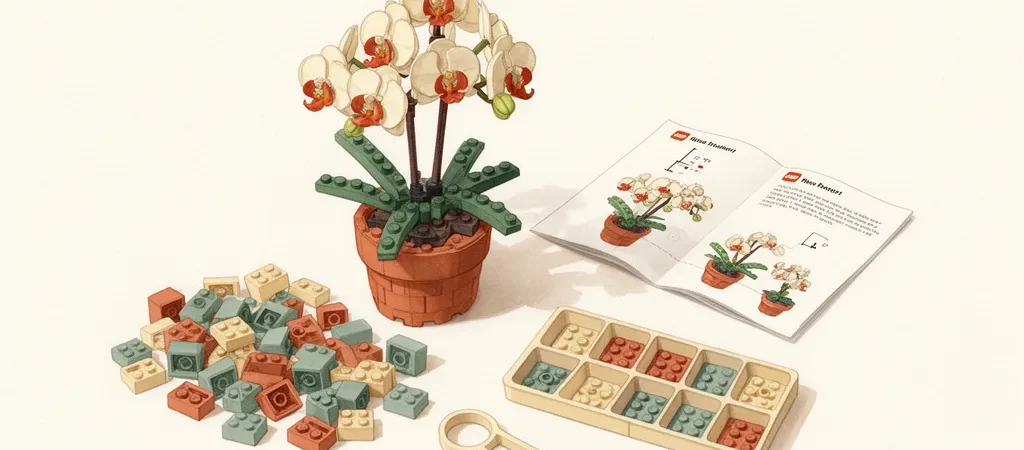
At 608 pieces and a genuine ~1.5-hour build, the Orchid is the canonical adult-beginner display pick and the single most-recurring “first set” recommendation. It hits the sweet spot exactly: a finished, display-worthy object in one sitting, no part pre-sorting or reading-ahead required.
- Adjustable stems and petals mean the finished display can be re-posed
- Sits in a real vase on a shelf; reads as home decor, not a “toy on display”
- Lots of small green stem/leaf elements late in the build can feel slightly repetitive

LEGO Icons Tiny Plants 10329
The underrated pick of the botanical line: 758 pieces packaged as nine tiny potted plants, and crucially it ships with easy/medium/advanced instruction paths — a built-in on-ramp that lets a nervous beginner start easy. Reviewers praise it as the most beginner-friendly, highest-value botanical.
- Tiered easy/medium/advanced build options let the recipient scale difficulty to their comfort
- Smallest footprint of the botanicals — nine terracotta-style pots suit even a crowded desk
- Newest of the botanicals, so slightly fewer long-run reviews than the Orchid

LEGO Icons Wildflower Bouquet 10313
939 pieces but reviewers consistently report a ~1-hour build because the eight wildflower species repeat similar techniques — high visual payoff for low difficulty, exactly the beginner-relevant tradeoff gift-buyers should shop by.
- Eight distinct wildflower species make a genuinely giftable, non-toy-looking bouquet
- Adjustable stems let the recipient trim to fit any vase they already own
- Does not include a vase — recipient needs one to display it

LEGO Architecture Paris Skyline 21044
The one-evening architecture pick: 694 pieces of distinct landmarks (Eiffel Tower, Louvre, Arc de Triomphe) that break the build into satisfying mini-sections and finish in 2-3 hours. A narrow, shelf-friendly footprint.
- Landmark-by-landmark structure gives natural stopping points and repeated “done!” moments
- Under 3 inches deep — fits a bookshelf or office ledge without dominating it
- Officially rated Ages 12+, not an 18+ set — beginner-appropriate but not part of the “adults” marketing line

LEGO Star Wars Darth Vader Helmet 75304
The genuinely beginner-appropriate first 18+ Star Wars set: 834 pieces, a ~2-3 hour build, and a striking display bust on an included nameplate stand. It delivers a marquee-looking result without UCS-level endurance.
- Finished bust looks like a premium collectible, not a toy — high display payoff for a first fandom set
- Symmetrical construction teaches basic technique repetition, which builds beginner confidence
- The curved-panel greebling near the end is the trickiest section for a total first-timer

LEGO Technic NASCAR Camaro ZL1 42153
The “secret engineer” pick that stays in the sweet spot: 672 pieces of real Technic mechanics (steering, moving pistons, opening hood) that finish in 2-3 hours instead of a multi-day marathon. A genuine entry point into gears-and-axles building.
- Introduces working Technic functions (steering, pistons) at a manageable scale
- Finished car is a legitimate desk display, not just a mechanism to admire once
- Technic instructions (studless, part-orientation-heavy) are a genuine step up in reading difficulty; sticker application requires patience
Matching the Set to Their Actual Interest Without Overbuying
The decision is simpler than the wall of boxes suggests. If they like their space to feel put-together — plants, decor, calm — buy a botanical: the Orchid for a single elegant piece, Tiny Plants if they’re anxious about difficulty, the Wildflower Bouquet if they already own a vase they’d love to fill.
If you want a “wow” shelf piece that starts conversations, the Darth Vader bust reads as a premium collectible the moment it’s out of the box — provided they actually care about Star Wars. And if you’ve ever watched them take apart a gadget just to see how it works, the Technic Camaro gives them real gears and steering without a multi-day commitment.
Resist the urge to “size up” as a show of generosity. The goal is a set that gets finished, not one that maximizes piece count on the receipt. A completed 600-piece orchid on their shelf is a better gift — and a better on-ramp into the hobby — than a 3,000-piece box that intimidates them into never starting.
What to skip
Skip the Ultimate Collector Series and marquee display sets as a first gift — the 9,090-piece Titanic, the UCS Millennium Falcon, the Colosseum. A 12–15 hour endurance build with heavy parts-sorting is exactly how a beginner’s set ends up half-finished in the box. Also skip anything that visually reads as a “kids” set, no matter how cheap it looks. You want a completed, displayed model that signals respect for the recipient’s taste — not a test of stamina, and not a toy.
The right first set is a starter, not a monument. The box that gets opened, finished, and set on a shelf the same weekend is what quietly converts a lapsed childhood builder into an adult hobbyist — and no amount of piece count does that if the model never gets completed.
What the gift signals matters too: choosing by their actual taste — the plant person gets a botanical, the tinkerer gets Technic — tells the recipient you saw them, not just the biggest box on the shelf.
If you’re torn between two, size down. A too-easy set gets built, displayed, and enjoyed; a too-hard one gets shelved in the box. And if they finish it in a weekend and want more, that’s your next-gift answer built in: step them up to a larger botanical like the Bonsai Tree, or the next tier of Technic.