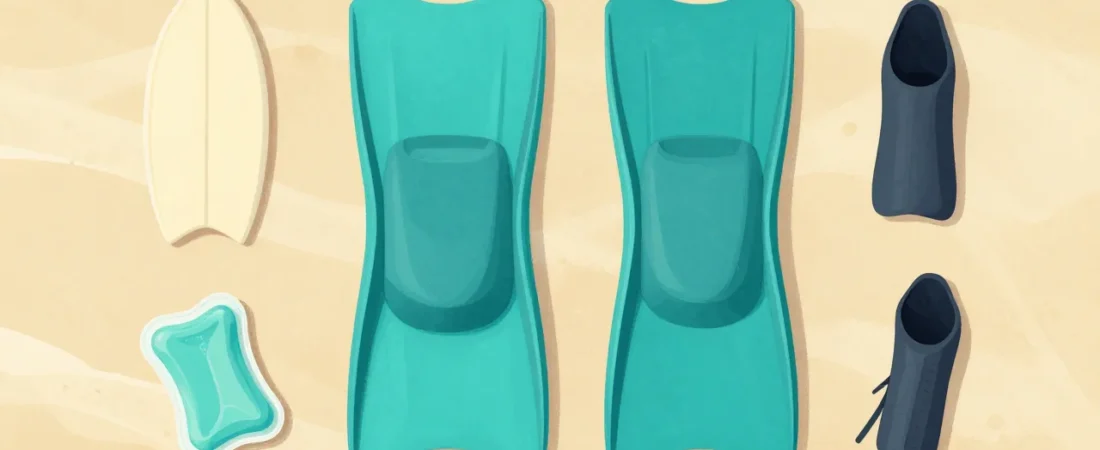
An intermediate bodyboarder already owns a board and fins. They’ve been in the water enough to read a wave face, to know when they’re getting outrun, to feel the moment their grip slides on a rail grab. The worst gift you can give them is a beginner kit — it signals you don’t know where they actually are.
The gear gaps at this stage are specific: a bicep leash they keep meaning to switch to, fins that can actually reach the steeper sections of a break, tethers to keep those fins on their feet through a proper wipeout. These are not glamorous upgrades. They’re the ones that directly determine whether a session is productive or frustrating.
This guide is built around those gaps. Every pick maps to a skill marker or a session blocker, and every pick comes with honest guidance on when it’s wrong — because at this stage, a mismatched board is worse than no new gear at all.
How we select these gifts
- Specialty retailers first: We start with what dedicated bodyboarding retailers actually stock — 662 Bodyboard Shop and major surf shops that maintain dedicated bodyboard sections. Retailers whose business depends on repeat customers don’t stock junk.
- Community consensus: We cross-reference retailer inventory against what intermediate riders recommend — r/bodyboarding and competition event gear lists.
- Stage fit: Intermediate adult bodyboarders are riding open-face waves consistently, attempting el rollo and basic airs, and starting to read wave selection. Their gear needs are accessories-first — the board is rarely the limiting factor.
- Budget range: Picks span $8.99 to $299.99. The accessories cluster under $55 and deliver the most direct per-dollar impact.
- Skip-this guidance: Where a popular pick isn’t right for this specific stage, we say so and explain why.
What Defines an Intermediate Bodyboarder (And Why It Changes What They Need)
Three markers put a rider at the intermediate stage: they’re riding the open face of waves rather than just the whitewash, they’re actively attempting rotation maneuvers (el rollo, spinners), and they’re making wave selection decisions rather than paddling into anything that moves. Each of those markers creates a specific gear gap.
Riding open-face waves means reaching steeper, faster sections — requiring propulsive power that short-blade fins can’t deliver. Attempting rotation maneuvers makes a wrist leash an active problem: it creates torque through the arm during the spin. Practicing rail grabs and drop-knee on a slick deck without wax means losing grip during the move rather than landing it.
The board itself matters less at this stage than most people assume. An intermediate rider on a matched PE board with proper fins, a bicep leash, and deck wax will outperform the same rider on an expensive PP board with wrong-sized fins and a wrist leash. Accessories first. Board only when the rider confirms they’ve outgrown their current construction.
Performance Fins: The Upgrade That Changes Everything
Most intermediate bodyboarders are still riding the fins that came bundled with a beginner kit — injection-molded, short-blade, stiff rubber that delivers about 60% of the propulsive power a dedicated fin produces. The gap determines whether a rider can reach a steeper section before the wave closes, and whether they have enough speed coming out of a bottom turn to project into a maneuver.
The DaFiN Pro Classic Swim Fins are the only swim fin endorsed by the USLA — ocean lifeguards depend on them professionally. Mike Stewart, an eleven-time world bodyboarding champion, co-developed the full-blade design. Natural rubber construction floats in water rather than sinking when a fin kicks off in a wipeout.
One hard caveat: DaFins run a full size large. A rider who wears a US 10 shoe should order a US 9 DaFin. The pocket also runs narrow — high-volume or wide feet will find the fit uncomfortable regardless of sizing. That’s the single biggest source of returns on this fin and entirely avoidable with the right measurement.

DaFiN Pro Classic Swim Fins
The only swim fin endorsed by the USLA, stocked at every dedicated bodyboarding retailer, and developed with Mike Stewart. Natural rubber floats in water. Full-blade design delivers propulsive power that lets intermediates reach faster, steeper waves that shorter fins can’t access.
- Natural rubber floats — critical safety feature when a fin kicks off in a wipeout
- Full-blade delivers more propulsive power per kick than short-blade fins
- USLA endorsement: used by ocean lifeguards professionally
- Runs a full size large — order down; pocket runs narrow for wide feet
Fin Tethers: The $30 Insurance Policy on Their $80 Fins
Every intermediate bodyboarder who surfs overhead waves or heavy beach breaks loses a fin eventually. Fin tethers are the $30 solution to losing an $80 pair of DaFins, and they’re mandatory at most competitive bodyboarding events.
The XM Surf More Fin Tethers are the only major surf leash product manufactured in the USA, carrying a 3-year warranty. The neoprene padding and extra-long velcro strap are consistently cited as the reason there’s no chafing — a complaint that follows most other tether brands. Gift these alongside the DaFins for a complete under-$115 upgrade bundle.

XM Surf More Fin Tethers
Prevents losing $80 DaFins in heavy wipeouts for $30. Only major surf leash brand manufactured in the USA with a 3-year warranty. Neoprene padding and extra-long velcro strap eliminate ankle chafing. Mandatory at competitive bodyboarding events.
- Prevents losing $80 fins every session for $30
- No chafing — cited consistently across reviews vs competitors
- USA-made with 3-year warranty
- One-size-fits-all can shift on very small or very large ankles
The Bicep Leash Upgrade
A wrist leash creates rotational torque through the arm during el rollo and spinners — pulling against the spin at precisely the moment technique matters most. Every experienced bodyboarder switches to a bicep leash when they start working rotation. It’s a functional upgrade, not cosmetic.
The Creatures of Leisure Superlite Bicep Leash solves the two main bicep leash failure modes: the 360-degree rotator swivel prevents cord twist mid-maneuver, and the heat-coiled cord retracts and stays off legs during paddling. Measure bicep circumference before ordering — it comes in S/M and L/XL only, and a leash that slips is worse than a wrist leash.

Creatures of Leisure Superlite Bicep Leash
Bicep attachment allows free wrist rotation through spinners and el rollo — functionally necessary as riders develop rotation maneuvers. 360-degree rotator swivel prevents cord twist mid-maneuver. Heat-coiled cord retracts and stays off legs while paddling.
- 360-degree rotator swivel prevents cord twist during el rollo and spinners
- Heat-coiled cord retracts off legs while paddling
- Non-slip cuff holds through heavy wipeouts
- S/M and L/XL sizing only — must measure bicep circumference
Board Upgrades (When — and Only When — They Make Sense)
Most intermediate bodyboarders don’t need a board as a gift. The fins, leash, and wax will have more direct session impact than swapping boards. Three situations actually warrant a board upgrade: the rider is learning drop-knee and struggling with a floppy beginner board; they’ve been on PE and want to feel a stiffer core; or they’re already on PP and need more projection for rotation maneuvers.
For drop-knee learners: the Science Launch Tech PE Bodyboard by Mike Stewart. PE core plus double stringer — forgiving enough for technique development, stiff enough for speed. Explicitly listed as intermediate across specialty retailers.
For the accessible PP upgrade: the BZ Accel PP Core Bodyboard. Zero-G polypro core and Surlyn slick at under $150 — PP construction at a price that usually doesn’t exist.
For riders already on PP who want projection: the Hubboards Hubb Pro PP, co-founded by world champions Dave and Jeff Hubbard. Kinetic PP plus CFT stringer delivers snap that PE can’t replicate. Confirm the rider’s weight, home water temperature (PP stiffens below 60°F), and current construction before gifting any board.

Science Launch Tech PE Bodyboard
Explicitly listed as an intermediate board at major specialty retailers. PE core plus double stringer is the right construction for learning drop-knee — stiff enough for speed, forgiving enough not to punish early attempts. Available 39–43 inches for sizing by rider weight.
- PE core + double stringer ideal for drop-knee development
- Slotted channels deliver directional grip better than entry-level PE builds
- Available 39–43 inches for proper sizing
- HDPE slick slightly slower than Surlyn boards at this price point

BZ Accel PP Core Bodyboard 42″
Zero-G PP core and Surlyn slick at under $150 — a price point that rarely exists for PP construction. Right for intermediates who’ve been on PE and want to feel the core difference without a $300 commitment. Versatile template works across beach breaks and reef.
- Zero-G PP core + Surlyn slick at accessible price point
- Surlyn slick usually reserved for $200+ boards
- All-around template works across conditions
- Single stringer: less snap than dual-stringer designs

Hubboards Hubb Pro PP Crescent Tail
Co-founded by multi-time world champions Dave and Jeff Hubbard. Kinetic PP core plus CFT stringer produces spring-like snap absent in PE builds — the recoil energy through a bottom turn that PE cores don’t generate. For riders already on PP who want projection for el rollo and spinner development.
- Kinetic PP + Surlyn: meaningful speed and recoil step-up from PE
- CFT stringer delivers snap critical for projection maneuvers
- Handhold contour deck improves grip during inverted and DK riding
- PP can delaminate faster without UV protection — store out of direct sun
Deck Wax: The Cheapest Gift With the Most Direct Performance Impact
Bodyboard decks — PE and PP alike — are smooth. The moment a rider works on drop-knee, rail grabs, or any maneuver requiring sustained grip pressure, a slick deck becomes the limiting factor. Sticky Bumps Bodyboard Wax Warm/Tropical 3-Pack is formulated specifically for bodyboard deck surfaces — 662 Bodyboard Shop stocks this formula for exactly that reason. At $8.99 for three bars, it’s the strongest stocking-stuffer in the guide: direct performance impact, zero wrong-fit risk, immediately useful at the next session. Cold-water caveat: this Warm/Tropical version is wrong below 68°F — check where they surf before ordering.

Sticky Bumps Bodyboard Wax Warm/Tropical 3-Pack
Specifically formulated for smooth bodyboard deck surfaces — not repurposed surf wax. 662 Bodyboard Shop stocks this formula by name. Intermediates lose grip on slick decks precisely when drop-knee and rail grabs demand it most. Non-toxic, biodegradable, $3 per bar.
- Formulated for bodyboard deck surfaces — not adapted from surf wax
- Non-toxic and biodegradable
- 3-pack at $3/bar — season supply
- Warm/Tropical wrong for cold water below 68°F — goes waxy and stops gripping
What to skip
Skip ocean-themed apparel, beginner all-in-one kits, and foam learner boards. Also skip gifting a PP core board unless you’ve confirmed the rider’s weight, home water temperature (PP stiffens badly below 60°F), and that they’re not already on PP looking for something beyond it. When in doubt, DaFins and fin tethers together land better than any board pick — they work for every intermediate, in every water temperature, regardless of what board the rider currently owns.
DaFins and fin tethers together cost under $115 and address the two most common session-enders for intermediate riders. A bicep leash removes the single biggest mechanical obstacle to learning rotation maneuvers. Deck wax costs less than a tank of gas and gets used at every session. These are not aspirational upgrades — they’re the specific gaps every intermediate has, and the ones that directly support the maneuvers they’re working on right now.