The gift that decides whether a new knitter keeps going isn’t the needles or the pattern — it’s the fiber. Walk down a craft-store aisle and the “learn to knit” kits practically shove a fat skein of squeaky acrylic and a pair of giant plastic needles into your hands, because that combination photographs fast and feels like a bargain. In a beginner’s hands, it does the opposite of what they need.
Super-bulky acrylic slides off the needle, hides every stitch, and punishes the too-tight tension every beginner has for their first few hours. The result is a pile of unreadable loops, a dropped stitch that can’t be found, and a half-finished thing shoved in a drawer. The yarn quit before the knitter did.
This guide is built around one swap: smooth, light-colored worsted wool on smooth bamboo needles, so the first stitches are legible, forgiving, and fixable. Get that right and the rest of the kit is cheap. Here’s exactly what to gift so an adult beginner actually finishes their first scarf.
How we select these gifts
- Specialty retailers first: We start with what dedicated yarn shops actually stock and re-stock — Austin’s Knit ATX for the yarn, and the notions wall of any local yarn store (LYS) worth its salt. Shops whose business depends on beginners coming back for their second project don’t sell them fiber that makes them quit. Where a local shop doesn’t carry a category, we cross-check reputable national craft and notions retailers instead.
- Community consensus: We cross-reference shop inventory against what knitters recommend to each other — r/knitting’s recurring “what should I buy first” and finishing threads. Products that show up in both signals get the heaviest weight.
- Age and stage fit: This guide targets the adult absolute beginner — someone who can’t yet read their own stitches, whose tension runs tight and uneven, and who will drop a stitch and not know how to fix it. Every pick is chosen to remove one of those specific friction points: fiber that makes stitches legible, needles that grip so loops don’t slide off, and a book that teaches the one repair that saves a project.
- Budget range: The core picks run about $6 to $14 each, so a complete, genuinely good starter kit lands near $50 all in — a real gift, not a token, and not an overspend on gear they’ll outgrow.
- Skip-this guidance: Where the most-marketed “beginner” pick — the chunky-acrylic arm-knitting kit, the 40-piece accessory tin — is actually wrong for this stage, we say so and explain why.
Why wool, not acrylic, is the make-or-break gift for a first project
Beginners quit knitting for four documented reasons, and every one of them is a fiber-or-color problem in disguise. Fix the yarn and you fix most of them before the first stitch.
They can’t read their stitches. The single hardest early skill is looking at a row of loops and telling a knit from a purl, and counting how many you have. A smooth, round, plied worsted wool in a pale solid makes each stitch sit up crisp and countable. Dark yarn, variegated “self-striping” yarn, and fuzzy novelty yarn all hide the exact stitches a beginner most needs to see — which is why a light, solid color isn’t a style choice here, it’s a teaching tool.
Their tension is tight and uneven. Every beginner grips. Acrylic has no give, so tight stitches stay tight and choke the needle. Wool is elastic — it stretches over the needle and relaxes back, quietly evening out the death-grip tension of a first project. And when the piece is done, wool blocks flat with a little water and patience; uneven acrylic stays uneven forever.
A dropped stitch feels unfixable. On slick acrylic a dropped stitch runs away down the fabric before a novice can catch it. Wool’s slight grip holds a dropped stitch roughly in place long enough to be rescued — which, paired with the one book below that actually teaches the fix, is the difference between “I made a mistake” and “I ruined it.”
Overwhelm. A giant skein and a pattern with fourteen abbreviations is a wall. A single ball of forgiving wool, one pair of needles, and a garter-stitch scarf — knit every row, no purling — is a door. The gear should shrink the first project, not inflate it.
The needle half of the swap matters just as much. Bamboo in the worsted sweet spot — US 7 to 8, 4.5 to 5.0 mm — has just enough surface drag that loose beginner stitches stay put instead of sliding off, the way they do on cold, slick nickel-plated metal. Smooth light wool on grippy bamboo is the whole thesis of this guide. Everything below serves it.
The core starter kit, curated
Four things make the working kit: the needles, the yarn, a blunt needle to finish the ends, and a pair of snips. Buy these four and a beginner can cast on a scarf the day they open the box. Start with the Clover Takumi Bamboo Straight Needles in US 8 — the exact needle the wool-on-bamboo argument calls for, and the one most-recommended first pair in r/knitting starter threads.
Pair them with Cascade 220 Worsted in Natural — the heart of the whole guide. It’s a smooth, light-cream, 100% wool worsted where every stitch is legible, it’s the yarn Knit ATX keeps on the shelf, and it’s the near-universal answer when a new knitter asks for “forgiving first-project wool.” The two notions that finish the kit — the Clover Chibi bent-tip tapestry needles for weaving in ends and the Fiskars Folding Travel Scissors for snipping yarn — are the small things a beginner doesn’t know they need until the moment they’re gnawing yarn off a ball with their teeth.

Clover Takumi Bamboo Straight Needles, US 8 (13-inch)
The exact needle the angle calls for: US 8 bamboo straights that grip the yarn so an absolute beginner isn’t chasing dropped stitches off slick metal. It’s the single most-recommended beginner bamboo needle across r/knitting starter threads, and the 13-inch length holds a scarf’s worth of worsted stitches comfortably. Paired with the Cascade 220 below, it’s the whole “smooth wool on grippy bamboo” thesis in two items.
- Bamboo surface has just enough drag to keep loose beginner stitches on the needle instead of sliding off
- Around 60% lighter than aluminum, so hands don’t fatigue during long learning sessions
- Tapered points are blunt enough to be forgiving but sharp enough to enter stitches cleanly
- A single fixed pair, not a set — a second size means a second purchase later

Cascade 220 Worsted Wool Yarn, Natural
The heart of the wool-not-acrylic angle. Cascade 220 in Natural is a smooth, light-colored worsted-weight 100% wool where every stitch is legible and countable — the yarn Austin’s Knit ATX carries and the near-universal r/knitting answer to “forgiving first-project wool.” The undyed light cream makes counting rows painless, and the wool’s elasticity quietly evens out the too-tight tension every beginner brings.
- Smooth, round, plied wool gives crisp stitch definition so a beginner can see knits vs. purls
- Resilient and forgiving: frogs and re-knits without shredding — essential when you’ll rip back a lot
- Light Natural colorway maximizes stitch visibility for counting
- Not superwash, so it needs hand-washing — a learning-project yarn, not a machine-wash item
- A touch rustic against the skin; fine for a scarf, less so for next-to-neck wear

Clover Chibi Bent-Tip Tapestry Needles
Every finished piece needs its ends woven in, and blunt tapestry needles stop a beginner from splitting the yarn while doing it. The Chibi bent-tip set is the recurring “buy this, not the sewing needle in your junk drawer” pick in r/knitting finishing threads — the bent tip slips between stitches far more easily than a straight one, so a novice can hide ends cleanly instead of leaving a lumpy tail.
- Blunt eye-tip glides between stitches without splitting the plies of the wool
- Bent tip makes scooping under stitches to hide ends easier for a novice
- Comes in its own hard case so it doesn’t vanish to the bottom of the bag
- Only three needles — easy to lose one, though the case helps
Fiskars Folding Travel Scissors
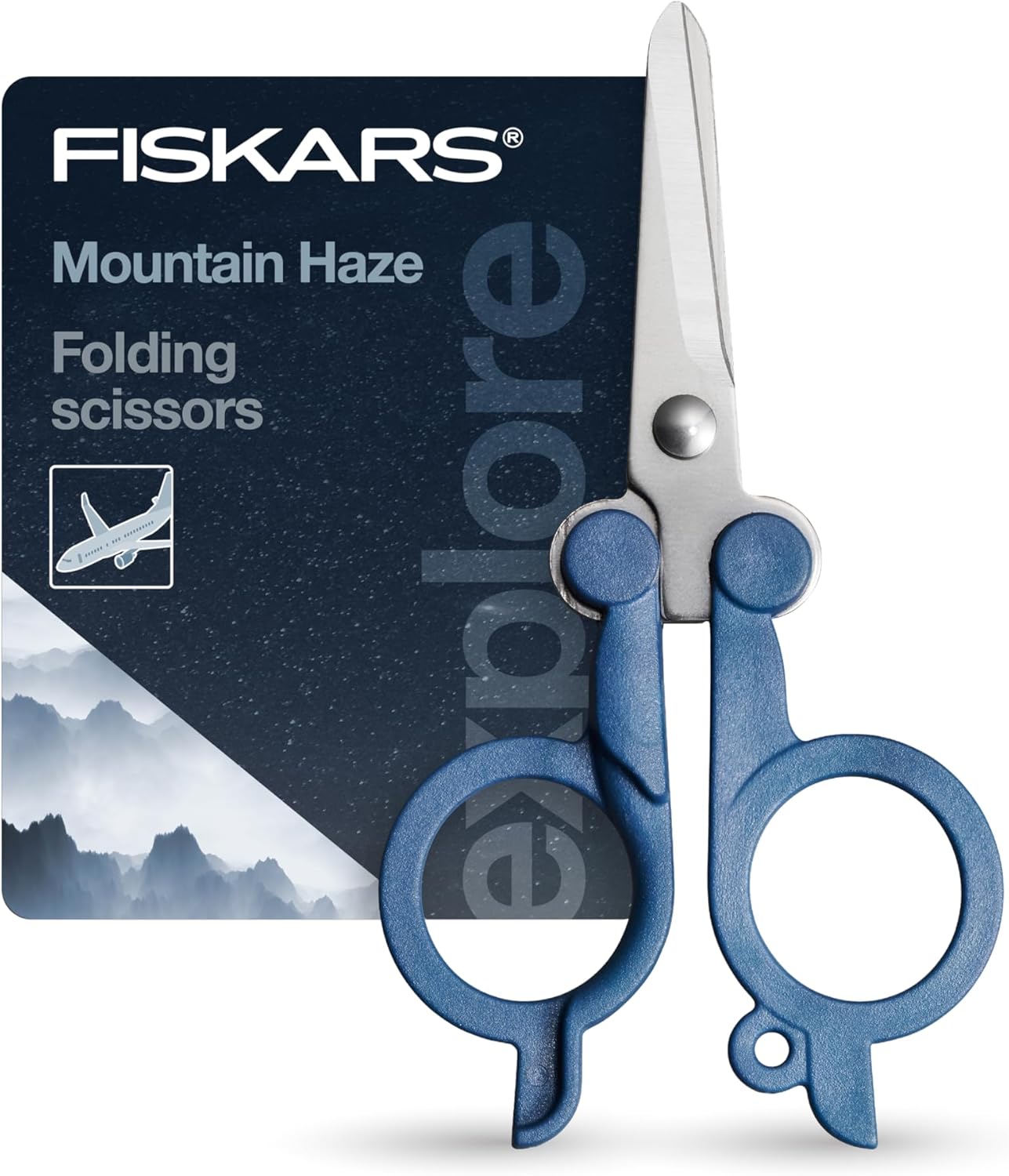
Small folding snips are the notion a beginner doesn’t know they need until they’re gnawing yarn off a skein. Fiskars is the trusted-brand answer, and the folding design makes it safe to toss in the project bag and TSA-legal for knitting on a plane. Recommended over floppy keychain scissors because it actually holds an edge.
- Blade folds into the handle so it lives safely in the project bag without a sheath
- TSA-compliant sub-4-inch blades travel legally for on-the-go knitting
- Fiskars steel takes and holds a proper edge, unlike novelty mini-scissors
- Small blades are for snipping yarn only, not cutting fabric or heavy trims
The one book that teaches, not just decorates: Stitch ‘n Bitch
Most knitting books on the shelf are pattern collections — gorgeous photography, zero teaching. A beginner doesn’t need a hundred sweaters they can’t make yet; they need one book that walks them from casting on to a finished scarf and, above all, teaches them how to fix a dropped stitch. That’s the book that decides whether a mistake ends the project or becomes a shrug.
Stitch ‘n Bitch: The Knitter’s Handbook is the perennial adult-beginner pick for exactly this reason. It assumes no prior knowledge, covers cast-on, knit, purl, and bind-off in plain language, and — crucially — shows how to rescue a dropped stitch and read a mistake. Its irreverent, non-fussy voice is the other quiet advantage: it teaches an adult without making them feel condescended to, which is a bigger factor in sticking with the hobby than most gift-givers realize.

Stitch ‘n Bitch: The Knitter’s Handbook
The book the whole kit is built around. Stitch ‘n Bitch is the perennial adult-beginner learn-to-knit handbook, walking a novice from casting on through a first real project in plain, encouraging language — and, crucially, how to FIX a dropped stitch, the skill that decides whether a mistake ends the project. The irreverent tone keeps an adult from feeling condescended to.
- Genuinely beginner-first: cast-on, knit, purl, and bind-off without assuming prior knowledge
- Includes first-project patterns so the recipient has somewhere to go after the stitches
- Warm, non-fussy voice adult beginners say kept them motivated
- Photography and styling feel dated versus newer titles
- Fewer step-by-step photos than a purely visual guide
Skip the chunky-acrylic shortcut: why super-bulky “beginner” kits set them up to quit
The chunky-acrylic starter kit is the most-marketed and most-gifted beginner product in this whole category, and it’s the one that most reliably ends with the yarn in a drawer. It looks like the obvious choice — big needles, fat yarn, “you’ll finish fast!” — which is exactly why it’s worth spelling out what goes wrong.
Super-bulky yarn on US 13–17 needles is slick and enormous, so stitches slide off the needle at the slightest wobble and a dropped stitch runs instantly. The acrylic has no elasticity, so the beginner’s tight tension stays locked and lumpy with nowhere to relax. And the giant scale hides nothing and reads nothing — you can’t count what you can’t distinguish, and every stitch looks like the last. Novelty yarns (eyelash, boucle, self-striping) are worse still: they’re deliberately textured or color-shifting in ways that camouflage the exact stitches a learner needs to see.
None of that fixes the real reasons beginners quit — and several of them cause it. “Finish fast” is the wrong goal anyway; the goal is finish at all, with stitches they could read and mistakes they could fix. A worsted scarf takes a few evenings longer than an arm-knit blanket and teaches ten times as much.
First projects the gift is for — and the second-project upgrade
This kit is built for three specific first projects, all worsted, all forgiving, in roughly this order of safety. The garter-stitch scarf is the safe first: cast on, knit every single row, no purling, no shaping — just miles of the same stitch until tension settles and the hands learn the motion. A simple dishcloth is the low-stakes variant if a scarf feels long — small, fast, and useful even if it comes out wonky. A simple cowl is the natural third, adding a join in the round once the basic stitch is automatic.
Frame the gift as a runway, not a dead end. Once tension evens out and reading stitches stops being a struggle — usually a project or two in — the second-project upgrade is where knitting gets interesting: a simple hat, or a first project that mixes knits and purls into a texture. That’s the point to gift a second needle size or a set of double-pointed needles, not before. The kit’s job is to get them through the scarf; the second project is theirs to choose.
What to skip
Skip: super-bulky/chunky acrylic “arm-knitting” kits, giant US 13–17 needles marketed as “easiest,” novelty yarns (eyelash, boucle, self-striping), slick nickel-plated needles, dark or variegated yarn that hides stitches, and 40-piece accessory tins where the yarn and needles are an afterthought. None of them fix the real reasons beginners quit; several cause them. The pattern is the same one that runs through this whole guide: the thing that photographs well and feels like a bargain is usually the thing that makes a beginner put the needles down.
The giftable complete-kit checklist
Wrap these together and you’ve handed someone a scarf they can start the same night — not a craft supply, but the odds they finish something:
- Clover Takumi Bamboo Straight Needles, US 8 — the grippy bamboo that keeps stitches on the needle ($9.49)
- Cascade 220 Worsted Wool, Natural — the smooth, legible light wool the whole guide is about ($11.50)
- Clover Chibi Bent-Tip Tapestry Needles — for weaving in ends without splitting the yarn ($5.99)
- Fiskars Folding Travel Scissors — the snips they don’t know they need yet ($9.99)
- Stitch ‘n Bitch: The Knitter’s Handbook — the one book that teaches the dropped-stitch fix ($13.29)
- A simple project bag — any zip pouch or drawstring tote so the whole kit lives in one place and travels together (a few dollars; no link needed — grab whatever matches their taste)
- A set of locking stitch markers — clip-on markers that also lock into a dropped stitch to hold it until the book’s fix is applied (a few dollars; the cheap add-on that punches above its price)
Card note to tuck in the bag: “Start with the scarf.”
You’re not buying a craft supply — you’re buying the odds they finish something. Light wool, smooth bamboo, one honest book, and two cheap add-ons that keep the whole thing in one bag. Everything in this kit exists to get an adult beginner past the four walls that make people quit and to the moment a finished scarf comes off the needles.
That moment is what the gift really signals: not “here’s a hobby, good luck,” but “I got you the version that’s actually forgiving, so the first try goes well.” If you’re unsure whether the hobby will stick, that’s an argument for this kit, not against it — the whole thing lands near $50 and every piece gets used even if they only ever make the one scarf.
If they’re standing there unsure what to make first, point them at the scarf and nothing else. A garter-stitch scarf on this wool and these needles is the lowest-risk, highest-confidence first project there is — knit every row until it’s long enough, weave in the ends, done. A too-easy first project gets finished and builds momentum; a too-ambitious one gets shelved. Start with the scarf.