Somewhere on a big-box shelf right now is a slim white telescope box with a photo of Saturn on the front and “675x POWER!” stamped across the top. It is the single most common telescope a well-meaning gift-giver buys, and it is the reason a depressing number of would-be stargazers quit inside a month. The hobby has a blunt nickname for it: the hobby killer.
Here is the part the box is built to hide. A telescope’s actual job is not to magnify — it’s to gather light. The number that decides what you’ll see is aperture (the width of the main lens or mirror), and that number is nowhere on the front of the “600x” box, because on those scopes it’s tiny. Crank a 2.4-inch scope to its advertised 600x and you get a dim, shaking, mushy blob that no amount of focusing will fix.
This guide is for the person buying a first real telescope for an adult — a partner, a parent, a friend who keeps saying they want to “get into astronomy.” We’ll show you why aperture beats magnification every time, which scopes the actual astronomy community hands beginners, and the small, cheap accessories that decide whether the gift gets used in six months or shelved in six weeks.
How we select these gifts
- Aperture per dollar, first and last: Useful magnification caps at roughly 50x per inch of aperture. A 2.4-inch scope tops out near 120x — not 600x; everything past the cap is empty, fuzzy, shaking magnification on a dimmer and dimmer image. So we ignore the “power” number entirely and rank by how much aperture (light-gathering) you get for the money, because that is the spec that determines what you’ll actually see.
- A mount that holds still: A steady low-power view beats a wobbly high-power one every single night. The cheap “600x” scopes fail here too — they sit on spindly tripods that shake for five seconds after every touch. We favor the Dobsonian mount, the most beginner-proof design ever made: you literally point the tube and look.
- A real path to finding things: The number-one reason adults quit astronomy isn’t the scope — it’s not being able to find anything in it. Every pick here either makes aiming intuitive or comes paired with the finder-and-atlas system that teaches star-hopping.
- Community consensus over marketing: We cross-reference what specialty astronomy retailers and local clubs like Starry Sky Austin actually recommend against what beginners report back on Cloudy Nights and TelescopicWatch. Picks that show up in both — the Dobsonian, the Telrad, the Pocket Sky Atlas — get the heaviest weight.
- Budget range: Picks span $16.95 to $799.95, so this works whether you’re adding a $17 stocking-stuffer to someone’s kit or buying the whole first setup.
- Skip-this guidance: We wall off astrophotography as a separate, expensive, advanced path — it is the wrong first gift — and we name the popular “obvious” buys that quietly sabotage a beginner.
Aperture Over “Power” — The One Spec the Boxes Hide
Start with the lie on the box. Magnification is the easiest number to print and the least important number to care about. Any telescope can reach any magnification — you just swap in a shorter eyepiece. The question is whether the image stays bright and sharp when you do, and that is entirely a function of aperture.
The working rule among observers is about 50x of useful magnification per inch of aperture. A 2.4-inch (60mm) refractor — the typical “600x” department-store scope — genuinely tops out around 120x. Push past that and you’re spreading a small amount of gathered light over a bigger, dimmer, blurrier image. The “600x” claim isn’t a feature; it’s the spec equivalent of selling a car by its odometer’s top number.
Aperture is light-gathering, and light-gathering is what you see. An 8-inch mirror collects roughly 840 times more light than your naked eye — that’s the difference between Saturn as a faint star-like dot and Saturn as a ringed disc with the dark Cassini gap visible. There’s a ceiling neither side controls, too: Earth’s atmosphere. On a typical night the air’s turbulence (“seeing”) blurs the view past roughly 200–300x no matter how good or expensive the scope is. So the giant number was never reachable to begin with.
That leaves three things that actually matter for a first telescope, and they’re the lens we judge everything else through: the most aperture you can afford, a mount steady enough to hold the view, and a realistic way to find objects in the sky.
Why a Dobsonian Is the Best First Telescope
Ask any astronomy club what to buy first and you’ll get the same answer often enough that it’s nearly a cliché: a Dobsonian. A “Dob” is a big light-gathering mirror sitting in a simple wooden box base that swivels left-right and tips up-down. There’s no tripod to level, no equatorial head to align to the pole, no batteries, no menus. You point the tube at the sky and look. It puts every dollar into aperture instead of into a complicated mount — which is exactly why it shows beginners more for the money than anything else on the market.
The consensus first scope is the manual 8-inch, and ours is the Sky-Watcher Classic 200. Eight inches of aperture is the sweet spot where Saturn’s rings, Jupiter’s bands, and hundreds of deep-sky objects come genuinely alive, while the scope still fits in a closet and a car. It’s the scope clubs physically hand a new member. The one honest tradeoff is size: it’s a 40-pound, four-foot backyard instrument, not something you carry one-handed.
When that’s too much scope to store — an apartment, a small car, a recipient who wants to grab and go — the Sky-Watcher Heritage 130P is the answer at half the price. It keeps the exact same point-and-look Dobsonian philosophy in a collapsible tube that packs to backpack size and sits on any sturdy table. With the old Zhumell Z130 discontinued, it’s the standing forum-favorite tabletop Dob, and a real 130mm mirror still delivers Saturn’s rings and Jupiter’s cloud bands.
The third answer attacks the beginner’s real wall — finding things — head-on. The Celestron StarSense Explorer 8″ is still an aperture-first 8-inch Dob, but its app uses your phone’s camera to read the sky and walk you to targets with on-screen arrows. This is the legitimate, non-gimmicky version of “computerized,” because the optics and mount underneath are a serious Dob rather than a wobbly toy propped up by electronics. Same family, three answers to one question: how much scope, and how much hand-holding.

Sky-Watcher Classic 200 8″ Dobsonian Telescope
The consensus answer to “what should my first telescope be” — a classic manual 8-inch Dobsonian. Eight inches of aperture (not magnification) is the single spec that decides what you’ll actually see: Saturn’s rings and the Cassini gap, Jupiter’s cloud bands and four moons, lunar craters in crisp relief, and hundreds of deep-sky objects. The Dobsonian base is the most beginner-proof mount ever made — you point the tube at what you want and look, with no equatorial alignment, no GoTo batteries, and no setup ritual to kill the impulse to go observe. It delivers more light-gathering per dollar than any other design, which is exactly why every club and forum hands a beginner a Dob.
- 8″ (203mm) of aperture gathers roughly 840x more light than the naked eye — the one factor that most determines what you’ll see
- Point-and-look Dobsonian mount: no alignment, no electronics, no learning curve before the first view
- Most aperture per dollar of any telescope type — the near-universal first-scope recommendation from clubs and forums
- Big and heavy (~40+ lbs assembled, a 4-foot tube) — a backyard scope, not grab-and-go, and needs a car for dark-sky trips
- Manual aiming means you must learn to find objects yourself (pair it with the Telrad + atlas below)

Sky-Watcher Heritage 130P Tabletop Dobsonian
The smartest sub-$300 entry point and the natural pick when the full 8″ Dob is too much scope to store. With the old Zhumell Z130 discontinued, the Heritage 130P is the standing forum-favorite tabletop Dobsonian: a real 130mm parabolic mirror that shows Saturn’s rings and Jupiter’s bands, on a collapsible FlexTube that packs down to backpack size and sits on any sturdy table or stool. It keeps the aperture-over-magnification and easy-aiming philosophy intact at half the price of the big Dob.
- 130mm aperture in a ~6-pound package that collapses small — genuinely portable and apartment-friendly
- Real Dobsonian point-and-look aiming; no tripod alignment or electronics to fail
- Best optics-per-dollar under $300 according to both Cloudy Nights and TelescopicWatch
- Needs a stable ~30-inch-high surface (table/stool) — no full tripod is included
- The helical focuser won’t hold heavy 2-inch eyepieces, and the open FlexTube benefits from a light shroud under streetlights

Celestron StarSense Explorer 8″ Dobsonian
The capable step-up alternative that directly attacks the beginner’s core skill gap — FINDING objects. It’s still an aperture-first 8″ Dobsonian, but the StarSense app uses the phone’s camera to plate-solve the sky and walk you to targets with on-screen arrows, which shortcuts the star-hopping learning curve for an adult who’d otherwise give up frustrated. This is the legitimate, non-gimmicky version of ‘computerized,’ because the optics and mount underneath are a serious Dob, not a wobbly department-store go-to.
- StarSense app turns the “I can’t find anything” wall into guided point-and-shoot — the #1 reason beginners quit, solved
- Full 8″ of aperture on a stable Dob base; the assist is a bonus, not a crutch propping up bad optics
- No motors or external power for the mount — the phone does the finding, your hands do the moving
- Pricier than the optically-equivalent manual Classic 200, and ships with only one basic 25mm eyepiece and a basic red-dot finder
- App alignment needs a reasonably modern smartphone and a few minutes of setup each session
What You’ll Actually See Through It
This is the conversation that keeps a beginner in the hobby, so have it honestly before the gift is unwrapped. A telescope does not show you the colorful, swirling Hubble photos. Those are long-exposure images stacked from hours of camera data; your eye sees in real time and in faint light, so most deep-sky objects appear as soft gray smudges. The Orion Nebula through an 8-inch is a genuinely beautiful ghostly gray cloud with four baby stars inside it — not a magenta-and-teal poster.
What an 8-inch Dob does deliver, on a decent night, is the stuff that makes people gasp the first time: Saturn floating as a tiny ringed world with the dark Cassini gap splitting the rings; Jupiter showing two or more cloud bands and its four bright Galilean moons rearranging night to night; the Moon’s craters in knife-edge relief along the terminator. Seeing those with your own eye, live, photons that left Saturn over an hour ago landing on your retina — that lands differently than any photo.
Two free habits make all of it sharper. Let the scope sit outside for 30–60 minutes first so its mirror cools to the night air (warm optics make the image shimmer). And protect your eyes’ dark adaptation — it takes 20–30 minutes in the dark for your pupils to fully open, and you keep it by using red light only.
The honest hedge on all of this is a pair of binoculars, and the Celestron Cometron 7×50 is the one veterans tell beginners to buy first. Zero setup, instantly usable, and a wide enough field to sweep the Milky Way, the Pleiades, and the smudge of the Andromeda Galaxy — they teach the sky’s layout faster than any telescope. They’re a near-zero-risk gift on their own and the perfect grab-and-go partner to a Dob, but they’re a companion, not a substitute: 7x won’t resolve Saturn’s rings. That’s the scope’s job.

Celestron Cometron 7×50 Astronomy Binoculars
The low-cost entry/companion every veteran tells beginners to buy first — and the honest hedge on realistic expectations. Binoculars require zero setup, show a wide swath of the Milky Way, the Pleiades, the Andromeda Galaxy and dozens of clusters, and teach the sky’s layout faster than any scope. Cloudy Nights repeatedly names the Cometron 7×50 a fantastic sub-$100 bargain; it’s the ideal stocking-sized gift on its own or as the grab-and-go partner to a Dobsonian.
- Instant, no-setup stargazing with a wide 6.6° field — the fastest way to actually learn constellations
- 50mm objectives gather real light for the price; 7x is steady enough to hand-hold without shake
- Under $40, tripod-adaptable, and doubles for daytime nature/birding — a near-zero-risk gift
- Entry-grade build with simple coatings — a noticeable step below $150+ binoculars in edge sharpness
- Not a telescope substitute: it won’t resolve Saturn’s rings or split close planetary detail
The Accessories That Actually Matter (and the Order to Buy Them)
Accessories are where most gift money gets wasted on filters and gimmick eyepieces nobody uses. The four below are the ones that genuinely change the experience, listed in the order they earn their keep. Notice that the cheapest item comes first.
Buy the Celestron Astro red flashlight first because it makes everything else usable. One glance at a white phone screen erases 20+ minutes of dark adaptation in a single second, and then you spend the next half hour half-blind. A dimmable red light lets you read a chart and check your aim without resetting your eyes. It’s under $20 and effectively mandatory.
Next is the Sky & Telescope Pocket Sky Atlas — the paper map that turns “I can’t find anything” into a plan. It’s spiral-bound to lie flat in the dark, holds one-handed at the eyepiece, and — critically — has Telrad finder rings printed right on the charts. It’s the atlas every club has handed beginners for half a century: deep enough to grow into, not so dense it overwhelms.
Those printed rings are why the Telrad Finder Sight is the third buy and the most beloved aiming tool in amateur astronomy. This is also the answer to a common question — what’s the difference between a Telrad and a plain red-dot finder? A red dot projects a single dot. The Telrad projects three concentric bullseye rings (0.5°, 2°, and 4° wide) onto the actual sky at zero magnification — the exact same rings printed in the atlas. You match the shape on the page to the shape overhead and hop straight to your target. It pairs best with the Classic 200 or StarSense; on the compact Heritage 130P, a small red-dot finder fits the short tube better.
Last, after the included eyepieces, comes the Astromania 9mm “Goldline” eyepiece — the forum-cult upgrade Cloudy Nights veterans buy in multiples. In an 8-inch Dob the 9mm gives a sharp ~130x for planets and the Moon, with a wide 66° field that makes targets far easier to keep centered than the stock 25mm. It’s a real optical step up for the price of a couple of coffees. The atlas and the Telrad are the system that matters most; the eyepiece is the cherry on top.

Telrad Reflex Finder Sight
The single most beloved aiming accessory in amateur astronomy and the direct fix for the star-hopping gap. Unlike a plain red dot, the Telrad projects three concentric bullseye rings (0.5°, 2°, 4°) onto the real sky at zero magnification — and those exact rings are printed as overlays in Sky & Telescope’s Pocket Sky Atlas, so you literally match the chart to the sky and hop to your target. Starry Sky Austin and virtually every Cloudy Nights beginner thread name it the finder to get.
- Bullseye reticle scales directly to the Pocket Sky Atlas overlays — turns abstract star-hopping into matching shapes
- Zero magnification, upright, non-reversed view — what you see is what’s overhead, the most intuitive way to aim
- Mounts on any tube without drilling and is widely called “the only finder you’ll ever need”
- At ~8 inches long it needs tube clearance — better suited to the Classic 200 / StarSense than the compact Heritage 130P (a small red-dot finder is the better match there)

Sky & Telescope’s Pocket Sky Atlas
The companion that makes the Telrad and the scope actually useful at the eyepiece. This is the standard beginner star atlas: spiral-bound to lie flat in the dark, 30,000+ stars and 1,500 deep-sky objects, with Telrad-ring overlays built into the charts so the finder and the atlas work as one system. Pairing a star-hop atlas with the scope is exactly the fix for the beginner’s finding problem — a concrete way to locate objects rather than wandering.
- Wire-bound to lie flat at the telescope and sized to hold one-handed in the field
- Telrad and finder-circle overlays printed on the charts — designed to be used with the finder above
- Half a century of being the atlas every club hands a beginner; deep but not overwhelming
- White pages are bright at night — pair it with the red flashlight (below) to protect dark adaptation
- A paper atlas has a learning curve; some app-first beginners will lean on StarSense or SkySafari instead
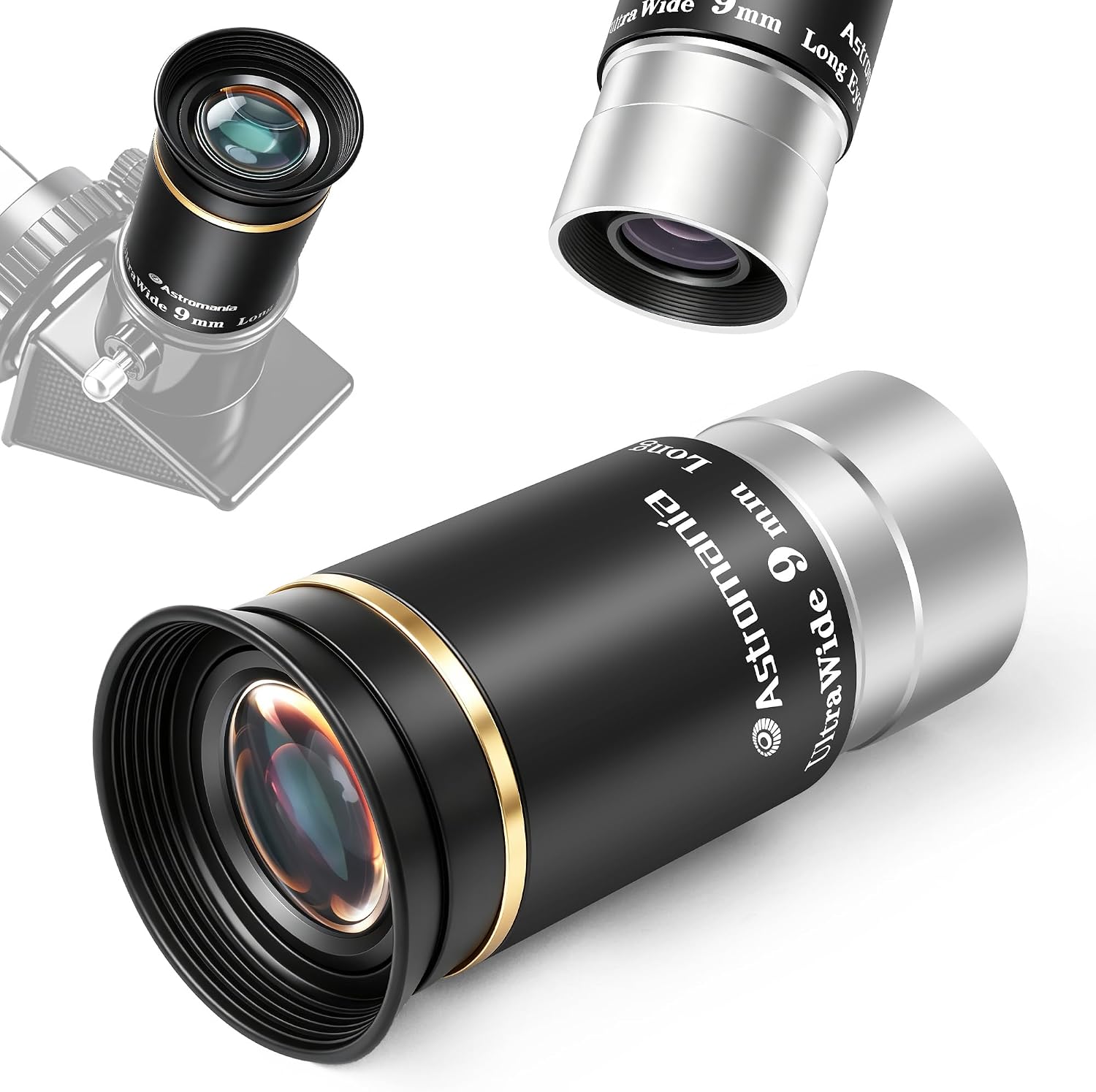
Astromania 9mm 66° “Goldline” Eyepiece
The underrated forum-cult pick: the so-called ‘goldline’ eyepiece that Cloudy Nights veterans buy in multiples because it punches absurdly above its price. The 9mm gives an 8″ f/5.9 Dob a sharp ~130x planetary-and-lunar magnification with a wide, immersive 66° field that makes targets far easier to keep centered than the stock 25mm. Forum consensus repeatedly calls the 9mm the standout of the set — a genuine optical upgrade for the price of a couple of coffees, and the perfect first eyepiece purchase after the included pair.
- 66° apparent field is roughly a third wider than the bundled Plossls — easier to find and hold a target, more “spacewalk” immersion
- The single most-recommended budget eyepiece on Cloudy Nights; the 9mm is the cult favorite of the line
- Threaded for standard 1.25″ filters and stays sharp even in fast f/5–f/6 beginner scopes
- Sold under several rebadged brand names (Astromania/SVBONY/Gosky), so the exact listing and price drift — verify the 66° 9mm specifically
- Eye relief is a bit tight for eyeglass wearers at this focal length

Celestron Astro Red Night-Vision Flashlight
The cheapest item here and the one that makes everything else work. A white phone screen or flashlight wipes out 20+ minutes of hard-won dark adaptation in a second; this dual-LED red light has a thumbwheel to dim to a faint glow so you can read the Pocket Sky Atlas and check the Telrad without blinding yourself. The flat square body won’t roll off the table, and it’s a near-universal first accessory in beginner astronomy kits.
- Variable-brightness red LEDs preserve night vision while you read charts and aim — the whole point of dark-sky observing
- Square anti-roll body and neck lanyard; runs a long time on one 9V battery (included)
- Under $20 and effectively mandatory — the highest usefulness-per-dollar pick in the stack
- 9V battery format is less convenient than AA / USB-rechargeable; some users swap to a rechargeable 9V
- Plain-red only — fine for observing, but astrophotographers sometimes want adjustable color temperature
Buying by Budget
Under $50 — the stocking-stuffer that isn’t a toy. The Cometron 7×50 binoculars ($39.99) are the best gift at this tier, full stop — instantly usable, genuinely fun, and the fastest way to learn the sky. If the recipient already owns a scope, the red flashlight ($16.95) or the Goldline eyepiece ($32.99) are small upgrades that punch above their price.
$250–$300 — a real telescope for a small space. The Heritage 130P ($269) is the most scope you can responsibly give at this price. Add the red flashlight and you’ve got a complete, apartment-friendly starter setup under $290 that will actually get carried outside.
$500–$550 — the consensus best first telescope. The Classic 200 8″ Dob ($519) is the pick the hobby itself would make. If you can stretch the budget by about $90, pairing it with the Telrad, the Pocket Sky Atlas, and the red flashlight builds the single best beginner bundle on this page — scope, aiming, and a plan to find things.
$800 and up — maximum hand-holding. The StarSense Explorer 8″ ($799.95) is for the recipient most likely to be discouraged by the finding curve — the app does the locating so the first few nights are wins, not frustration. It’s the same 8 inches of glass as the Classic 200, with the premium going toward guidance rather than optics.
What to skip
Skip anything sold by its magnification — “525x!”, “675x!” — instead of its aperture; that single choice is what kills the hobby, and the money belongs in light-gathering and a steady mount. Skip the tall, thin sub-60mm refractors on flimsy tripods, where the shake ruins every view, and steer well clear of bundled “0.965-inch” eyepieces and “power-boosting” Barlows — an obsolete format and empty magnification. As a first scope, skip the complicated computerized GoTo or equatorial mount: the alignment frustration kills momentum before the first good night (the StarSense app-assist above is the right kind of “computerized” because the Dob underneath does the real work). And skip astrophotography gear of any kind — it’s a separate, expensive, advanced path, and the wrong first gift entirely.
Frequently Asked Questions
Is a Dobsonian telescope good for beginners?
It’s the most widely recommended first telescope there is. A Dobsonian puts nearly all of its cost into aperture (light-gathering) instead of a complicated mount, and its point-and-look base requires no alignment, no electronics, and no setup ritual. That combination — maximum view for the money, minimum barrier to actually using it — is exactly why clubs and forums hand beginners a Dob.
How much magnification do you actually need in a telescope?
Far less than the boxes claim. Useful magnification caps at about 50x per inch of aperture, so a 2.4-inch scope tops out near 120x and an 8-inch reaches the mid-300s in theory. In practice, the atmosphere’s turbulence usually limits real-world views to roughly 200–300x on any given night, regardless of the scope. Most observing happens at low-to-moderate power; the headline “600x” number is marketing, not capability.
What can you realistically see with an 8-inch beginner telescope?
A lot, as long as expectations are set right. You’ll see Saturn’s rings with the Cassini gap, Jupiter’s cloud bands and its four bright moons, the Moon’s craters in sharp relief, and hundreds of deep-sky objects. Those deep-sky objects — like the Orion Nebula — appear as soft gray clouds, not the colorful Hubble photos, because your eye sees live and in faint light. Seeing them in real time with your own eye is the whole appeal.
Why are “high power” department store telescopes bad?
Because they sell the one number that doesn’t matter and skimp on the ones that do. A “675x” scope usually pairs a tiny 60mm lens with a flimsy, shaky tripod; cranked to its advertised power it shows a dim, blurry, jittering blob. The magnification is real in the sense that the eyepiece exists — but there’s no light and no stability behind it, so the view collapses. That’s the scope the hobby calls the “hobby killer.”
Can you see Saturn’s rings with a beginner telescope?
Yes — that moment is one of the main reasons people start. Even a small, quality 130mm tabletop Dobsonian shows Saturn as a distinct ringed disc. An 8-inch goes further, revealing the dark Cassini gap that divides the rings. What you need isn’t high magnification; it’s enough aperture and a steady mount, which is precisely what a Dobsonian delivers.
Aperture or magnification — which matters more for a first telescope?
Aperture, by a wide margin. Aperture is the width of the main lens or mirror, and it determines how much light the scope gathers — which is what actually decides brightness, detail, and what’s visible at all. Magnification just enlarges whatever light you’ve collected; without enough aperture, more magnification only spreads a dim image thinner. Buy the most aperture you can afford and ignore the “power” rating.
Do I need a red flashlight for stargazing?
Yes, and it’s the cheapest thing that meaningfully improves your nights. Your eyes take 20–30 minutes in the dark to fully adapt, and a single glance at a white phone screen or flashlight resets that adaptation in a second. A dimmable red light lets you read charts and check your aim while preserving your night vision, which is the entire point of observing from the dark.
What’s the difference between a Telrad and a red dot finder?
A red dot finder projects a single illuminated dot onto the sky — useful, but it gives you no sense of scale. A Telrad projects three concentric bullseye rings (0.5°, 2°, and 4° wide) at zero magnification, and those exact rings are printed on the charts in Sky & Telescope’s Pocket Sky Atlas. You match the rings on the page to the sky overhead and hop straight to your target, which turns star-hopping from guesswork into matching shapes.
The best first telescope isn’t the one with the biggest number on the box. It’s the one still being used in six months — and that comes down to light-gathering, a mount that holds still, and a real way to find things. A simple, stable Dobsonian and a $17 red flashlight will create more lifelong stargazers than every “600x” scope ever shelved in a closet.
If you only buy one thing, make it the Sky-Watcher Classic 200 8″ Dobsonian. It’s the scope the hobby itself recommends to beginners, and it shows the things that hook people on the first clear night. Short on space or budget, the Heritage 130P does the same job smaller; worried the recipient will get lost, the StarSense Explorer hands them a map. Any of the three beats the box on the shelf.
What this gift really unlocks isn’t the hardware — it’s the skill of finding your way around the sky. Pair the scope with the Telrad and the Pocket Sky Atlas, give it a clear night and a little patience, and you’re handing someone the keys to the whole sky for the rest of their life.