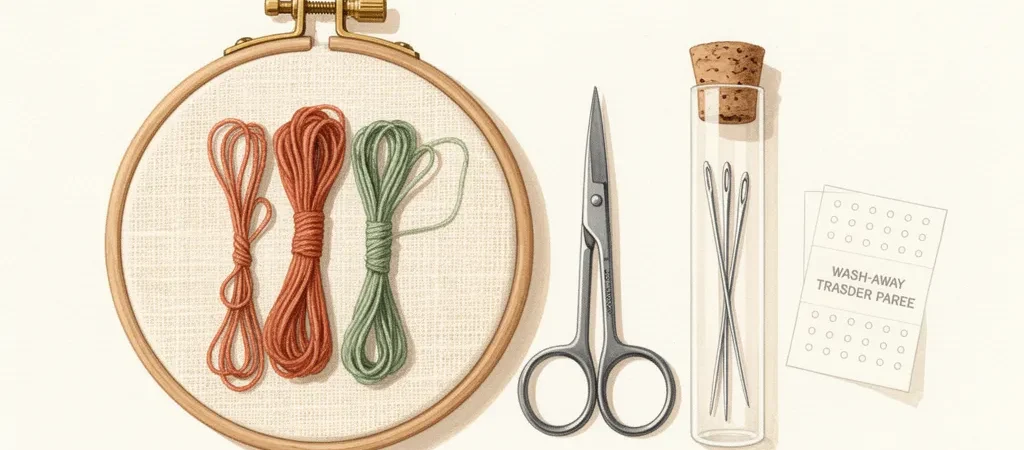
Search “embroidery kit for beginners” on Amazon and the top result is a 4-pack: four bamboo hoops that won’t hold tension, a rainbow of waxy no-name floss that frays on the third pass, and a leaflet of stitch diagrams nobody can follow. It’s the most-gifted embroidery present in America, and it’s a big part of why so many would-be embroiderers quit inside a week.
The fabric goes slack, the stitches pucker, the thread knots — and the recipient concludes they’re bad at embroidery, when the real problem was the gift. Cheap kits don’t just fail; they fail in ways that feel like the beginner’s fault.
The actual question a gift-giver needs answered is simpler than the 40,000 search results suggest: do you buy one well-designed kit, or a small stack of individual supplies? Both work. This guide covers the strongest version of each, then builds complete gift stacks at $25, $50, and $75 so every piece survives past project one.
How we select these gifts
- Specialty retailers first: We start with what specialty needlework retailers actually stock — Austin’s needlework shops carry Nurge hoops and DMC as their house defaults, and where the local scene thins out we check national specialty stitch shops that sell to working embroiderers. Stores whose business depends on return customers don’t stock warped bamboo or mystery floss.
- Community consensus: We cross-reference retailer inventory against what stitchers recommend in their own communities — primarily r/Embroidery beginner and pattern-transfer threads. Products that show up in both signals get the heaviest weight.
- Age and stage fit: These picks target pre-first-project adults, who need low-friction wins: pre-printed patterns instead of transfer methods, a 5–6″ hoop, and materials that teach floss separation — working 6-strand DMC in 2 or 3 strands, the single concept cheap kits never explain.
- Budget range: Picks span $4.79 to $36, so the guide works whether you’re adding a $5 stocking stuffer or building a $75 gift stack.
- Skip-this guidance: Where a popular pick isn’t right for this specific stage, we say so and explain why.
How We Pick: Kit or Supplies? The Decision Every Gift-Giver Gets Wrong
Almost every disappointing embroidery gift comes from answering this question badly — or not knowing it’s a question at all. The choice isn’t between a $12 kit and a $30 kit. It’s between one designer kit that teaches a complete first project, or a three-piece quality stack: a beechwood hoop with a brass screw, genuine DMC floss, and Bohin crewel needles. Never the 4-pack.
The kit route wins when the recipient has expressed interest but never stitched. A good kit removes every decision: the pattern is printed on the fabric, the floss is pre-selected, the stitches are taught in order. The supplies route wins when they’ve already finished one project, or when they’re the type who wants to work from their own ideas — supplies are what a kit graduate would buy themselves next.
Whichever route you pick, three criteria separate quality from junk. The hoop must hold tension without slipping mid-stitch. The floss must be colorfast and numbered, so a color can be rebought by code when it runs out. And the materials or instructions must account for floss separation — DMC floss is six strands twisted together, and most stitching is done with two or three of them pulled out. Cheap kits skip that entirely, which is why beginners end up forcing a rope-thick thread through fabric and wondering why it looks nothing like the photo.
Done right, the cost to start hand embroidery is roughly $25–50. Anything cheaper is usually paying for quantity of parts instead of quality of any single one.
The One-Kit Answer: A Designer Kit That Actually Teaches Stitches
If you’re buying one box and done, the Jessica Long Spiral Sampler is the answer. It’s designed by a working embroidery artist rather than assembled by an importer, and the difference shows in every component: the pattern is color-stamped directly on the fabric, the floss is genuine DMC, and the included 90-minute video walks through fourteen stitches in the order the design uses them.
The sampler format matters more than it sounds. A first project that’s one big image lives or dies on a single skill; a spiral sampler gives the beginner a small win every inch — satin stitch here, French knots there — so a rough patch never sinks the whole piece. That’s exactly what a pre-first-project adult needs: low-friction, visible progress, no transfer step to fumble on day one.
The honest tradeoff is that it’s one project. Once the spiral is stitched, the recipient needs supplies to keep going — which is where the rest of this guide comes in, and why the $75 stack below pairs the kit with tools that outlast it.

Jessica Long Spiral Sampler Beginner Kit
The anti-cheap-kit kit: a real designer’s sampler with color-stamped fabric, genuine DMC floss in twelve colors, a wooden hoop, proper needles, and a 90-minute video tutorial teaching fourteen stitches. A guided first project instead of a bag of 200 waxy skeins and no plan.
- Teaches 14 foundational stitches plus 16 variations in one structured project with video support
- Uses real DMC cotton floss and a pre-printed design — no transfer step to fumble on day one
- Costs more than the no-name mega-kits it replaces
- One project only — once stitched, they’ll need supplies to continue
The Quality Stack: Hoop, Floss, and Needles That Outlast Project One
The hoop is the make-or-break gift, and it’s where cheap kits fail first. A thin bamboo hoop loses its grip as you stitch; the fabric goes slack, every stitch pulls the weave instead of passing through it, and the finished piece puckers like a raisin. The beginner blames their hands. The Nurge 5″ beechwood hoop fixes this with a deep 24mm ring and a brass screw you can crank down with a screwdriver — fabric stays drum-tight for the whole session. Five to six inches is the right beginner size: big enough for a real design, small enough to keep every stitch within easy reach.
Floss is the second failure point. The DMC Popular Colors 36-skein pack is the same French-made mouliné hanging on the thread wall at every specialty shop. Thirty-six real skeins beat 200 mystery ones for a reason gift-givers rarely consider: DMC colors are numbered, so when the recipient runs out of 3799 mid-project, they buy another 3799 and it matches exactly. Mystery floss has no code, no re-buy, and frequently no colorfastness.
Needles round out the stack for under five dollars. Bohin crewel needles in sizes 3–9 cover everything from one-strand detail lines to bold six-strand outlines, and the eyes are noticeably easier to thread than the burr-prone anonymous needles that ship in kits. Together, these three pieces are the roughly $50 supplies alternative to the kit — and unlike the kit, nothing here gets used up after one project.

Nurge 5″ Beechwood Screw-Tension Hoop
The warped bamboo hoop is the single most common failure point in cheap starter kits — fabric goes slack, stitches pucker, beginners quit. Nurge’s fine-sanded Turkish beechwood hoop with a deep 24mm profile and brass tension screw holds fabric drum-tight; it’s the hoop specialty needlework shops sell as their default.
- 24mm-deep beechwood ring grips fabric far better than thin bamboo — screwdriver-tightenable brass hardware
- Splinter-free finish, nice enough to use as the display frame for finished pieces
- Costs 3-4x a bamboo hoop of the same diameter
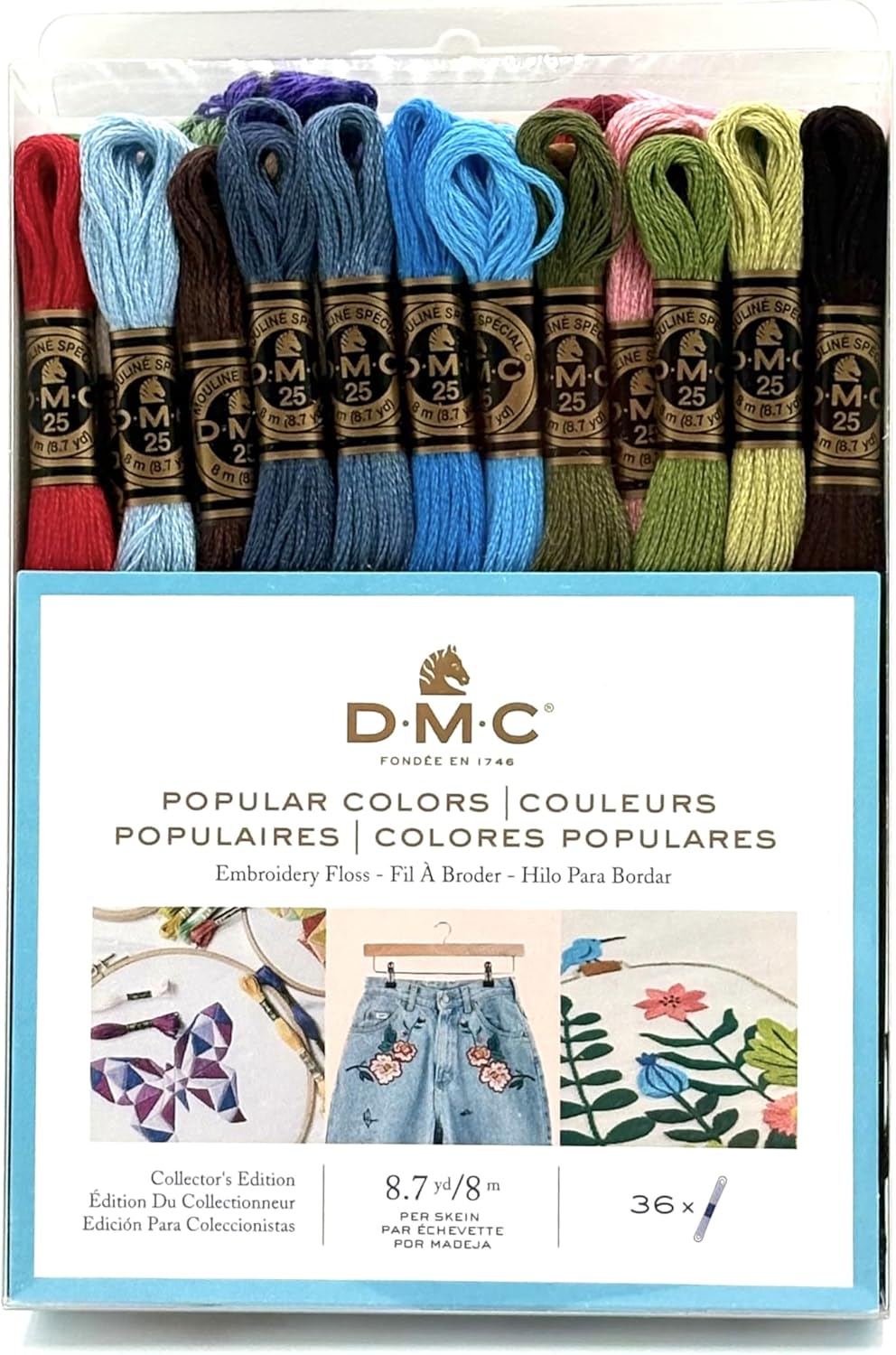
DMC Popular Colors 36-Skein Floss Pack
The official DMC-curated 36-color pack of genuine French-made mouliné — the exact floss on the thread wall at specialty shops. Thirty-six real DMC skeins beat 200 mystery skeins: strands separate cleanly, colors are numbered so they can be rebought forever, nothing bleeds in the wash.
- Genuine DMC 6-strand cotton — colorfast, numbered, infinitely re-purchasable by color code
- Curated ‘popular colors’ spread covers most first-year projects
- Beware lookalike listings that bundle third-party needles or substitute colors — this is the plain official DMC pack

Bohin Crewel Embroidery Needles (Sizes 3-9, 15 pk)
French-made Bohin crewel needles in a size 3-9 assortment: smooth nickel plating that won’t snag floss, and the larger eyes are genuinely easier to thread for adult eyes than the anonymous burr-prone needles in cheap kits. Designer shops sell this exact assortment as their recommended needle.
- Size 3-9 assortment covers 1-strand detail work through 6-strand bold lines
- Made in France since 1833; consistently burr-free eyes and plating
- No storage case beyond the paper packet — pair with a needle minder or pincushion
The Add-Ons That Feel Expert: Transfer Sheets, Snips, and a Stitch Dictionary
These three picks are what an experienced stitcher would tell you to buy, and each solves a specific wall beginners hit. The first wall comes right after the first kit: “how do I get a pattern onto fabric?” Sulky Sticky Fabri-Solvy sheets answer it with almost no skill required — print any pattern on a home inkjet, stick the sheet to fabric, stitch through it, rinse it away. It’s the most-repeated recommendation in r/Embroidery transfer threads, and it turns the entire world of indie PDF patterns into stitchable projects.
The second wall is tooling frustration that masquerades as clumsiness. The dull stamped snips in cheap kits chew floss instead of cutting it, leaving fuzzy tails on the back of every piece. Gingher’s 4″ embroidery scissors are the heirloom item of this guide: forged, hand-tuned blades that clip a single strand cleanly right at the fabric. If the gift needs one piece that signals “I took this seriously,” this is it.
The third wall is the gap between “finished one kit” and “can make anything.” The A-Z of Embroidery Stitches bridges it with step-by-step photographs of actual hands and thread — not the cryptic line diagrams that make cheap-kit leaflets useless. A book that lies flat next to the hoop beats a paused YouTube video every time thread is on the needle.

Sulky Sticky Fabri-Solvy (Stick ‘n Stitch), 12 Sheets
Pattern transfer is the wall most beginners hit after their first kit. These printable wash-away sheets let the recipient run any pattern through a home inkjet, stick it to fabric, stitch through it, and rinse it away — the single most-repeated product recommendation in r/Embroidery transfer threads.
- Works on dark, textured, and stretchy fabrics where tracing methods fail
- Printable via home printer — unlocks the entire world of PDF patterns from indie designers
- Must be fully rinsed out under running water or residue stays gummy
- Some stitchers find needles drag slightly through the adhesive layer

Gingher 4″ Classic Embroidery Scissors
The hand-tuned Gingher 4-inch is the embroidery scissors stocked by every serious stitch shop and passed down between generations. Fine points cut single strands cleanly right at the fabric — the dull stamped snips in cheap kits chew floss instead — and as the ‘heirloom’ item it makes the whole present feel considered.
- Forged, hand-tuned blades that cut to the very tip — clips one strand out of six cleanly
- Lifetime-tool build quality; Gingher offers blade re-sharpening
- Premium price for scissors; easily ‘borrowed’ by household paper-cutters, which ruins them

A-Z of Embroidery Stitches (Search Press)
The stitch dictionary r/Embroidery keeps recommending: every stitch shown in step-by-step photographs of actual hands and thread, not diagrams. The bridge from ‘I finished one kit’ to ‘I can design anything’ — and a physical reference sits open next to a hoop far better than a paused YouTube video.
- Photographic step-by-step for 140+ stitches, graded beginner to advanced
- Lies-flat reference format designed for use mid-stitch
- Reference book, not a project book — no patterns inside
Complete Gift Stacks by Budget: $25, $50, and $75 Builds
The ~$25 build: Nurge hoop + Bohin needles + Sulky transfer sheets ($32.68). This assumes the recipient has some floss already or you’re adding a few individual DMC skeins. It’s the right stack for someone who tried a cheap kit, got frustrated, and deserves to find out the problem was never them.
The ~$50 build (the default answer): Two paths. For a true never-stitched beginner: the Jessica Long kit + Sulky sheets ($49.99) — a complete guided first project plus the tool that unlocks project two. For someone with one project done: Nurge hoop + DMC 36-pack + Bohin needles ($46.68) — a permanent working setup where nothing runs out after one piece.
The ~$75 build: Jessica Long kit + Gingher scissors + the A-Z stitch dictionary ($79.98). This is the “I believe in this hobby for you” gift: a guided start, a lifetime tool, and the reference that carries them from following instructions to designing their own work.
Skip These: The Gifts That Make Beginners Quit
The difference between a cheap kit and a quality one isn’t polish — it’s whether the failure modes are built in. Thin bamboo hoops lose tension mid-stitch, and slack fabric guarantees puckered results no matter how careful the stitcher is. Polyester or waxy mystery floss knots, sheds, and won’t separate into strands cleanly, so every thread pull is a small fight.
The instructional gaps are just as damaging. Cheap kits never explain floss separation, so beginners stitch with all six strands and get thick, ropey lines that look nothing like the cover photo. And unbranded floss carries no color codes, which means the moment a color runs out, the project is stranded — there’s no way to buy a match.
One more trap: category confusion. Embroidery machines and punch needle sets show up in the same search results, but they’re different hobbies wearing the same name. A punch needle kit gifted to someone who asked about hand embroidery lands about as well as a bass guitar gifted to someone learning violin.
What to skip
Skip the multi-pack Amazon starter kits — bamboo hoops that lose tension mid-stitch and polyester floss that knots and sheds. Skip the 100-color rainbow floss bins: mystery-brand thread with no color codes means nothing can ever be rebought to match. And skip embroidery machines or punch needle sets entirely — they’re different hobbies wearing the same name, and neither teaches the hand stitching your recipient actually asked about.
A good embroidery gift buys the recipient their first honest data point: with fabric held tight and floss that behaves, am I enjoying this? Cheap kits corrupt that experiment, and the person never finds out. The hoop that still holds tension on project five is worth more than 200 pieces in a vinyl case.
If you’re stuck between the kit and the supplies stack, use one question: have they ever finished a stitched project? No — buy the Jessica Long kit and let a designer do the teaching. Yes — buy the hoop, the DMC pack, and the needles, because they’ve already proven they’ll use them.
And if the budget stretches, add the Gingher scissors. Every craft has one tool that outlives the giver, and in embroidery, that’s the one.